Your Cotton Swab Isn't Cleaning Your Ears — It's Packing Wax In Deeper
For anyone who's twisted a Q-tip in their ear a thousand times without thinking twice: there's a gentler way to actually get wax and water out, instead of pushing it further in.
Dana does it every morning without thinking. Shower, towel, then the little ritual — cotton swab in, a few careful twists, done. She's done it since she was a teenager. Her mom did it. It's just what you do.
Then one morning she paused mid-twist. She'd read something the night before — a comment from a nurse, actually, on a random forum thread — saying that a cotton swab doesn't really pull wax out. It's shaped like a plunger. Push it in, and most of what's on the tip gets shoved deeper into the canal, not lifted out of it. She stood there, swab half-in, and thought: wait — have I been doing this wrong the whole time?
It's an uncomfortable thing to realize about a habit that old. Not because it's dangerous exactly — most people never have a real problem — but because the thing you thought was "cleaning" might just be quietly repacking the same wax a little deeper every single day, until one day it's not loose anymore, it's a plug.
That unease is the easy part to fix. The harder truth is that the swab is just the most visible symptom of a bigger problem — almost everything sitting in the average bathroom cabinet for ear care has the same quiet flaw, and once you see why, the whole approach to keeping your ears clean starts to look different.

The Swab Habit: Why "Cleaning" Can Mean Pushing It In

The nerve this touches is simple and a little embarrassing: most people have never actually questioned the tool. A cotton swab feels precise. It feels like it's doing something. You can see the tip go in, you can feel resistance, and when you pull it out there's usually a little wax on it — proof, right? Except that little bit of wax on the tip is often just what was sitting closest to the opening. What was already deeper in the canal doesn't come out on a swab. It gets tamped down, like a plunger compacting whatever's ahead of it.
This is the part almost nobody explains clearly: the ear canal naturally moves wax outward on its own, slowly, over weeks. A swab works against that motion instead of with it. Every twist is a small step in the wrong direction. It's not that swabs are "bad" in some dramatic sense — it's that they're built for the opposite job of what people use them for.
Vacurio's answer isn't to scrub or dig. It's a soft silicone tip connected to a gentle vacuum — three adjustable suction levels — that pulls loose, surface wax and moisture outward, the direction the ear already wants to move things. Nothing gets pushed. Nothing gets packed. The tip sits at the opening; the suction does the work a swab never could, because a swab has no way to lift anything out — it can only push.
What most people misunderstand is that "cleaning" and "pushing" have felt like the same motion their whole lives. Once you understand that wax removal is a pulling action, not a pushing one, it stops feeling like a leap to believe a vacuum-style tool does something a stick with cotton on it structurally cannot. That's the whole difference in one sentence: one tool pushes, the other pulls.
The category itself isn't spotless — plenty of cheap electric ear cleaners have earned brutal reviews for genuinely doing nothing ("zero suction, just makes noise," as one reviewer put it). Vacurio doesn't promise to out-suck an impacted plug — that's a job for a professional, and no honest device claims otherwise. What it's built and tested for is the everyday layer: loose wax and trapped moisture, the stuff a swab was quietly repacking. That's a narrower promise than the wild claims some gadgets make, and that's exactly why it's one Vacurio can actually keep — backed by a 90-day money-back guarantee if it doesn't do that much for you.
Dana's version of this: she still does her thirty-second routine every morning. She just doesn't wonder anymore whether she's making it worse.
The Real Cost of "Trying Everything"

Here's the part that doesn't get talked about enough: the swab isn't the only thing in the drawer. Most people who've hit that "wait, is this working?" moment have already tried other fixes — softening drops, a bulb syringe, maybe even ear candles picked up out of curiosity. Dana's drawer has all three. The drops are half-used. The bulb syringe got tried twice and put away. The candles were a dead end from the start — she candled a few times before reading that it doesn't actually do anything measurable, and stopped.
None of that is a story about being careless. It's a story about a category that's never given people a tool built around the actual, honest job — everyday wax and water, not miracle deep-cleaning. So people keep buying the next thing, a little at a time, and it adds up to more money and more drawer space than most realize, without ever solving the actual daily habit.
Then there's the other cost: the clinic visit. A MinuteClinic-style earwax removal appointment commonly runs $99–$139, and without insurance it can climb toward $250. That's real money for what is, for most people, a five-minute procedure they'll need again in a few months, because wax comes back — it's not a one-time fix.
The misunderstanding here isn't about the product, it's about the math. People price ear care as "one visit" or "one bottle of drops" — a small, recurring cost that never feels big in the moment. But stacked over a year or two, the repeat visits and the repeat rebuys of things that didn't fully work usually add up to more than the price of one tool that handles the routine part at home, indefinitely. Once you see it as "buy once" versus "keep rebuying," the $69.99 price stops looking premium and starts looking like the one purchase that ends the other purchases.
Vacurio is priced above the $10–$50 gadgets that fill this category — on purpose. It comes with a kit built to actually answer the category's most common complaint ("even the smallest tip is too big for my ear") — three silicone nozzle shapes, two thin spiral tips, four replacement foam filters, all washable or replaceable — plus a 90-day money-back guarantee, well beyond the 30 days most competitors offer. It's a genuinely different value proposition than "cheap gadget, gamble on the reviews."
If you're wondering exactly what's in the box and how the suction levels actually work, that's worth walking through before you decide — full breakdown below.
Dana didn't need a lecture on ear anatomy to make the switch. She needed the math to make sense once: one $69.99 tool, versus a drawer she kept adding to and a clinic bill she kept avoiding. That's the whole case.
The Water You Can't Shake Out
This one has nothing to do with wax. It's the muffled, waterlogged feeling after a shower or a swim — everything sounds like it's underwater, and the instinctive fix is the head-tilt-and-hop, sometimes for a full minute, sometimes without much luck. Marcus knows this one well: three mornings a week in the pool, and at least half the time, one ear stays plugged with water long after he's toweled off and gotten dressed.
The nerve here is mild but constant — it's not painful, it's just annoying, in a way that repeats every single time you swim or shower, which for a lot of people is daily. And unlike deep wax removal, this is the one job almost every reviewer of every ear-cleaning gadget — even the ones who trashed the product for everything else — will admit the suction genuinely handles. Trapped water sits right at the opening of the canal; it doesn't need to be dug out, it needs to be pulled out, which is precisely what a vacuum is built to do.
The misunderstanding most people carry is that water removal and wax removal are "the same problem, different degree." They're not. Water is loose and mobile — it moves with suction easily. That's why this is the single most honest, most consistently deliverable promise of the whole device: it's not a stretch claim, it's the most straightforward physics in the entire product.
For families, this becomes a small daily ritual rather than an occasional annoyance — toddlers and school-age kids get waterlogged ears just as often as adults, and a gentle, family-usable tool with soft tips solves it for everyone in the house, not just the one person who bought it.
Marcus's version: he keeps his on the shelf by the shower now, not in a drawer. Thirty seconds, ear's clear, back to his day.
Seeing Is Believing

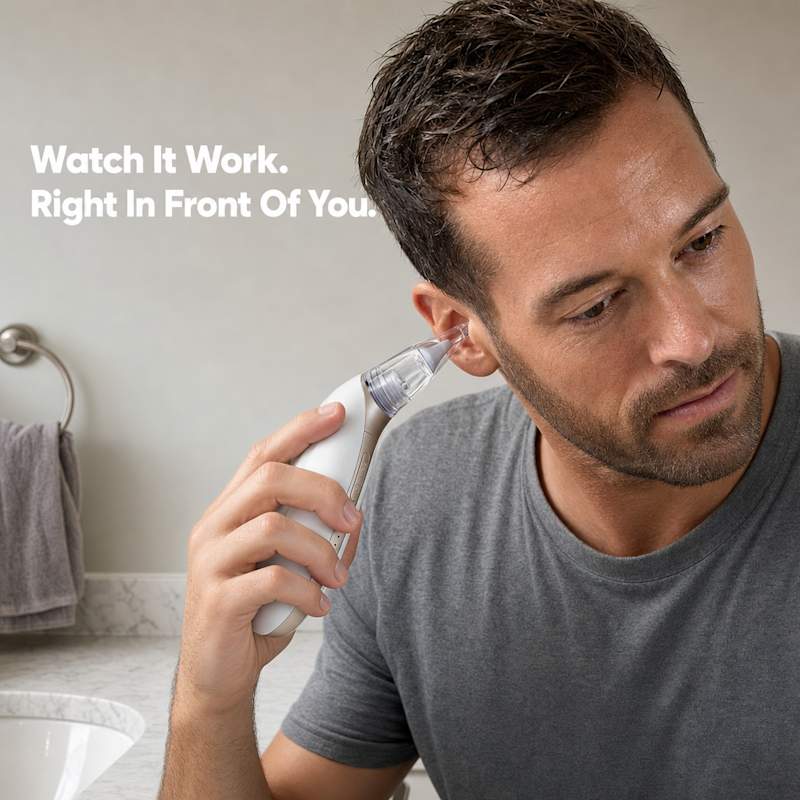
Curiosity is the quietest reason people buy something like this, but it's real. There's a specific, slightly odd satisfaction in actually seeing what a cleaning tool caught — it's the same instinct behind watching a pressure washer strip a dirty driveway. Vacurio's suction head is transparent for exactly this reason: you're not just told it worked, you watch it happen.
To be precise about what this is and isn't: Vacurio has no camera and no scope. It won't show you the inside of your ear canal on a screen. What it does show you — honestly, and every time — is what came out, collected right there in the clear chamber you can see and then rinse clean. That's a smaller promise than a camera device makes, and it comes with a smaller failure point: no app to lose connection, no "black screen of death," no blurry reversed image — problems that plague the camera-and-app category and generate a steady stream of one-star reviews.
The misunderstanding people carry about "proof" is that it has to mean seeing inside. It doesn't. What actually reassures a skeptical first-time buyer is evidence that the device did something — and a clear chamber filling with what used to be sitting in your ear is arguably more convincing than a blurry camera feed, because there's no image to interpret. It's just there or it isn't.
This is also where the skepticism about the whole category gets addressed directly. A fair number of reviews across cheap ear vacuums complain of "zero suction — it just makes noise." The clear chamber is Vacurio's answer to that exact doubt: you don't have to take anyone's word for whether it's doing anything. You watch it in real time, every use.
Marcus, admittedly, is the one in the house who finds this part more interesting than he'll say out loud.
What Customers Are Saying
"I always figured I was 'cleaning' my ears with a swab. Seeing what actually came out in the little chamber changed my mind fast — it's gentle and I can finally tell it's doing something."
Dana R., Columbus, OH
"I swim three times a week and the water-in-the-ear thing used to drive me crazy. Thirty seconds with this and it's gone. Simple and it works."
Marcus T., Tampa, FL
"Practical, easy to use, and the tip kit actually fits — that was my worry going in. Feels worth the price compared to everything else I'd tried."
J.K., Denver, CO
You Don't Have to Choose Between "Do Nothing" and "Do It Wrong"
- Cotton swabs push wax deeper instead of pulling it out — Vacurio's soft-tip vacuum works in the opposite, correct direction.
- Drops, bulb syringes, and candles either half-work or don't work at all — most people spend more trying all of them than they would on one tool that handles the routine part.
- A clinic visit for routine wax runs $99–$139 (more without insurance) — Vacurio costs less than a single visit and it's yours for years.
- Trapped water after every swim or shower comes out in seconds, no head-tilting required.
- The transparent chamber shows you exactly what it caught — no guessing, no "is this thing even working?"
None of this requires believing in a miracle. It requires believing that pulling is better than pushing, that routine upkeep at home is worth more than a $130+ trip for a five-minute job, and that a tool built around what it can actually deliver is worth more than one that promises everything and delivers noise. If any of that turns out not to be true for your ears specifically, you have 90 days to find out and send it back — longer than almost anything else in this category offers.