My Chiropractor Ran This on My Lower Back for Twenty Minutes a Week. Now the Machine Lives in My Nightstand.
For anyone currently in — or tired of paying for — chiropractic or physical-therapy visits for chronic lower back pain: the same category of electrode therapy you already know works, minus the drive, the copay, and the nine-day wait between sessions.
It's 4:07am and you're doing the thing again — left side, then flat on your back, then left side again, easing yourself down onto the sofa cushions one vertebra at a time so you don't wake anyone climbing back up the stairs. You have to be up in two hours. You already know how tomorrow at the desk is going to feel.
You've been to the appointments. Maybe you're still going. The pads go on, the machine hums, twenty minutes pass, and for the first time that day something in your lower back actually loosens instead of just aching quietly in the background. It works — you've felt it work, on that exact spot, more than once. The problem was never whether it works.
The problem is the appointment. It's the drive there, the drive back, the payment, and the fact that by the time you're pulling into your own driveway again, the relief that felt so real twenty minutes ago is already fading — and the next slot on the calendar is nine or ten days out. You didn't stop needing the treatment. You just got tired of needing someone else's building, someone else's schedule, and someone else's invoice to get it.
But the real problem underneath that — the one almost nobody says out loud in the waiting room — is that the "twenty minutes on the table" was never really about the room, the receptionist, or the appointment card. It was about a specific kind of electrode-based therapy, applied to a specific spot, for a specific amount of time. And that part — the actual part that helped — is a lot more portable than the industry around it wants you to think.

It's Not the Building. It's the Twenty Minutes.
Here's the thing almost no one says out loud at the front desk: the appointment isn't the treatment. The treatment is twenty minutes of electrode pads on a specific spot on your body, run at a specific intensity, on a machine that a physical therapist or chiropractor didn't build themselves — they bought it, plugged it in, and stuck the pads where your file told them to.
That's the part people quietly start to notice once they've been going long enough. Not that the treatment doesn't work — it clearly does, or they wouldn't keep booking — but that the thing doing the actual work is a piece of equipment, not a person's hands. Which raises an obvious, slightly uncomfortable question: if the machine is the mechanism, why does using it require someone else's building, someone else's calendar, and a copay every single time?
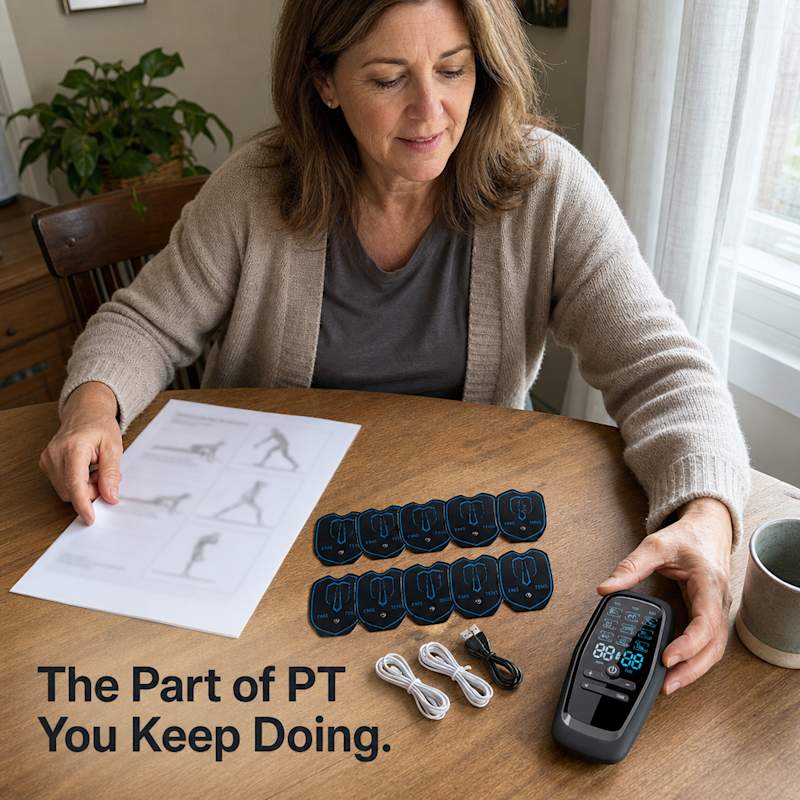
Pulsevo is built around that exact question. It's the same category of electrode-based muscle and nerve stimulation used in physical-therapy and chiropractic settings — sold as a unit you own, not a service you book. You put the pads where your provider put theirs. You run it for the same kind of session length. The difference is that it's in your nightstand at 4am instead of nine days away on a calendar.
To be precise about what this is and isn't: this doesn't replace physical therapy, and nobody credible should tell you it does — a diagnosed condition needs a diagnosis, and that's a person's job, not a device's. What's fair to say is narrower and, honestly, more useful: the modality — the electrode therapy itself — is something people report experiencing as familiar the moment the pads go on, because it's the same category of sensation they've felt on a treatment table before. That's not a medical claim. That's a description of what electrode-based stimulation feels like, reported as personal experience.
On cost: there's a real, well-documented gap between "book, drive, pay, drive back" every week or two, versus owning the unit outright — a gap wide enough that people who've made this switch describe the unit paying for itself against what would otherwise be less than two paid visits. Run the math on your own last two invoices, and compare it to a one-time purchase.

Two Cables, Two Zones, One Machine — At the Same Time
Most people assume "the machine" is basically interchangeable — pads, a battery, a dial, done. That assumption is exactly why the $25–$35 units at the drugstore and the $69.99–$149 unit sitting in Diane's nightstand look, on a spec sheet, almost identical. They're not.
Pulsevo runs two fully independent channels off one control unit, feeding eight pads total — not four. In practice that means two different areas of the body can be treated in the same session, at the same time, each on its own settings, without unplugging and re-plugging a single cable. That's not a marketing distinction. It's the one feature the $30 units simply cannot do, because they were never built with a second channel in the first place.
Why does that matter for a lower back specifically? Because chronic lower back pain rarely stays isolated to one exact spot — it radiates, it pulls at the hip, it tightens through the opposite side as you compensate. A single-channel unit forces a choice: treat this spot, or that one, not both, and definitely not simultaneously. Two live channels mean you're not choosing.
It's also the feature that quietly answers the household version of this problem. In Diane's house, it's her lower back at 4am. In Frank's — same house, same drawer, same machine — it's the two clicks he can't get out of his neck by 4:40pm at his desk. One unit. Two cables running to two completely different parts of two different bodies, at the same time if the timing lines up, or on separate evenings if it doesn't.

One Drawer, Not Three Separate Purchases
Here's a pattern worth noticing: in households where more than one person deals with this kind of pain, it's rarely just one person's problem. It's Diane's lower back and Frank's neck. Or it's a parent's shoulder and a teenager recovering from a sports strain. The instinct, when everyone's used to the appointment model, is to assume everyone needs their own separate solution — their own provider, their own visit, their own bill.
That instinct comes from how clinical care is structured, not from how the actual mechanism works. Electrode therapy doesn't need to be personalized to a single body the way a diagnosis does — the pads are hygienic, replaceable, and reposition to wherever they're needed. Once you see the unit as one machine with eight pads and two channels rather than "my machine for my one spot," the math on a household changes completely. It's not three appointments booked separately. It's one drawer, opened by whoever needs it, whenever they need it.
This is exactly the pattern people describe when more than one person in a home ends up using the same unit for entirely different complaints — one person's lower back, another's neck and shoulders, a third recovering from something else altogether, all off the same box. It's the reason a two-unit household bundle exists in the offer below: not as an upsell gimmick, but because two people rarely need the exact same session at the exact same hour.

What People Actually Reach For After the Formal Rehab Ends
There's a specific moment worth paying attention to: the point where a course of physical therapy, or a set of post-surgical exercises, officially ends. The clinic hands over a sheet of movements to keep doing at home, wishes you well, and that's it — the structured part is over, but the soreness, the stiffness, the "not quite back to normal yet" feeling usually isn't.
That gap — between "discharged" and "actually feels fine" — is where a lot of quietly frustrating weeks or months happen, because the formal support disappears exactly when people are still working through discomfort day to day. What people in that gap consistently describe reaching for isn't a new appointment. It's whatever gave them relief during the structured sessions — because that's the part that actually felt like it was doing something.
That's the honest, careful way to describe this use case, and it's worth being precise about the boundary: this is not a post-surgical treatment, it doesn't accelerate healing, and nobody should use it to skip a provider's actual instructions. What it is: the same category of electrode stimulation that was part of the in-clinic routine, still available on the same schedule you were already used to, after the clinic's calendar stops being the thing dictating when you get it.
One line worth pulling out here, because it matters for anyone reading this with a pacemaker, defibrillator, or other implanted stimulator in the family: electrode-based stimulation units, including this one, are not appropriate for use with those devices. Check with a provider first if this applies to you or anyone in your household before this unit goes anywhere near a drawer.
What Customers Are Saying
"I was skeptical it would feel like anything close to my PT sessions, but the pads in the same spot really do feel familiar. It's become part of my evening routine."
Diane R., Ohio
"Easy to set up and the two-cable setup means my husband and I both use it for completely different spots. Practical and well made."
Carol M., Pennsylvania
"Doesn't replace my chiropractor, but it's exactly what I reach for on the nights I can't get in for an appointment. Worth having in the house."
L.T., Arizona
The Part of This Worth Remembering
- The relief you've felt on the table comes from the electrode therapy itself — not the building it happens in
- Two independent channels and eight pads let you treat two areas at once, something the drugstore units can't do
- One unit reasonably covers more than one person in a household — a real reason the two-unit bundle exists
- Priced across a $69.99–$149 range depending on the bundle — worth comparing to your own last two invoices
- Not a replacement for a diagnosis or your provider's care — a way to keep doing the part that was portable all along
If you're the person still doing the 4am shuffle across the sofa, or the person nine days out from your next appointment wondering if you really need to wait — this isn't a replacement for your provider's care. It's the part of that care that was portable all along.