He Spent $1,800 on a Clinic. Hundreds More on Devices. And He Was Still Leaking — Until He Understood the One Thing Every Solution Had Skipped.
For men after prostate surgery who've already tried to fix this — and feel like they've already paid the price for failing.
There is a specific kind of frustration that doesn't have a clean name.
It's not just the leaking. You've lived with that. It's the money you spent trying to fix the leaking, the hope you loaded into each purchase, and the slow, humiliating return to the same pad, the same worry, the same wet pants — after you already paid.
One man put it plainly on a men's health forum after his Emsella course ended: "waste of $1,800." Not a bad experience. Not "it didn't work as well as I'd hoped." A waste. The word you use when you feel you were taken.
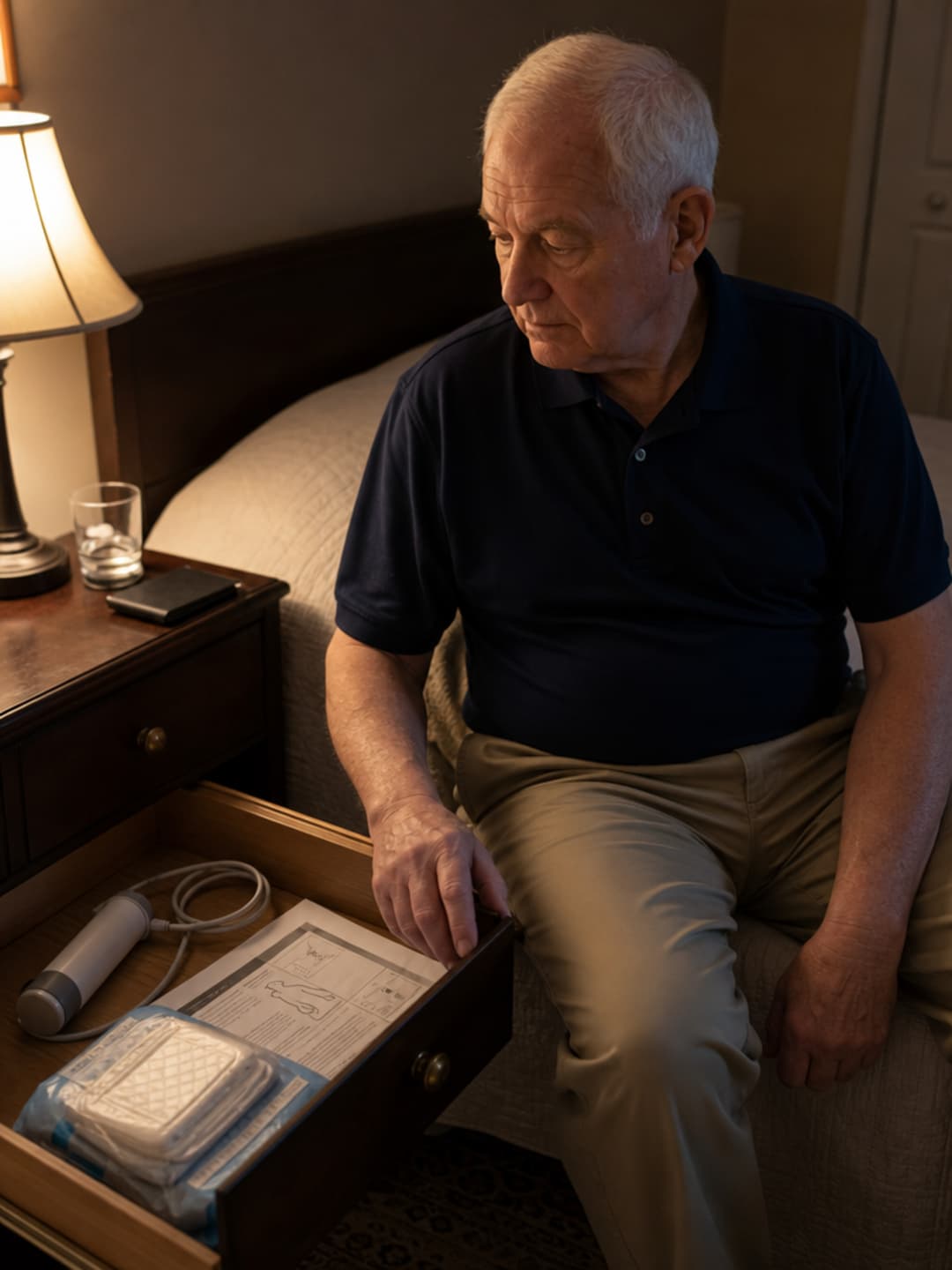
A different man bought a biofeedback pelvic-floor device — the kind with an app, the kind that costs over a hundred and fifty dollars — used it for a few weeks, and watched it migrate slowly from his nightstand to the back of a drawer. He's not alone. Spend time in any online forum for men after prostate surgery and you'll find some version of that drawer in nearly every thread: the device they bought, the money they spent, and the nothing they got back for it.
Here is what all of those solutions missed — and why what's sitting in that drawer tells you exactly what to look for instead.
The Drawer Is Full, and That's Not Your Fault
There is a reason the biofeedback device went into the drawer. There is a reason the clinic sessions ended and the pads did not.
It's not weakness. It's not giving up. It's that those solutions were built around a theory — that if you stimulate the right muscles electrically, or track the right signal on an app, the body will follow. What they were not built around was the physical reality of what a man after prostate surgery is trying to rebuild: a muscle that has been disrupted by a procedure, that needs to be actively loaded, progressively contracted, and — critically — confirmed. You need to know you did the work.
One man who spent time on the Mayo Clinic Connect forums described exactly this split. He had used the biofeedback device. He'd followed the app. But the muscle action the device was registering wasn't the one he needed. Nobody caught it. "Please don't buy the kGoal," he wrote, months later. "I've got one in my bedside drawer… ineffective." He wasn't blaming himself. He was describing a category problem: passive signal-and-stimulate devices hand the job to the technology. The technology can't feel what you can't feel.
At a clinic, the device does the work entirely. You sit. You are treated. You leave. That passivity is also why one urologist quoted on the same forum boards called the most popular clinic device "a GIMMICK" — not because the technology doesn't exist, but because for this population, for this problem, handing control to an external stimulus is structurally the wrong answer. You can't outsource a muscle you need to own.
The drawer exists because the solutions inside it were built for passive compliance. What post-surgical pelvic floor recovery actually requires is active, physical, countable effort — something to push against, and a number that proves you pushed.
That distinction is everything — and it's exactly the thing that makes the approach behind Pelvexia™ different from anything still gathering dust in that drawer.
Why Squeezing "Against Nothing" Was Always the Weak Link
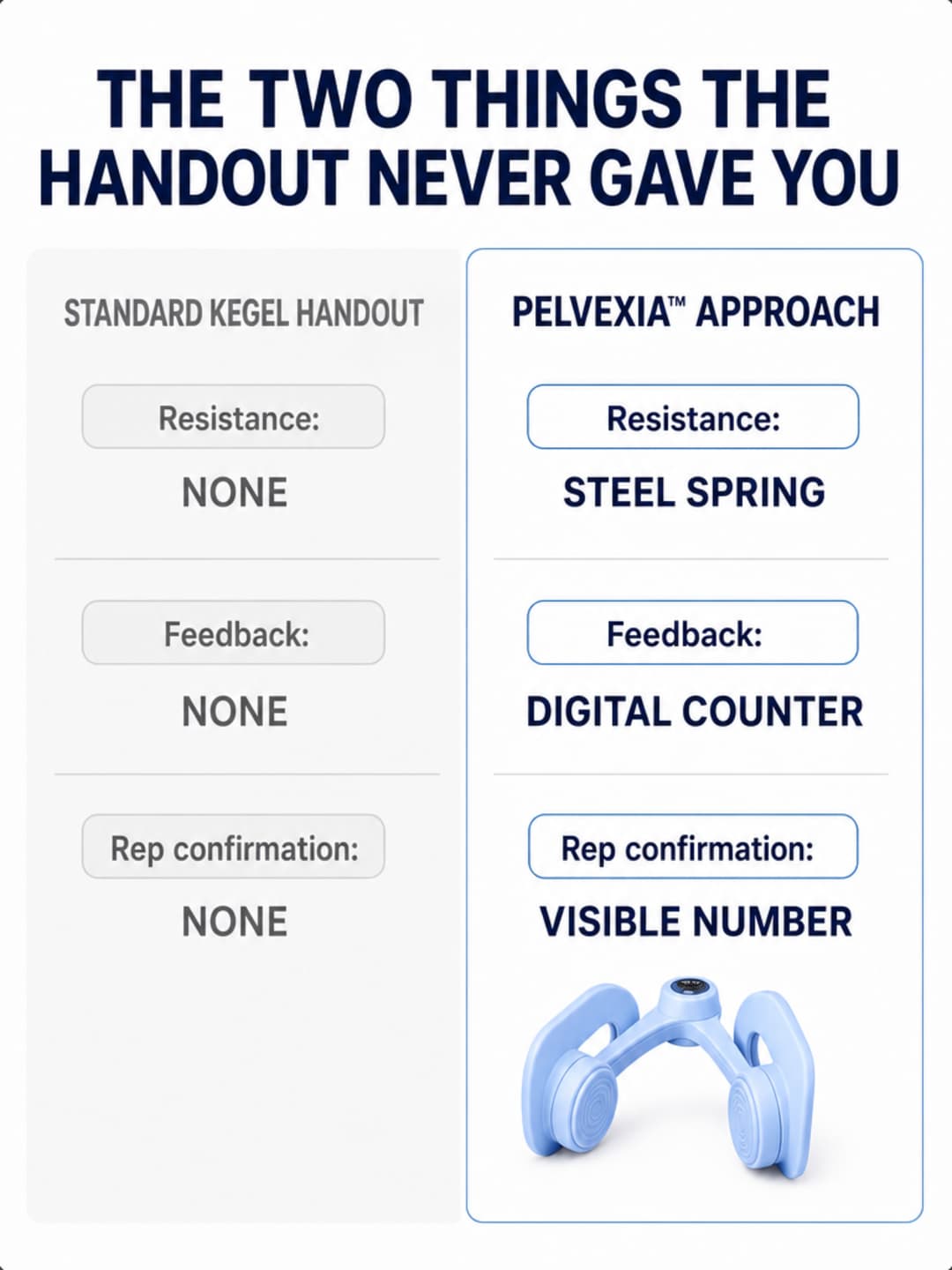
Here is the honest problem with the standard Kegel instruction: it asks you to contract an invisible muscle against no resistance, with no feedback, for a number of reps you can't verify, on a schedule you have to invent.
For women recovering from childbirth, that instruction has a long clinical history behind it and a clear anatomical pathway. For men — particularly men whose pelvic floor has been structurally disrupted by radical prostatectomy, or weakened by years of an enlarged prostate pressing against the urethra — the same instruction is almost missing its most important element. You need something to push against.
The Mayo Clinic Health System guidance for men suggests approximately 40 targeted pelvic floor contractions a day — four sets of ten — and explicitly cautions against simply doing more, because fatiguing a healing muscle can make things worse, not better. That guidance is about quality of contraction, not raw volume. One forum contributor reported contracting 100 times a day and watching his leakage get worse by evening, the dribbles turning to a stream by nightfall and filling three pads to capacity. He wasn't being undisciplined. He was working harder at the wrong version of the exercise.
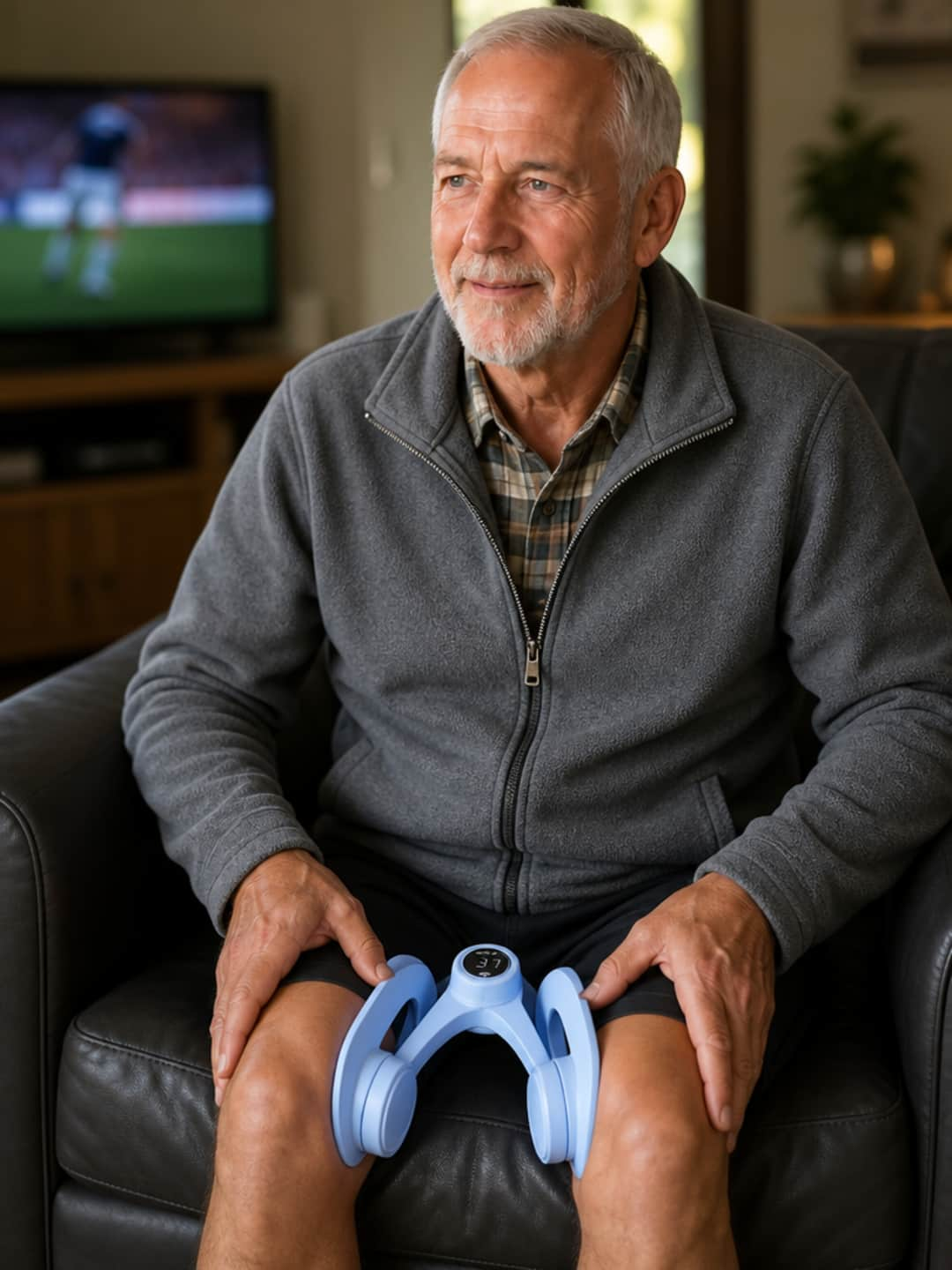
What Pelvexia™ adds to the standard instruction is two things that the handout never included. The first is physical resistance — a steel spring inside the frame that requires genuine force to compress when you place the device between your knees and squeeze. That resistance activates the hip adductors and the pelvic floor simultaneously, in a way that squeezing air simply cannot replicate. The second is a built-in digital rep counter. You squeeze, the counter advances. At the end of a set, the number on the counter is the number of reps you did. Not the number you think you did. The number.
One man in the forums put it simply: "the resulting graph showed the gradually decreasing volume over time despite daily ups and downs. This gave me confidence I was improving." He was describing what any countable, trackable system gives you: evidence. The counter doesn't evaluate the quality of your contraction, but it confirms that the contraction happened — and for a man who has spent months doing invisible exercises and wondering whether he's doing them at all, that confirmation is not a small thing.
Resistance plus rep tracking. That is what the handout missed. And that gap is why most men who did try to do the right thing ended up with the wrong result.
$1,800 Isn't the Worst Part of the Math
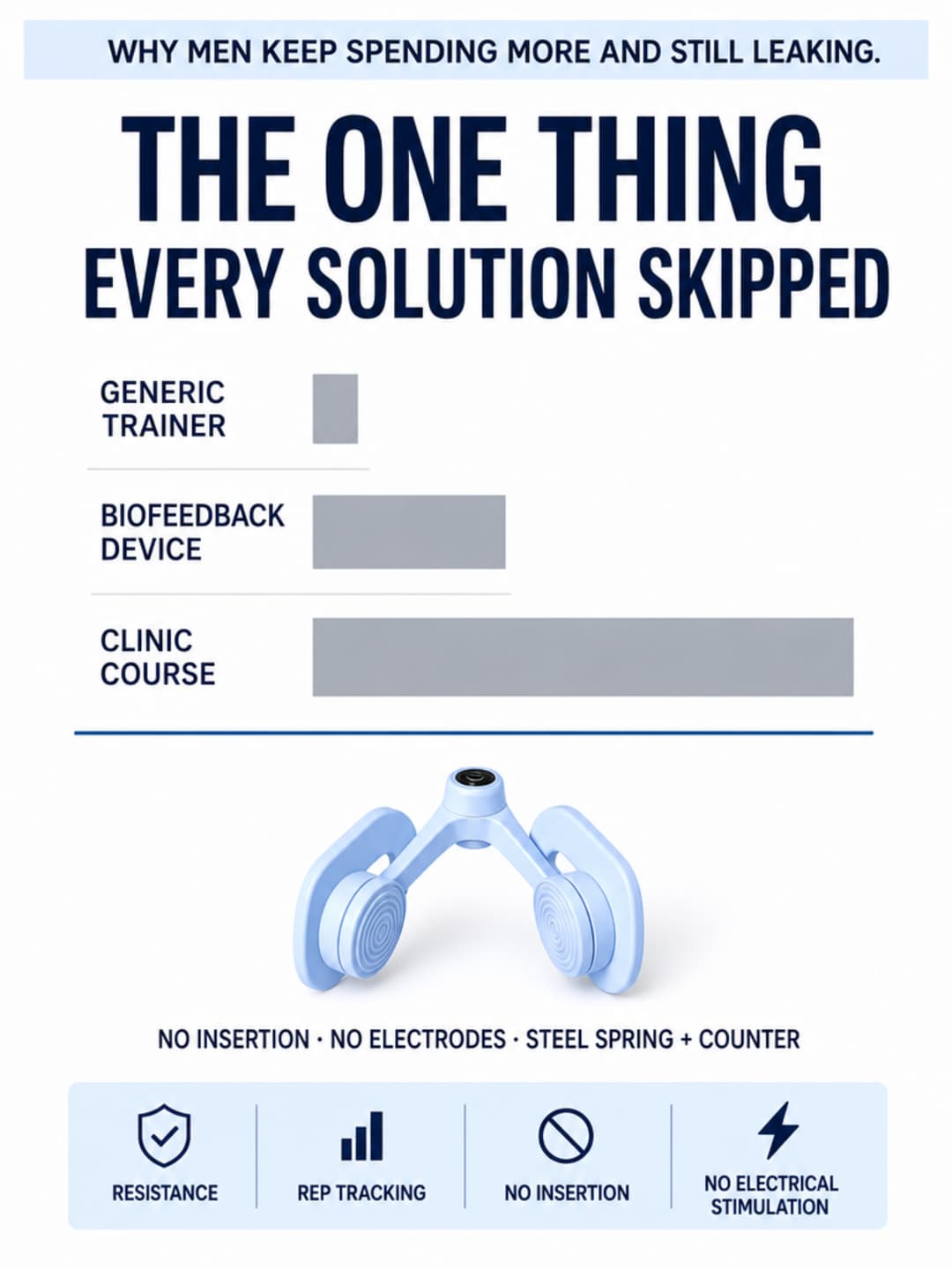
The most-cited figure in men's health forums, whenever the conversation turns to pelvic-floor clinics, is $1,800.
That's a common price for a course of sessions on the most heavily marketed electrical stimulation chair — the one you've probably seen advertised, or maybe sat in. The one a urologist on a public forum called "a GIMMICK." That's not our characterization; it is a paraphrased quote from a man relaying his own urologist's view. And that urologist may or may not be right — but the man who called it "a waste of $1,800" is describing his experience, and he is not unusual.
Here is what makes that number more interesting: the American Cancer Society estimates approximately 333,830 new prostate cancer cases in the United States in 2026. Roughly 90,000 men undergo radical prostatectomy every year in this country. In one cohort study of robot-assisted prostatectomy, 50.7% of men experienced stress incontinence at one week post-surgery; 43.7% at one month; 8.5% at twelve months. The AUA guideline is direct about what that trajectory looks like: incontinence "is expected in the short-term and generally improves to near baseline by 12 months after surgery but may persist and require treatment."
May persist. And require treatment.
For the fraction of men in that 8.5% — and for the much larger group who are still in the early months and have not yet found a consistent improvement — the pelvic-floor device market presents itself as a solution. The clinic at $1,800. The biofeedback unit at $150–$220. The app-connected system. And then the cheaper alternatives, the ones that look like repurposed women's exercise equipment, that arrive with no male-specific guidance and no way to tell whether you did anything useful.
The cost of getting this wrong is not just the money. It is the month you spent doing the wrong thing, the pads you kept buying while you waited for the device to work, and the accumulated skepticism that now makes you read every product claim looking for the angle. That skepticism has a cost too. The man who decides that the whole category is a gimmick and does nothing, waiting for the body to resolve it on its own, trades money risk for time risk — and for a problem the AUA guidelines describe as potentially persistent, time is not automatically on his side.
The question is not whether to spend money. The question is whether what you are spending it on gives you something physical and verifiable to work with — or whether it does the work for you and takes the receipt.

A Device That Does It For You Versus a Tool That Makes You Do It
— a note on what this page is, and what it isn't
At this point you've read enough to recognize the structural difference — and it's worth naming it plainly, the way the forums eventually name it when men who've spent money compare notes.
The clip below is from a man on the Mayo Clinic Connect boards. He wrote it after considering the available devices: "I favor learning how to control these muscles rather than looking for some way to not learn, by having some device just do it for you." And separately: "I wanted to move the muscles myself."
Those two sentences are a precise description of what separates the device categories from each other — and why a resistance-and-counter trainer exists in a different category from electrical stimulation or biofeedback.
A pelvic-floor stimulator sends an electrical current. Your muscles contract in response to that current — passively, without voluntary effort. Whether that produces lasting strength in a post-surgical patient is what the urologist in the forum thread called into question. A biofeedback device reads a signal and displays it on an app. It gives you data on whether you're contracting, but it doesn't give you anything to contract against — which is how a man can use one for weeks, feel nothing, and discover afterward that the app was reading the wrong muscle group entirely.
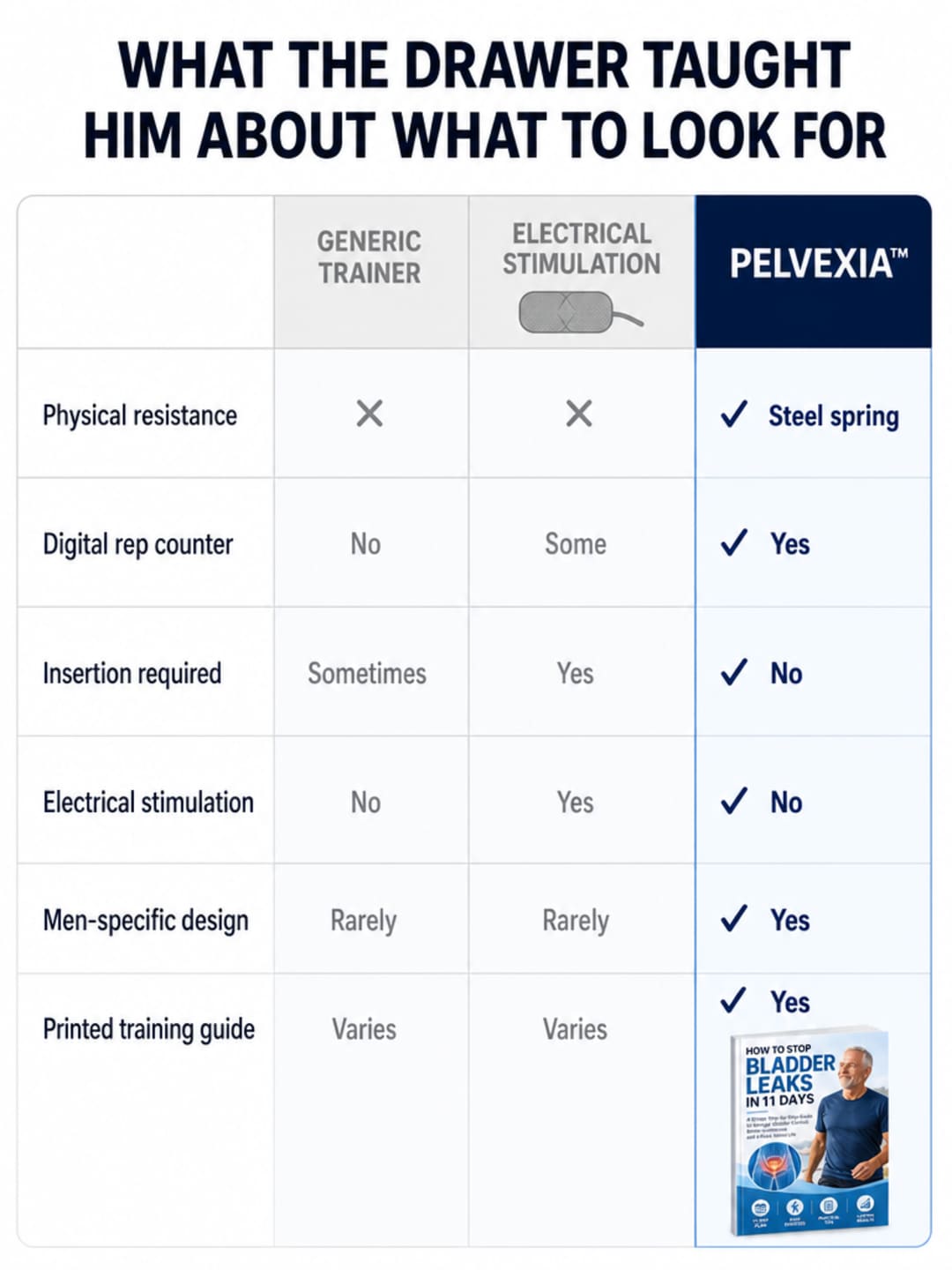
Pelvexia™ works in the other direction. You supply the effort; the device supplies the resistance and the count. The steel spring requires genuine force to compress. The digital counter advances when you do the rep — not when a sensor picks up any nearby muscle signal, but when you physically complete the squeeze. It is a training aid in the strictest sense: it makes a voluntary exercise physical, measurable and repeatable. No app, no insertion, no electrical stimulation. The ergonomic frame with its soft TPE rubber cushioned pads sits between your knees and does nothing until you do.
That is not a marketing position. It is a mechanical description. And for the man who has already watched passive technology fail him, it is the distinction that matters most.
| Generic knee trainer | Electrical stimulation | Pelvexia™ | |
|---|---|---|---|
| Physical resistance | Some | No | Steel spring |
| Digital rep counter | No | No | Yes |
| Insertion required | No | Sometimes | No |
| Electrical stimulation | No | Yes | No |
| Men-specific design | Rarely | Varies | Yes |
| Printed training guide | No | No | Yes |
The Chair in Front of the Television Is the Right Clinic
Here is the version of this that actually works in practice.
The man on the Mayo Clinic Connect boards who described tracking his progress on a chart — the one who said the "gradually decreasing volume over time" gave him "confidence I was improving" — was doing something fundamentally different from the man who bought the $1,800 session package. He was doing the work himself, in his own home, every day, with a way to see that it was working.
Another man, on the same boards, described his routine: "I do the exercises while doing my morning Wonderword puzzle." That's not a clinical protocol. That's a sustainable habit built into a life. And it's the kind of consistency — daily, seated, low-barrier, countable — that the device-and-clinic model can never replicate, because it ends when the course ends.
A man of 67, silver-cropped hair, wearing a grey zip-up fleece over a plaid flannel shirt, is sitting in his recliner. The game is on. The Pelvexia™ is between his knees — light blue, compact, familiar now. The counter is at 38. He squeezes: 39. He squeezes again: 40. He sets it on the side table and goes back to watching the game. The drawer in the bedroom still has the old device in it. But this one he did today. And yesterday. And the day before.
That is the transformation. Not a clinic outcome. Not a number on a pamphlet. A routine that happened, confirmed by a counter, in a chair in a man's own home — the only place where consistency is actually possible.
The printed training guide in the box demonstrates the combined movement: the knee squeeze and the pelvic-floor contraction together, with a recommended daily set that aligns with established guidance rather than asking you to simply do more until something happens. No insertion. No electrodes. No app. Soft TPE rubber pads so the frame doesn't cut into the knees. A steel spring that gives you something real to push against, so "I did them" means something different than it did with the handout.
The drawer was full because the solutions in it asked you to trust the technology and wait. This one asks you to do the work — and gives you a number that proves you did.
If you want to read the full details on how the device works — the spring mechanism, the counter, the training guide and what the routine actually looks like day to day — the complete breakdown is on the next page.
What Customers Are Saying
"Finally something that makes the exercise feel real. The counter takes all the guesswork out of it — I know exactly what I did each day."
Robert M. — Phoenix, AZ
"Well made and straightforward. The guide explained the movement clearly and the resistance felt appropriate from day one. Not a gimmick."
T.H. — Columbus, OH
"I'd given up on this kind of thing after some expensive disappointments. This one I actually use. The soft pads make a difference and the counter keeps me honest."
Dennis K. — Portland, OR
The Drawer Doesn't Have to Be the End of the Story
You already paid for the lesson. You know what passive technology costs. You know what it delivers.
The question sitting in front of you right now is not whether pelvic-floor training works — the clinical guidance is not in dispute. The question is whether you have a tool that makes the training physical, countable and yours. A steel spring to push against. A counter that advances when you do the rep. A routine you can do in the chair where you already spend the evening.
Everything in the drawer had one thing in common: it was doing the work for you, or it wasn't giving you the feedback to know the work was done. Pelvexia™ does neither of those things. It gives you something to push against and a number that proves you pushed.
- Stop wondering whether your Kegels are actually registering — the counter tells you
- Trade passive stimulation for active, loaded, daily training you can confirm
- A seated routine that fits the chair you're already sitting in
- No insertion, no electrodes, no app — a physical training aid, not a passive treatment
- A printed guide that demonstrates the combined movement so you're doing it right from rep one
Every morning you delay the routine is another morning that starts the same way it's been starting. The drawer full of failed solutions didn't cost you just the money — it cost you the months you were doing nothing useful. That clock doesn't stop on its own.
The mechanism is on the next page. So are the full details, the training guide, and the 90-day window to find out whether this is different.
Pelvexia™ is a pelvic floor exercise aid. It is not intended to diagnose, treat, cure or prevent any disease. Talk to your doctor or pelvic floor therapist, especially after surgery.