Nobody Prepares Men for This Part of Recovery
After prostate surgery, they told you what to expect in the operating room. Nobody mentioned you'd spend forty-five minutes in the women's pad aisle trying to figure out which absorbency.
There is a specific kind of moment that men who've been through prostate surgery — or who've been managing an enlarged prostate for years — almost never talk about out loud.
It happens in a supermarket.
You've turned down the wrong aisle. Or maybe the right one, which is somehow worse. There are rows of products with flowers on the packaging. Pink. Lilac. "For women, by women." You stand there trying to read the fine print on the side of a box while a woman pushes her trolley past and you very carefully look at the shelf behind her head. You spend longer than you'd like to admit. You leave with the wrong thing, or maybe the right thing, and you feel something you did not expect to feel at sixty-four years old: like you have absolutely no idea what you're doing.
That moment — that specific, unannounced indignity — is what nobody tells you about when they discharge you from the hospital.
They hand you a photocopied sheet about pelvic floor exercises. They tell you things will improve. What they do not tell you is that "managing" a leakage problem and training the muscles behind it are two entirely different things. One puts you in that aisle every week. The other gets you out.
That gap — between enduring the problem and actively working on it — is exactly where this article begins.

Reason 1 — The Moment Nobody Warned You About Is Costing You More Than a Box of Pads
The leakage is one thing. The way it reorganises a man's life around itself — quietly, incrementally, without anyone formally announcing that this is happening — is something else entirely.
It starts small. You start wearing darker trousers. Not because you like them more. Because you know. You start choosing the aisle seat at church, the chair closest to the bathroom at the restaurant. You stop taking your grandson to the park on the days when you don't feel confident about your control. You don't explain why. You just don't go.
One man on a patient forum — nine months after surgery, a man who had done everything his discharge sheet told him to do — described spending an hour in what he called "that mystery aisle in the supermarket where there are a hundred and eleventy-seven different pads for women." He wasn't exasperated at the products. He was exasperated at the situation: that this was where he had ended up, with no guidance built for him, shopping for something designed entirely around a different body and a different problem.
Another man described wearing pads backwards because the standard fit didn't work for male anatomy. Backwards. After six decades of getting dressed in the morning without thinking about it at all.
This is what the humiliation of post-surgical incontinence actually looks like for most men — not dramatic, not loud, just a steady accumulation of small indignities that add up to a man who has quietly stopped doing things he used to do. Stopped going to the golf course on a whim. Stopped taking long drives without a plan. Stopped trusting his own body.
The problem isn't that pads exist. The problem is that wearing them full-time means you are managing the leakage, not working on the muscle behind it. And those are not the same project.
What nobody in the discharge conversation usually makes explicit is this: the pelvic floor is a muscle. Muscles respond to training. But training requires feedback — something to work against, something that tells you whether you did the work. An invisible contraction into empty air, repeated forty times on a photocopied sheet, is a starting point. It is not a training program.
And the gap between those two things — between a piece of paper and an actual structured routine — is where most men stay stuck the longest.

Reason 2 — Why the Handout Failed Him (and Why "More Squeezes" Was Never the Answer)
Here is what the pelvic floor handout almost universally gets wrong for men coming out of prostate surgery.
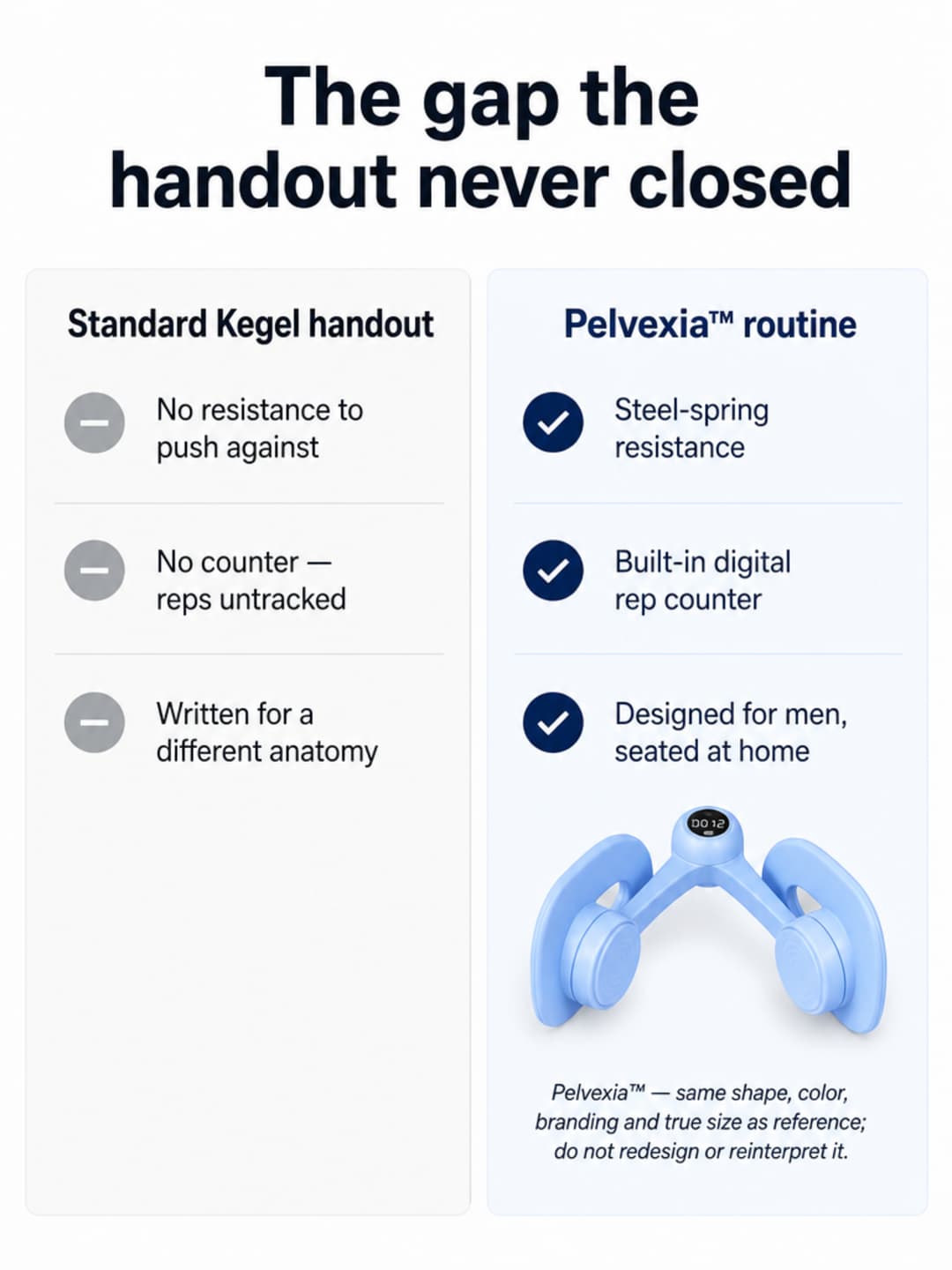
It was written for a different problem. Kegel exercises were originally developed and documented for women recovering from childbirth. The postpartum pelvic floor is real, the exercise is real, and for that context the handout makes reasonable sense. But the male pelvis is different in structure, the injury pattern after radical prostatectomy is different, and the feedback mechanism — or rather, the complete absence of one — makes the standard printed instruction almost impossible to execute correctly without guidance from a specialist who has actually worked with men after this specific surgery.
"Why my nurse, who never stood at a urinal in her life, would think that an exercise for postpartum women would help me, I dunno," one man wrote, with a precision that probably resonates with a lot of men who have been in that same consulting room.
The exercise itself — contracting the pelvic floor — is the right underlying movement. That part is not wrong. What is wrong is asking a man to perform it in a vacuum, with no resistance to work against, no way to know whether he is contracting the correct muscle group, and no method of tracking whether he did the work at all.
The mechanic of Pelvexia addresses the gap at the physical level.
You sit down. You place the device between your knees. You squeeze your knees together against the steel-spring resistance, and at the same time you contract the pelvic floor upward and inward — the combined movement, described in the printed training guide included with the device. The spring gives you something real to push against. Your muscles are doing measurable work, not an invisible contraction into air. And the built-in digital counter tracks every completed rep — so the question "did I actually do them?" has a visible answer. The counter increments. You see 38 become 39 become 40.
There is nothing electrical here. Nothing is inserted. No app is required. It is a physical resistance trainer with a rep counter: the same underlying exercise, made structural, countable and repeatable.
The printed guide sets out the recommended daily routine — a capped daily set aligned with exercise guidance rather than an unlimited "just do more" instruction, because fatiguing a recovering pelvic floor is a real risk that a lot of men who've read the forums know about firsthand.
That shift — from invisible guesswork to a physical, counted, seated routine — is the mechanism. The question is what it costs a man to stay on the wrong side of it for another six months.
Reason 3 — What Twelve Months of "Just Managing It" Actually Costs
Consider what the management approach actually requires, tallied honestly.
Men's incontinence pads run roughly two to four dollars each at retail. A man managing moderate post-surgical leakage might use two or three a day. Over twelve months, that is somewhere between fifteen hundred and four thousand dollars in pads alone — and that figure does not include the appointments, the devices purchased and abandoned, or, for those who went the clinic route, the course fees.
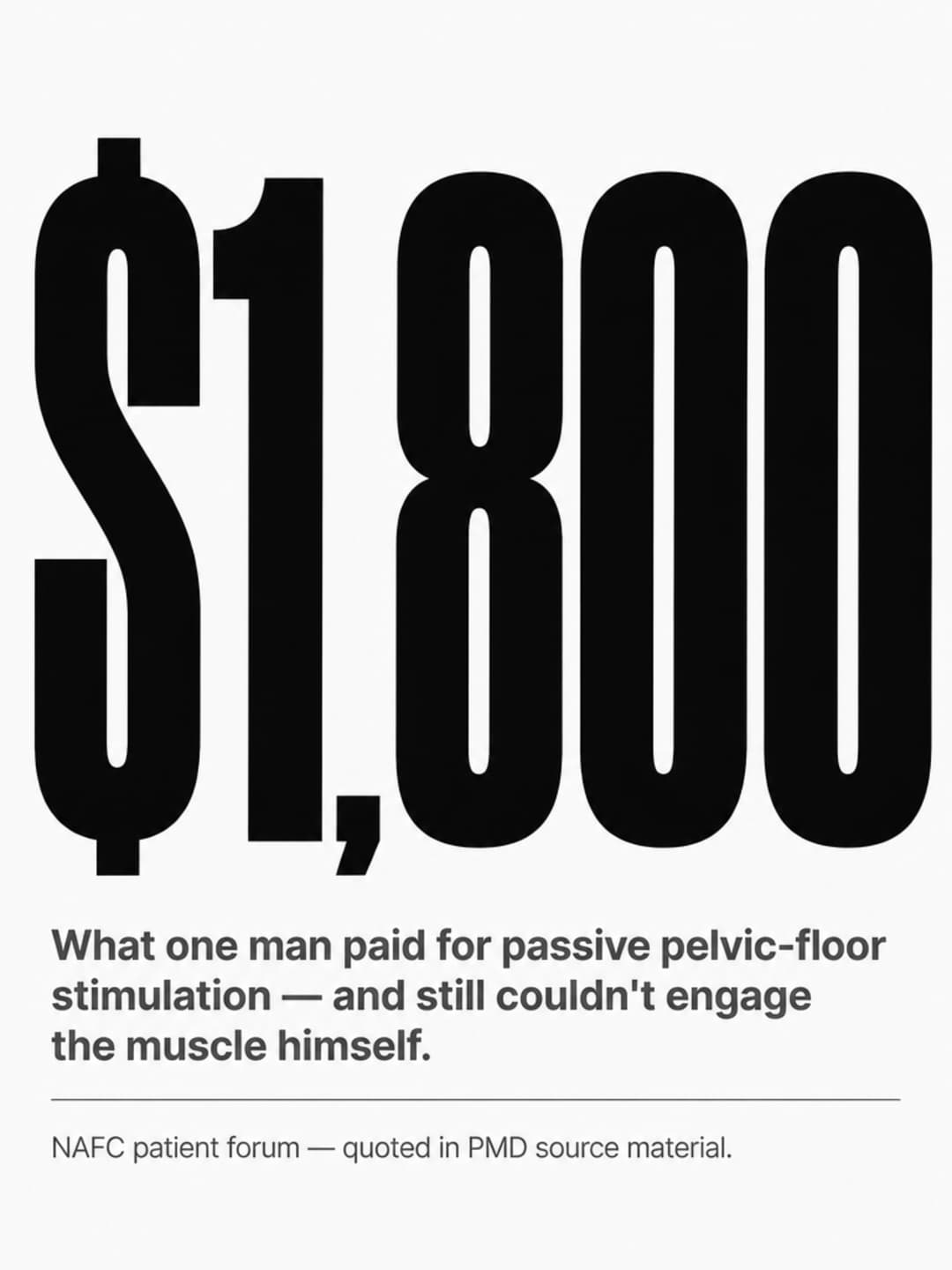
One man described a series of sessions at an electrical stimulation clinic — the kind where you sit in a special chair that generates electromagnetic pulses through the pelvic floor — and came away with a result he described as a "waste of $1,800." Not because the technology doesn't exist. But because for his specific pattern of post-prostatectomy incontinence, passive stimulation from an external chair was not the same as actively training the muscle himself. He made the point that after six months of "being zapped," he had learned nothing about how to engage his own pelvic floor under load.
"I wanted to move the muscles myself," another man wrote directly. "I favor learning how to control these muscles rather than looking for some way to not learn, by having some device just do it for you." That distinction — active training versus passive stimulation — is not a marketing line. It is a real philosophical difference in how the muscle gets trained.
The American Urological Association's guidance on post-prostatectomy incontinence is plain: incontinence after surgery "is expected in the short-term and generally improves to near baseline by 12 months after surgery but may persist and require treatment." The word persist is doing real work in that sentence. For a significant portion of men, the twelve-month mark arrives without the hoped-for resolution — and those men are then making decisions about what comes next.
The cost-of-staying-still calculation is not abstract. It is a monthly line item in the medicine cabinet, a social shrinkage that becomes habit, and for a meaningful number of men, a permanent shift in how much they do and where they go.
Reason 4 — Why the Market for Men's Pelvic-Floor Equipment Is Almost Entirely Built for Someone Else
Walk the options for a man who has been told to take his pelvic floor seriously.
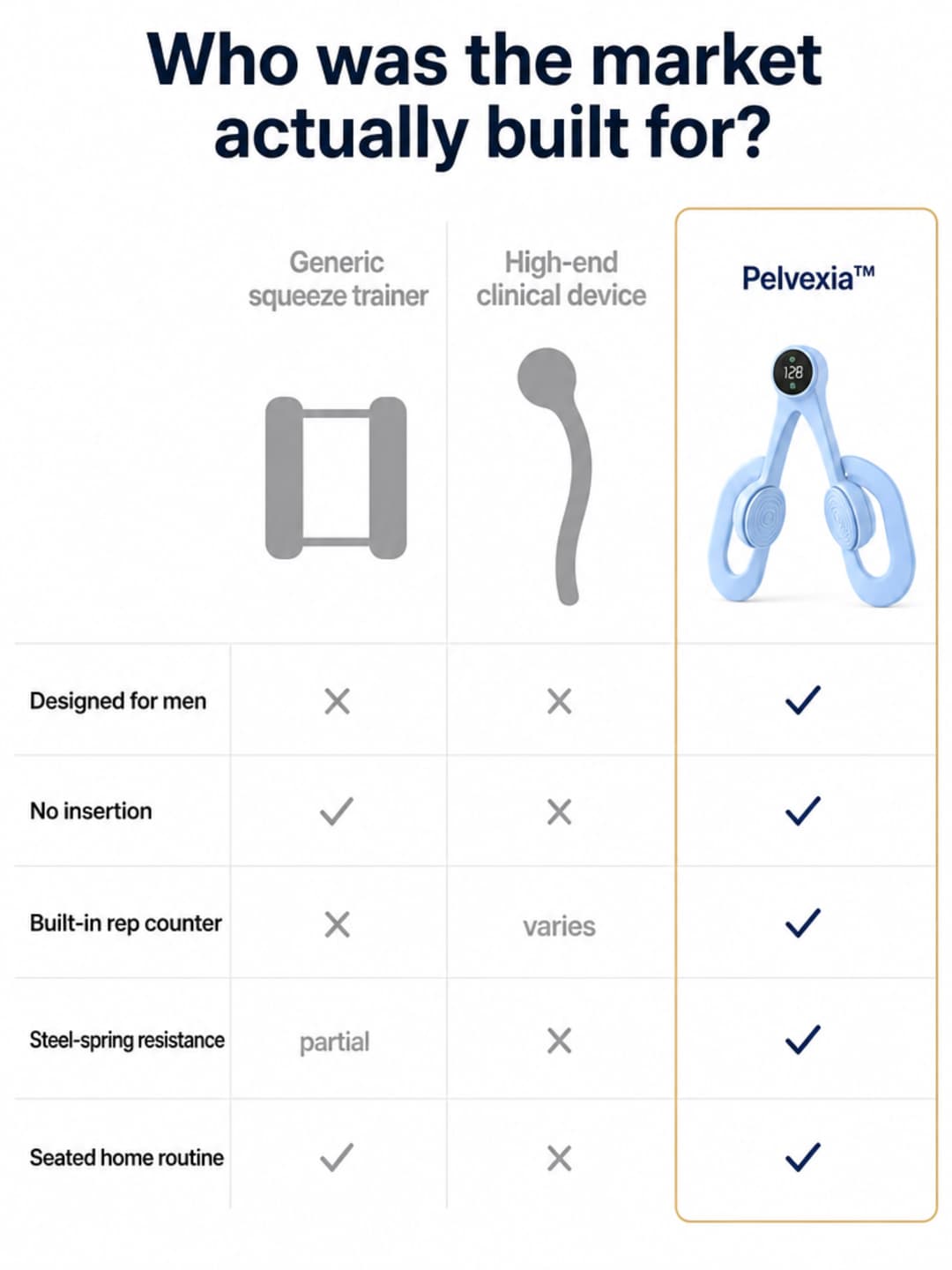
The cheapest category — generic knee-squeeze resistance trainers, widely available online — starts around five dollars and goes to forty-five. They are almost without exception marketed with pink packaging, "postpartum" language, and photographs of young women in yoga studios. The resistance specifications are listed in pounds, optimised for a different body and a different use case. Several men who've reviewed them online describe squeezing the device and "feeling nothing" — no feedback, no rep tracking, nothing that tells them whether the movement reached the right muscle group. One review noted that the product arrived with no instructions at all.
At the other end of the category sit the clinical-grade devices — biofeedback trainers with apps and Bluetooth, insertable probes, electrical stimulation chairs. These exist on a pricing spectrum that begins around a hundred and seventy dollars for an app-connected biofeedback device and extends to multi-thousand-dollar clinical courses. One well-known app-connected biofeedback trainer — specifically designed for internal use — was described by a man nine months after prostatectomy as "in my bedside drawer" after purchase: "a fun device, but ineffective." The internal mechanism detected muscle activity, but could not correct the movement pattern that was producing no improvement.
None of these options were designed by starting with the question: what does a man in his mid-sixties, nine months after radical prostatectomy, actually need in order to train his pelvic floor at home, privately, consistently, with honest feedback?
Pelvexia was designed as that answer. Not as a clinical device. Not as a repurposed postpartum product. A seated, at-home resistance trainer — light blue, not pink — with a steel spring for resistance and a digital counter for feedback. No insertion. No electrodes. No app. A printed training guide written for men. The routine can be performed in the armchair during the evening news, which is also, incidentally, where a lot of men report that they are most likely to actually do it.
Reason 5 — The Moment It Stops Being About Managing and Starts Being About Training
There is a particular account from a man on a patient forum — quoted in research on post-prostatectomy recovery — about the day something changed for him.
He had been logging his pad usage. Not obsessively, just a note each day. After a few weeks he could see, on paper, that the volume was gradually decreasing despite the daily fluctuations that felt random and discouraging. "This gave me confidence I was improving," he wrote. It was not a dramatic recovery. It was a graph line moving slowly in the right direction — and the visibility of it changed how he engaged with the problem. He was no longer just enduring it. He was watching himself train through it.
That is the shift that a structured, countable routine enables that a handout does not.
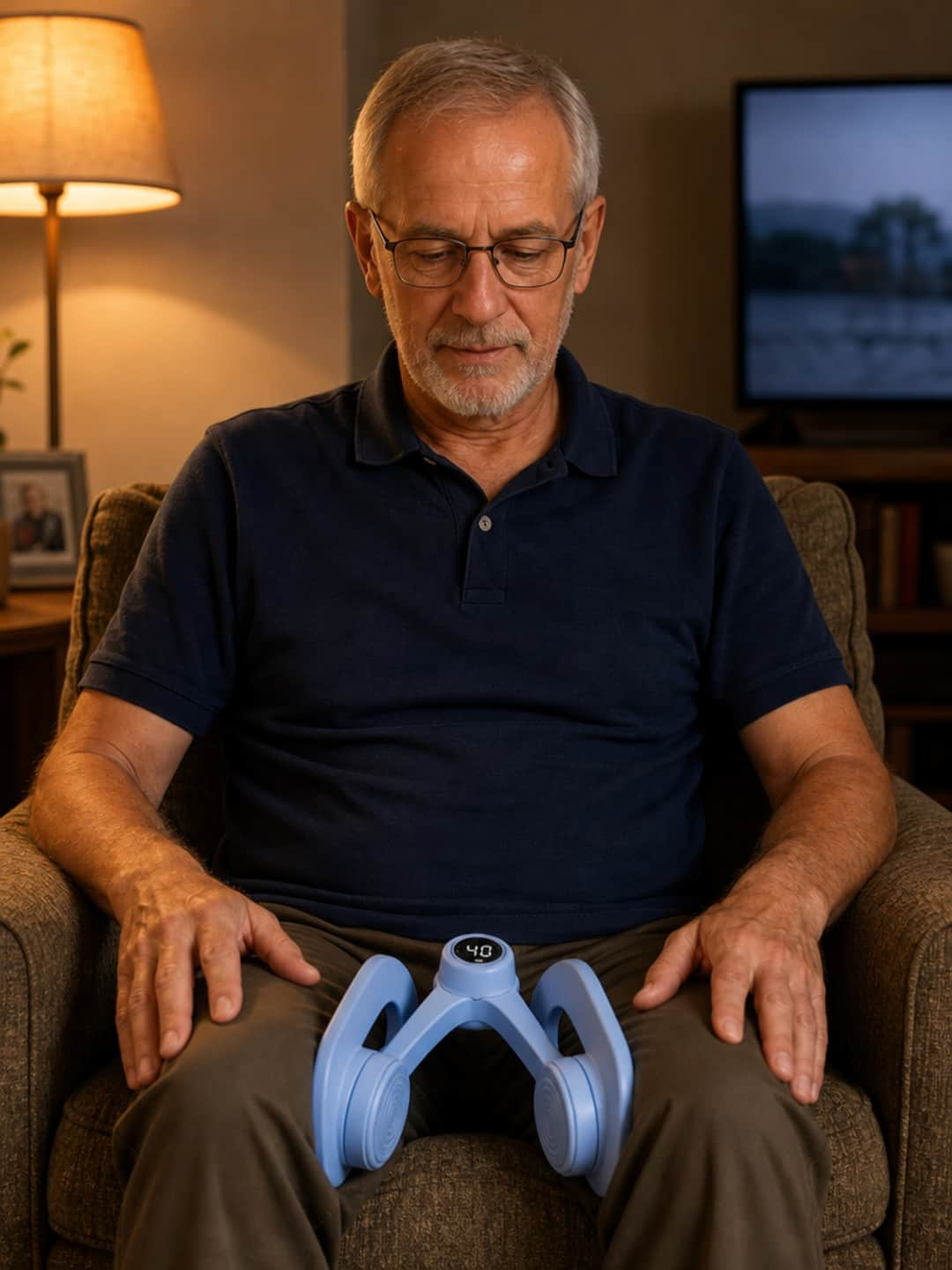
Raymond — nine months post-surgery, dark-navy polo, sitting in his armchair during the game — places the Pelvexia trainer between his knees. The steel spring gives resistance. He contracts the pelvic floor simultaneously with the knee squeeze, the way the printed guide demonstrates. The counter increments. He watches 38 become 39 become 40. He doesn't have to wonder whether he did the work. He did the work. He can see that he did the work. And tomorrow he will do it again, and the day after that, because this is a routine rather than an instruction — something physical, repeatable, and his.
It is not a cure. Pelvexia is a training aid — a pelvic floor exercise tool. It does not diagnose, treat or prevent any medical condition, and any man managing post-surgical incontinence should be doing so in conversation with his doctor or pelvic floor therapist.
But there is a real and documented difference between a man who is passively managing leakage and a man who is actively building a training habit around the muscle responsible for it. The first man is in the women's pad aisle. The second man is in his armchair, watching the counter tick over, doing the work.
One of those men knows he is moving. The other is not sure.
What Customers Are Saying
"Finally something that makes the routine feel real. I know exactly how many I've done each session — that alone made me stick with it."
D.M. — Phoenix, AZ
★★★★★
"Well made, straightforward to use, and the guide is clear. My PT was fine with me using it alongside my regular appointments."
Robert T. — Tampa, FL
★★★★★
"I'd tried other devices and felt nothing. This one is different because I can feel the spring and I can see the count. It makes the whole thing less abstract."
G.H. — Sacramento, CA
★★★★☆
He Spent Forty-Five Minutes in That Aisle. He Doesn't Have to Stay There.
The man in that supermarket aisle is not unusual. He's the man most prostate surgery patients become for some portion of their recovery — standing somewhere he never expected to be, shopping for something designed for someone else, managing a problem nobody gave him the right tools to train.
The research behind Pelvexia is full of men describing exactly this. "I followed the instruction sheets and nothing good happened." "My physio had no experience with men recovering from this." "I've got one device in my bedside drawer — ineffective." These are not outliers. They are the majority experience of men who were told to do Kegels and handed a piece of paper.
Here is what training with structure — rather than just managing with pads — actually changes:
- The invisible exercise becomes physical and countable — steel-spring resistance gives the pelvic floor something real to push against, and the built-in digital counter tells you exactly how many reps you've completed.
- The routine fits where life actually happens — seated, at home, ten minutes in the armchair during the news; no clinic, no commute, no insertion, no electrodes.
- The pad aisle becomes optional — not overnight, but as a direction of travel; a training habit aimed at the muscle behind the problem, not a management system built around it.
- It was designed for men — not repurposed from postpartum equipment, not pink, not sold on the assumption that the anatomy is interchangeable.
- The question "did I actually do them?" has an answer — one that increments on a screen you can read from your armchair.
Tomorrow morning, one of two things happens. Either the Pelvexia routine starts — resistance, reps, counter ticking up, a training habit that accumulates — or the pad goes in the pocket as usual and the aisle is waiting at the end of the week.
The mechanism is simple. The choice is yours. The full details are below.
Pelvexia™ is a pelvic floor exercise aid. It is not intended to diagnose, treat, cure or prevent any disease. Talk to your doctor or pelvic floor therapist, especially after surgery. Forum quotes are drawn from publicly available patient forums and are used anonymously; handles have been removed. Statistics cited are from the American Urological Association, American Cancer Society, and PMC-indexed research; they describe population-level data and are not product outcome claims.