You Checked for a Spare Pad Before You Checked Your Wallet. Here's Why — and What Finally Changes It.
There's a version of this that nobody talks about at the follow-up appointment.
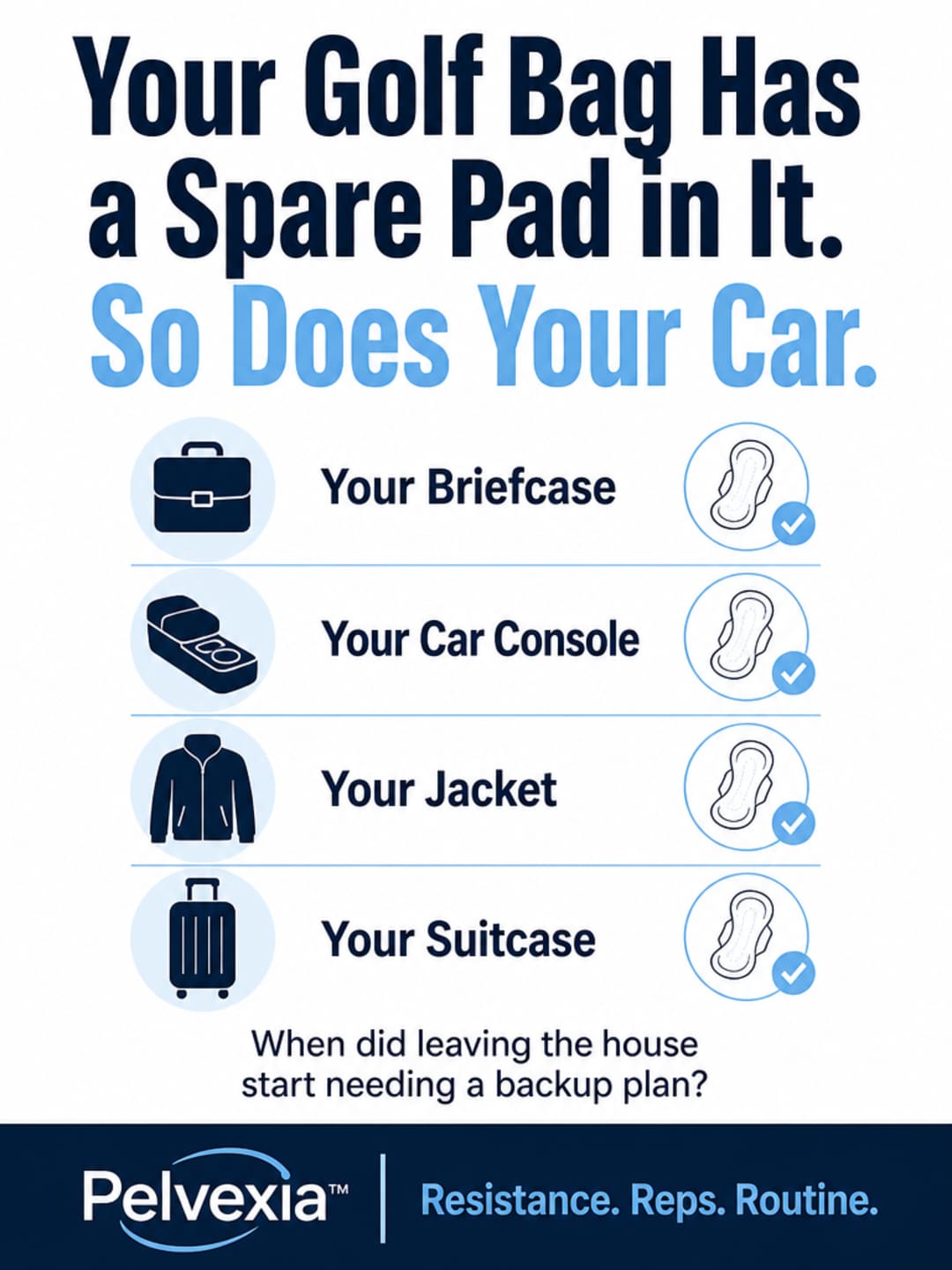
The surgery goes fine. The recovery goes roughly as expected. And then, somewhere around month two or month three, a new habit forms — so quietly you almost don't notice it at first. Before you leave the house, you check. Golf bag: pad in the side pocket. Car console: one spare, wrapped. Jacket pocket: another, just in case. Suitcase: four, packed before the shirts.
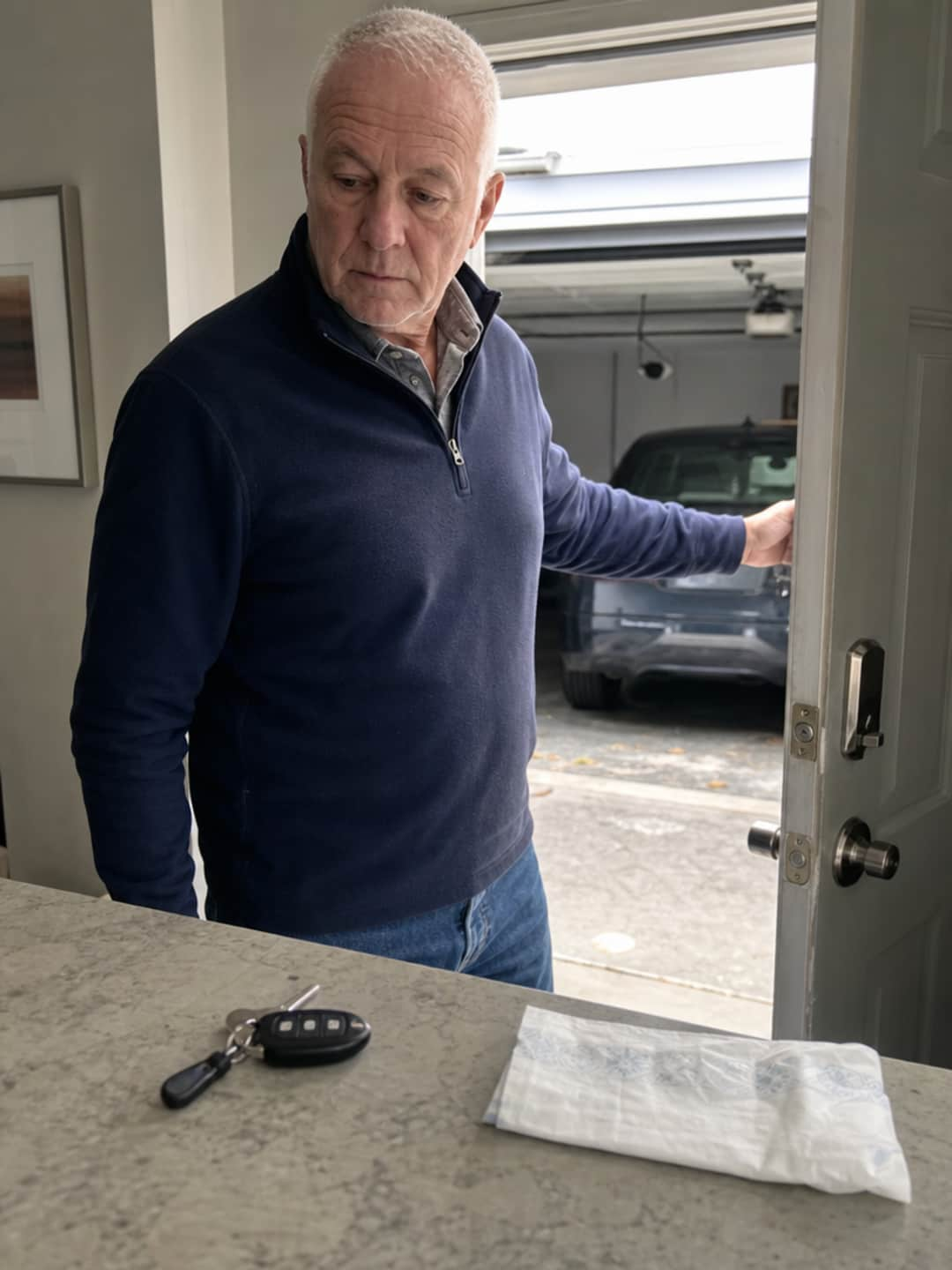
It doesn't feel like a life change. It feels like being careful. Responsible, even. But then one afternoon you catch yourself standing at the garage door, half-out, running through the mental checklist — and you realize the checklist has been running your day for months.
"I never go without some form of pad in my underwear just in case," one man wrote on a health forum thirteen months after his surgery. He was still playing golf. Still going for walks. Still, technically, doing everything. But the words just in case had moved into the center of every plan he made, like a tenant who showed up for a week and stopped paying rent.
That feeling — that low hum of what if — is what this is actually about. Not just the leakage. The way the fear of leakage starts making decisions you used to make yourself.
The question worth asking isn't how to manage it better. It's whether the muscle underneath it can be trained at all — and whether most men trying to do that have ever actually been given the right tool to try.
The Day You Realized You Were Planning Around It, Not Through It
There is a specific kind of diminishment that doesn't announce itself. It arrives as a small adjustment. You leave twenty minutes earlier so you can find the bathroom before the movie starts. You pick the table near the men's room. You cut the walk short — not because you're tired, but because you're three-quarters of a mile from the car and you're doing the math.
Individually, none of these feel like a big deal. Together, they add up to something: a life that has quietly reorganized itself around a problem that was supposed to be temporary.
One man, fourteen months after his prostatectomy, described still playing golf, still hiking, still doing everything he'd done before. And still — every single time — packing a pad before he packed anything else. He hadn't stopped living. But the just in case had moved into every plan.
That's the real thing men in this situation lose. Not the activities. The ease. The ability to decide to go somewhere without running the checklist first.
Post-prostatectomy stress incontinence is well-documented: according to a cohort study published in peer-reviewed literature, more than half of men experience it in the first week after surgery, and while the majority improve significantly over the following months, a meaningful percentage still deal with it at the twelve-month mark and beyond. The American Urological Association acknowledges it openly — incontinence "is expected in the short-term and generally improves to near baseline by 12 months," but may persist and require further attention.
Expected in the short-term. Most men read that as a promise. When month twelve comes and the checklist is still running — when the spare pad is still in the golf bag — they don't know whether they're in the minority that takes longer, or the minority that needs something different.
What almost none of them know is whether the pelvic-floor exercise they were told to do is actually doing what it was supposed to do. Because nobody ever gave them a way to check.
That's where this gets interesting — and it begins with understanding why the standard advice, however well-intentioned, left this particular reader exactly where he is.
The Reason the Handout Never Got You Out of the Checklist
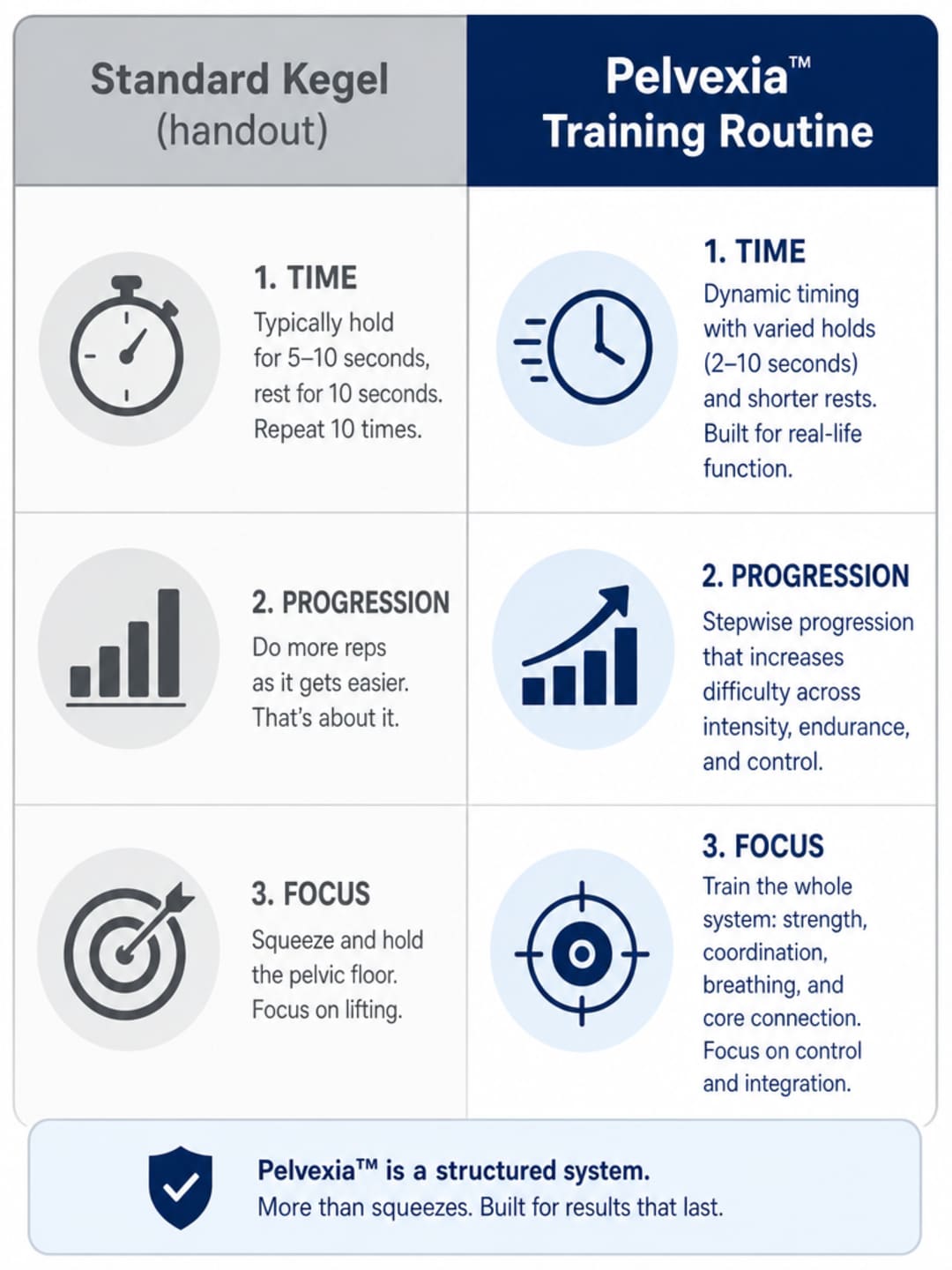
Here is something the physio's instruction sheet doesn't say: when you squeeze a pelvic-floor muscle against no resistance at all, you have no way to know whether you are actually engaging the right muscle, how hard, for how long, or whether the twenty-three reps you did in the car counted.
"Kegels went nowhere for me," one man wrote, months after his prostatectomy. Another: "Kegels have done NOTHING for me — what has any of this done? NOTHING! I'm sick of squeezing as hard as I can." A third tried 100 repetitions a day and found himself filling three pads to capacity by evening — not because the exercise was wrong in principle, but because he had no way to gauge load, no feedback on form, and no way to know if he was working the right muscle or simply tiring a neighboring one.
The Mayo Clinic Health System's guidance for men sets a sensible ceiling: around four sets of ten — roughly 40 repetitions a day — with rest between. More than that can fatigue the muscle rather than strengthen it. The men doing 100 weren't being lazy or impatient. They just didn't have a way to count to 40 with any confidence, so they kept going.
This is the mechanism gap the checklist lives in. Not the absence of effort. The absence of structure — something to push against, so the contraction has an external load to meet; and something that counts, so the session is a known quantity rather than a guess.
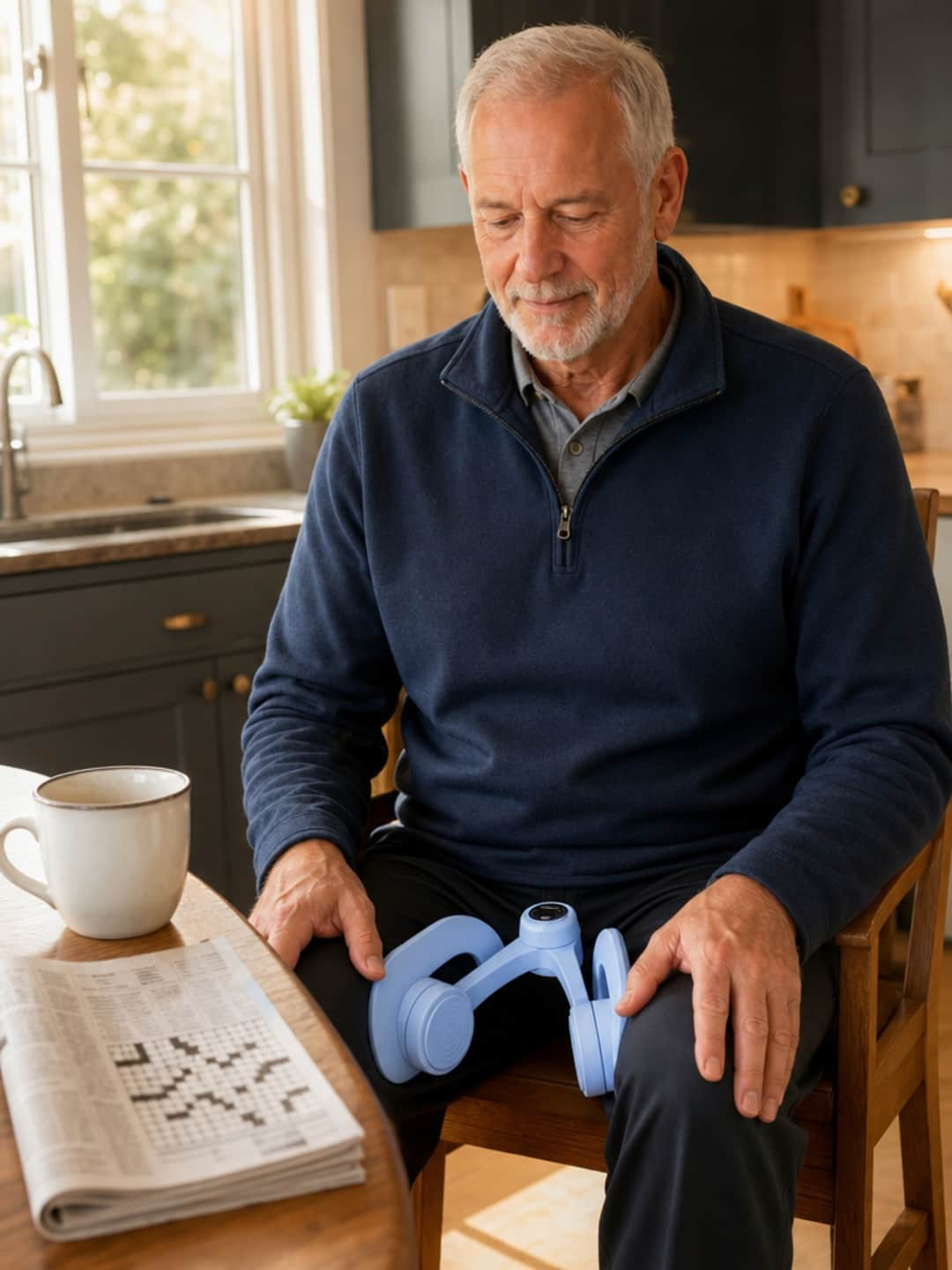
Pelvexia works by giving both. You sit — armchair, kitchen chair, wherever — place the light-blue frame between your knees, and squeeze the knees inward against a steel spring while simultaneously contracting the pelvic floor. The spring gives the muscle a load to work against rather than air. The built-in digital counter tracks each rep as a number: 12, 13, 14. When you reach 40, you know you reached 40.
The counter is deceptively important. It answers the question men on the forums keep returning to: "Did I actually do them?" Not approximately. Not probably. The number is on the display.
That visible, countable routine doesn't replace the Kegel. It is the Kegel — structured, loaded and confirmed. Which is a different thing from the handout entirely. And it's why what happens next in many men's experience — the exhausting and expensive trail of trying other solutions — starts to make a different kind of sense.
The Bill You've Already Been Paying — and Didn't Notice Adding Up
The thing about managing leakage rather than training the muscle behind it is that the costs are small enough, individually, that nobody sits down and totals them.
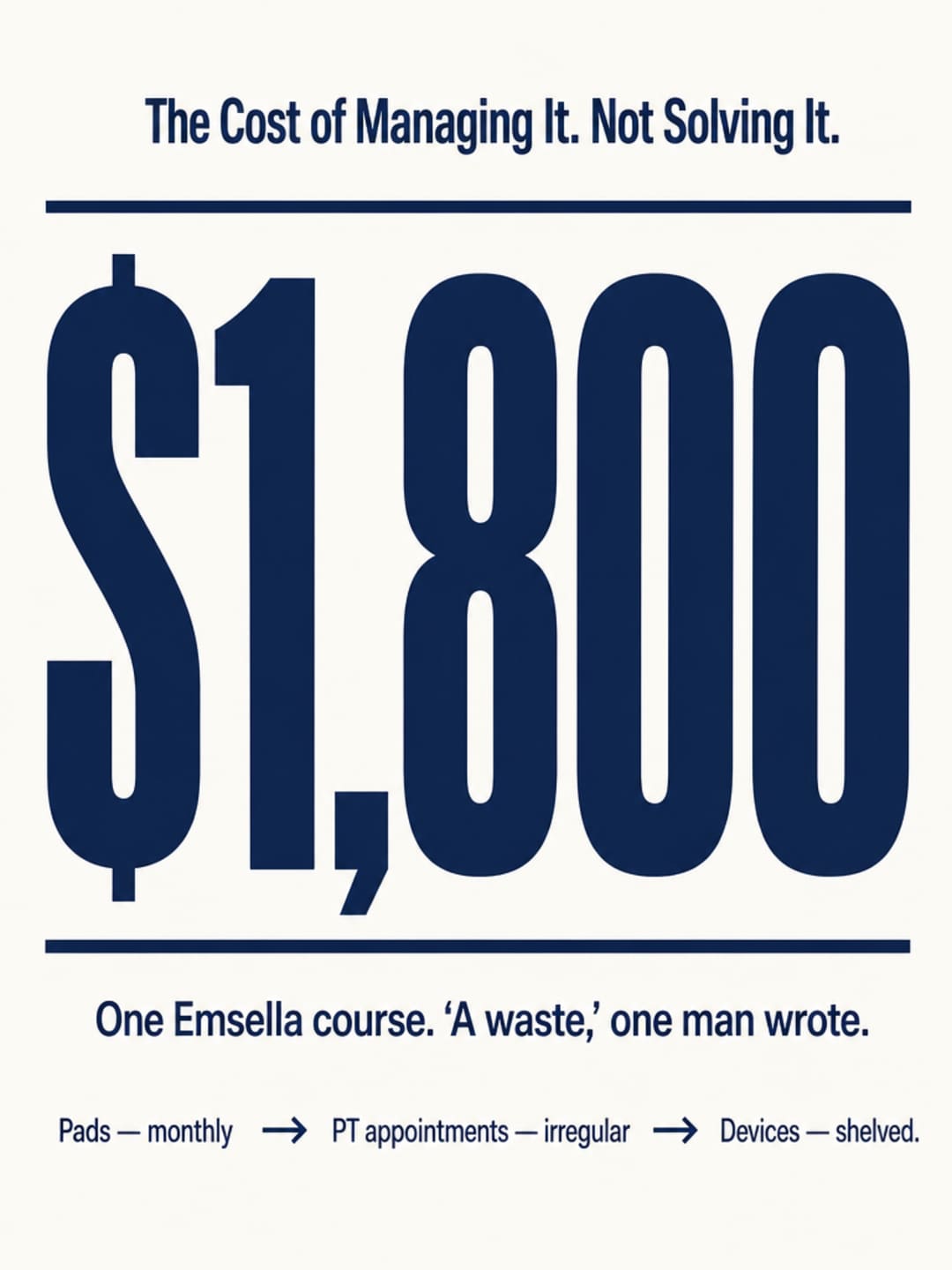
Men's incontinence pads — the ones actually designed for men — run roughly $15 to $35 a pack, depending on absorbency and brand. A pad-a-day habit is not unusual in the months after surgery. Over twelve months, that's a number nobody planned for and almost nobody accounts for: somewhere in the range of $180 to $350 in pads alone, conservatively, and that assumes the leakage is mild. "Will fill 3 pads to the max," one man wrote. Daily.
Then there are the appointments. Pelvic-floor physical therapy — when a qualified therapist with male post-prostatectomy experience is available — is frequently not covered fully by insurance. "Medicare pays pennies," one man noted on a health forum. Emsella clinic treatments, in which you sit in a chair and receive high-intensity electromagnetic stimulation, typically run $875 to $2,000 for a course. "I found it to be a waste of $1,800," one man wrote, plainly.
The point isn't that any of these choices was foolish. It's that the ongoing cost of not solving the underlying problem accumulates quietly, in increments small enough to absorb one at a time but large enough to add up to something real over a year or two. The pad-a-day. The occasional appointment. The gadget tried and shelved. The specialist visit.
What almost none of these options gave the men spending the money was a repeatable, daily, measurable training routine they could perform independently and know — with certainty — they had completed. That accountability gap is where the money keeps going.
"It could be a spendy gamble," one man said, describing a device he was considering. He wasn't wrong about the category. He was just looking at the wrong part of the cost picture. The gamble isn't one purchase. It's the ongoing bill for staying stuck.
What You've Been Offered Versus What You Actually Need
Let's put it simply.
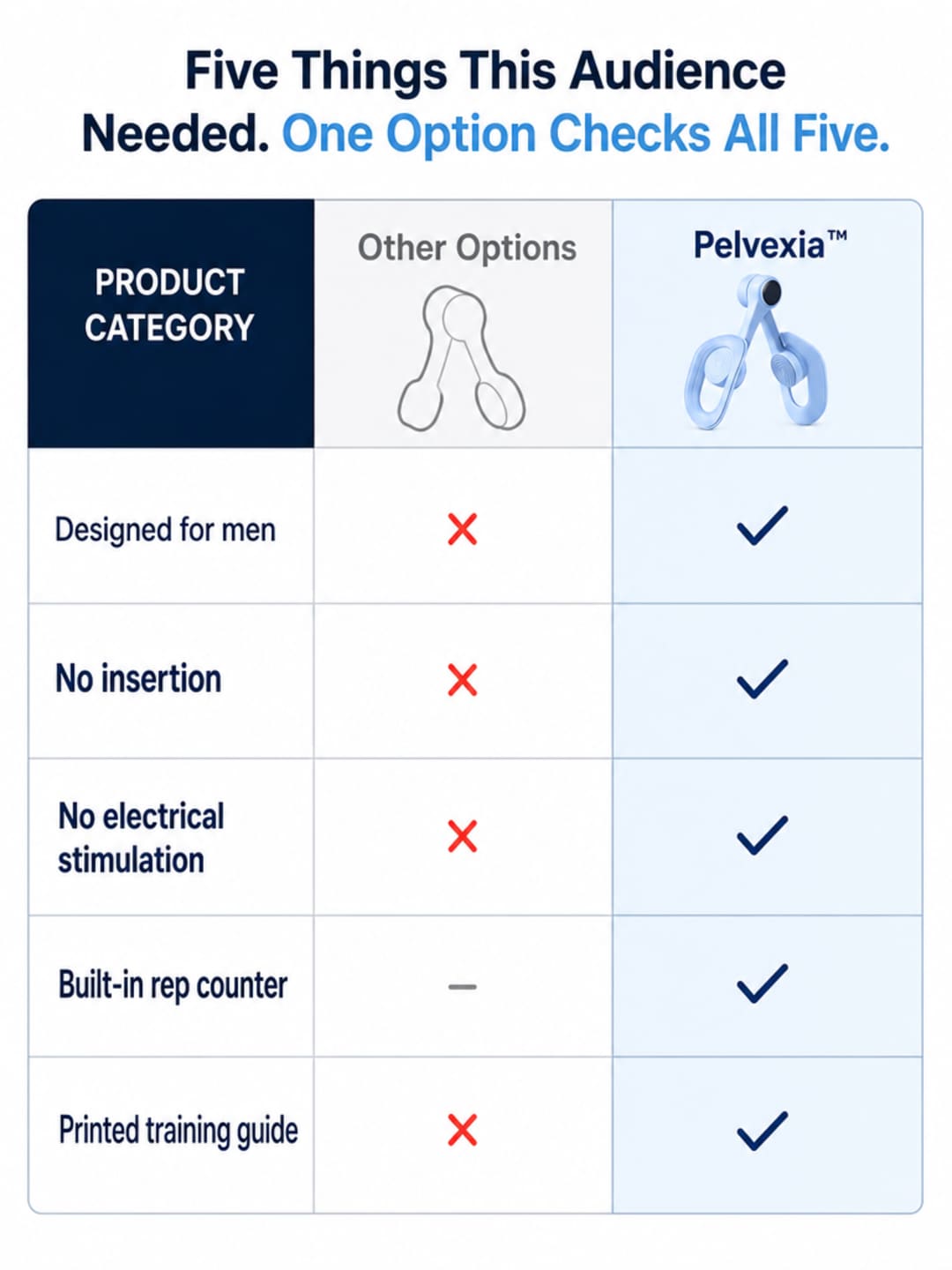
The options available to men after prostate surgery — the ones usually mentioned — fall into roughly four categories. A handout of generic exercises. Electrical stimulation (e-stim devices or clinic-based chairs). Insertable biofeedback devices. And generic knee-squeeze trainers designed and packaged for postpartum women, priced between $5 and $45, with resistance levels calibrated for a completely different purpose and no counter of any kind.
"Why my nurse, who never stood at a urinal in her life, would think that an exercise for postpartum women would help me, I dunno," one man wrote, drily.
The electrical stimulation option — whether a home device or a clinic chair — has its proponents, but it also has a urologist on record calling it "a GIMMICK, not proven at all." And at $875 to $2,000 for a clinic course, it's a significant bet on that disagreement. One man who tried the clinic approach described spending $1,800 and counting himself in the "waste" category.
The insertable biofeedback devices are non-starters for most men in this situation. "The other device I considered was a wand-shaped metal thing that you shove up you and it zaps you," one man wrote. "It's a no from me."
The generic knee-squeeze trainers are cheap and available — but they are female-coded, resistance-heavy in the wrong direction, have no counter, and come with no guidance on the combined movement that actually engages the pelvic floor through the knee-squeeze action.
Pelvexia occupies a different position. It is men's-first by design. No insertion. No electrodes, no electrical stimulation of any kind. The steel-spring resistance is designed for the seated knee-squeeze routine rather than maximum-load competition. The digital counter is built in. The printed instruction guide demonstrates the combined movement — knees in, pelvic floor lifted simultaneously — so the exercise is learned rather than guessed. Soft TPE rubber cushioned pads on the jaw contact points mean the frame doesn't cut into bone.
None of this is a miracle. It is a training tool that gives the right exercise the right structure. That framing matters — because the next part is where the difference becomes real.
If you want to see exactly how the routine works — the seated position, the combined movement, the counter in action — the full details are on the next page. But the shape of what changes is worth understanding first.
What the Morning Looks Like When the Checklist Isn't the First Thing
This is the part nobody writes about, because it is ordinary in a way that is hard to describe to someone who hasn't lost it.
You wake up. You make coffee. You sit in your chair with the newspaper or the morning crossword and you do your ten minutes. Counter to 40, the steel spring compressing and releasing, the pelvic floor working with it. The light-blue frame goes back on the shelf. You finish the coffee. You get dressed.
And then — not on the first morning, and not the second, but eventually — you walk out to the car without running the checklist. Not because you've forgotten the problem. Because the problem is getting smaller. Because you're doing something measurable about it every day, and you know you are, because the counter told you so.
"The resulting graph showed the gradually decreasing volume over time despite daily ups and downs," one man wrote after tracking his progress carefully. "This gave me confidence I was improving." That word — confidence — is the real thing that had been missing. Not a cure. The evidence that something was actually changing.
"I wanted to move the muscles myself," another man wrote, explaining why he had sought out an active training routine rather than an electrical stimulation device. That instinct is not misplaced. The pelvic floor is a muscle. Muscles respond to progressive, structured, resistance-based exercise. That's not a marketing claim — it's how the body works.
The seated routine Pelvexia supports — roughly the volume the Mayo Clinic Health System recommends for men, about 40 reps in a daily session — fits into the morning paper, the evening news, the halftime break. It doesn't require a separate appointment, a drive, or a booking. It doesn't require anything to be inserted or anything electrical to be attached. It requires sitting down and starting the counter.
The golf bag is still in the garage. The difference is that the pad in the side pocket is there less as a necessity and more as a habit you're actively working to break. That's a different relationship to the same object — and it starts with a very different morning.
What Men Are Saying About Pelvexia™
"Clear instructions and a simple routine. I actually know I'm doing the reps now — the counter makes a real difference. Well made and does exactly what it says."
R.M., Phoenix AZ
"I'd tried doing Kegels for months with no way to track anything. Having something physical to squeeze against and a number on the display finally made the routine feel like a proper workout."
Gary T., Denver CO
"Solid build, comfortable pads, and the guide is straightforward. Easy to fit into the morning without any fuss. Practical and worth it."
D.W., Charlotte NC
The Checklist Has Been Running Long Enough.
Three to four months from now, if nothing changes, the pad is still in the golf bag. The spare is still in the car console. The long drive is still planned around rest stops. Every morning begins with the same quiet calculation: how much did I leak last night, and what does today need to account for?
That's not a recovery. That's an adaptation. And adaptations don't shrink on their own.
Here's what the men who found their way back to something like normal had in common — not a miracle device, not a $1,800 clinic chair, not a handout they'd already tried. They had a daily, structured, measurable routine. Something physical to push against. A number that confirmed they'd done the work. A guide that showed them how.
- The "just in case" checklist persists because invisible exercise gives no feedback — and no feedback means no progress you can see or trust
- The pelvic floor is a muscle; it responds to resistance and structured repetition the way every other muscle does
- The standard advice — the handout, the postpartum framing, the guess-and-hope approach — was never designed for men in this situation
- A daily seated routine, around 40 reps against a steel spring, is the specific structure that changes the morning calculation
- The counter is the part that makes it real: it turns "did I do them?" into a number on a display
Every morning you skip the routine is a morning the checklist stays in charge. The mechanism is straightforward. The equipment exists. The only question is whether you start tomorrow or whether the golf bag gets repacked the same way it was today.
The full details — how it works, what's included, what the routine looks like in practice — are on the next page.
Pelvexia™ is a pelvic floor exercise aid. It is not intended to diagnose, treat, cure or prevent any disease. Talk to your doctor or pelvic floor therapist, especially after surgery.