He Did the Kegels for Over a Year. He Was Still Leaking. Here's What the Handout Never Told Him.
There is a moment most men never talk about.
It is not the surgery, or the diagnosis before it, or even the first time the leakage happened. It is the moment — somewhere around month three or four or eight — when a man realizes that he has been doing everything he was told and nothing has changed. He has been squeezing. Holding. Releasing. Repeating. He has been faithful to the routine in a way he was never faithful to a gym membership. And he is still reaching for a pad before he leaves the house.
"Kegels went nowhere for me," one man wrote on a prostate-health forum, fourteen months after his surgery. He was not lazy. He was not non-compliant. He had done exactly what the discharge sheet said. What the discharge sheet never told him — what almost nobody tells men in this situation — is that squeezing a muscle against nothing, with no way of knowing whether you are even contracting the right one, is not training. It is guessing. And guessing does not build strength.
"I followed the instruction sheets and nothing good happened." That sentence, or something very close to it, appears in men's health forums again and again. It is not a complaint about effort. It is a complaint about a system that handed men a tool designed for postpartum women, written by clinicians who — as one man put it with more patience than the situation deserved — had "no experience with men recovering from a prostatectomy." The exercise itself is sound. The delivery has failed the people who need it most.
What follows is not a promise that any device will fix what surgery changed. It is an explanation of why the handout alone keeps failing, what makes a pelvic-floor training routine actually work, and why the difference between "doing Kegels" and training the pelvic floor comes down to two things that a photocopied sheet cannot give you: something real to push against, and a number that proves you did it.

"I'm Squeezing as Hard as I Can. What Else Am I Supposed to Do?"
This is where most men are when they find this page.
Not newly diagnosed. Not fresh out of surgery. Past all that. Months in, sometimes more than a year in, having done the work — genuinely done it — and standing at the point where effort and outcome have simply refused to connect. "I'm squeezing as hard as I can," one man wrote. "What has any of this done? NOTHING." He had been kegeling, by his own count, a hundred times a day. By evening, the dribbles had become a stream. He was filling three pads to the maximum before bed.
The reason that story lands so hard for so many men is that it removes the comfortable explanation. You cannot say he did not try. You cannot say he lacked discipline. The only honest conclusion left is that the method itself was not giving him what a proper training session requires — which means the problem was never his effort. It was the absence of feedback and resistance, and nobody had told him that.
Source: PMC9983825 · American Urological Association guideline
Knowing that does not make the situation easier. But it does clarify something important: if an exercise protocol has a structural gap, adding more reps to it does not fill the gap. It just adds more reps.
What that gap actually is — and why it keeps even the most committed men stuck — is the one thing the discharge handout was never designed to explain.

The Reason a Photocopied Sheet Cannot Build a Muscle
Here is the structural problem, stated plainly.
Pelvic-floor exercises work on the same physiological principle as every other resistance exercise: you contract a muscle against load, you do it consistently and with adequate volume, and over time the muscle adapts. That is not a theory. It is how skeletal muscle responds to training, and the pelvic floor is skeletal muscle.
The handout skips the load.
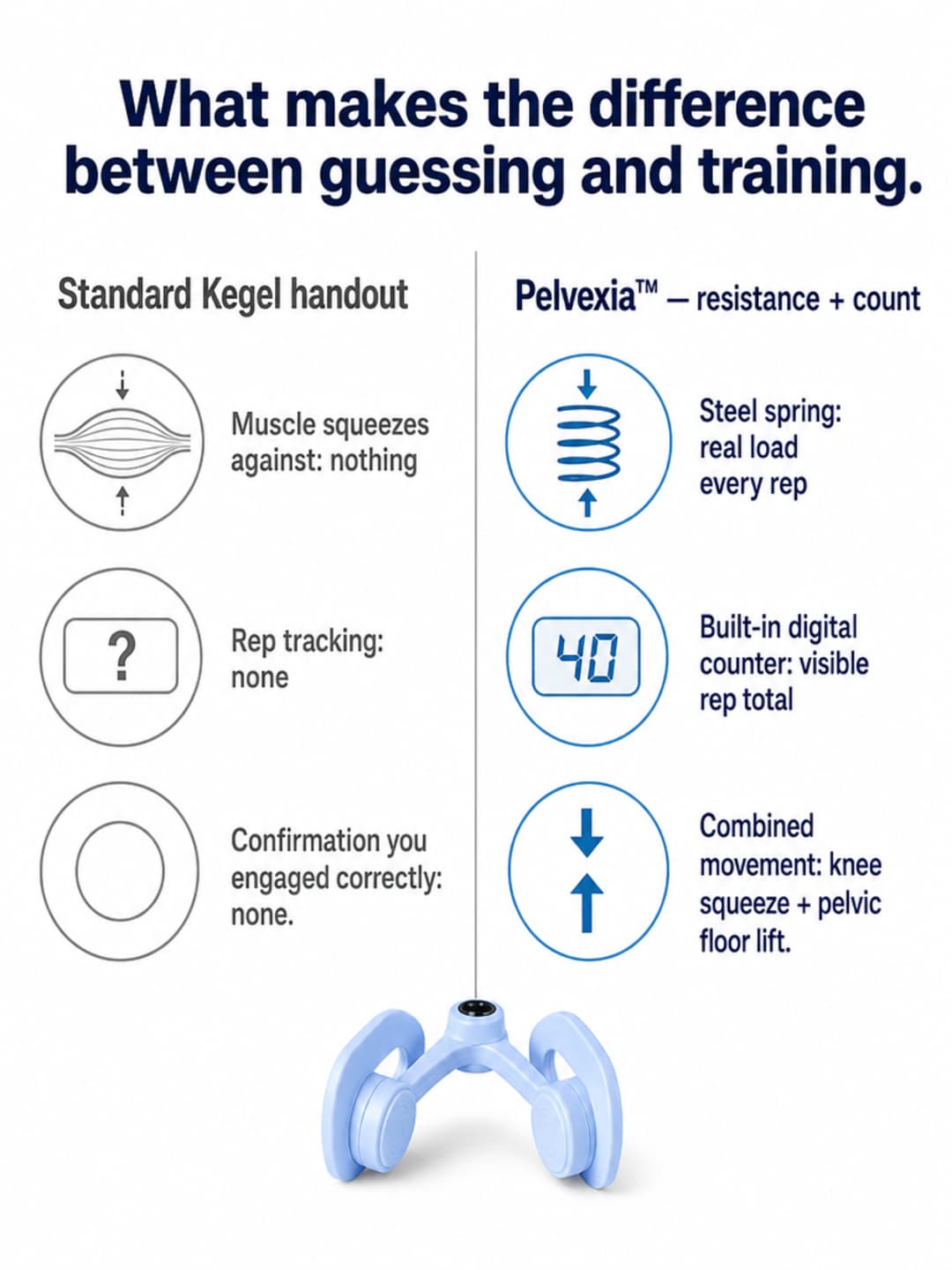
When you squeeze a pelvic-floor muscle with nothing to push against, there is no external resistance — only the muscle contracting into air. For some men, particularly those who begin the exercises early and whose pelvic floor was in good baseline condition before surgery, that is enough to maintain tone during recovery. For men whose pelvic floor sustained significant disruption during a prostatectomy, or men who simply do not know whether they are engaging the correct muscle group at all, squeezing against nothing gives the neuromuscular system very little to work with. The Mayo Clinic Health System guidance for men recommends around 40 Kegels a day — roughly four sets of ten — because doing more than that fatigues the muscles rather than strengthening them. The instruction is not to do more. It is to do them better.
What Pelvexia adds to that same underlying exercise is a steel spring. You place the trainer between your knees, you squeeze the knees inward against the spring's resistance while simultaneously contracting the pelvic floor, and the spring pushes back. The combined movement — inner-thigh compression and pelvic-floor lift — recruits the target muscle in a way that an unsupported squeeze in free air simply cannot replicate with the same consistency. The resistance is physical. It is there every rep.
And then there is the counter.
"Did I actually do them?" is a question that appears in almost every men's health forum thread about Kegel compliance. Not because men are forgetful, but because an invisible contraction of an internal muscle leaves no trace. The digital rep counter on Pelvexia's frame answers that question with a number. You know you did 40 because the display says 40. That sounds trivial. It is not — the single most consistent predictor of an exercise routine's success is the ability to track it, and a number you can read turns a guess into a training session.
But understanding why the mechanism matters is only half of it. The other half is understanding what happens when you stay stuck in the guessing phase — and how much that actually costs.
The Number Nobody Adds Up
Most men in this situation are not thinking about cost. They are thinking about inconvenience, about embarrassment, about whether this is permanent.
But the cost is real, and it accumulates quietly.
Incontinence pads designed for men — when you can find them, since the pharmacy aisle is not organized with this in mind — run, conservatively, several dollars a day for men with moderate leakage. Over a year that is somewhere between $300 and $600 in pads alone, for a problem that pads do not treat. They absorb the symptom. They do not address the muscle. Every pad purchase is a transaction that extends the problem's timeline, not a step toward ending it.
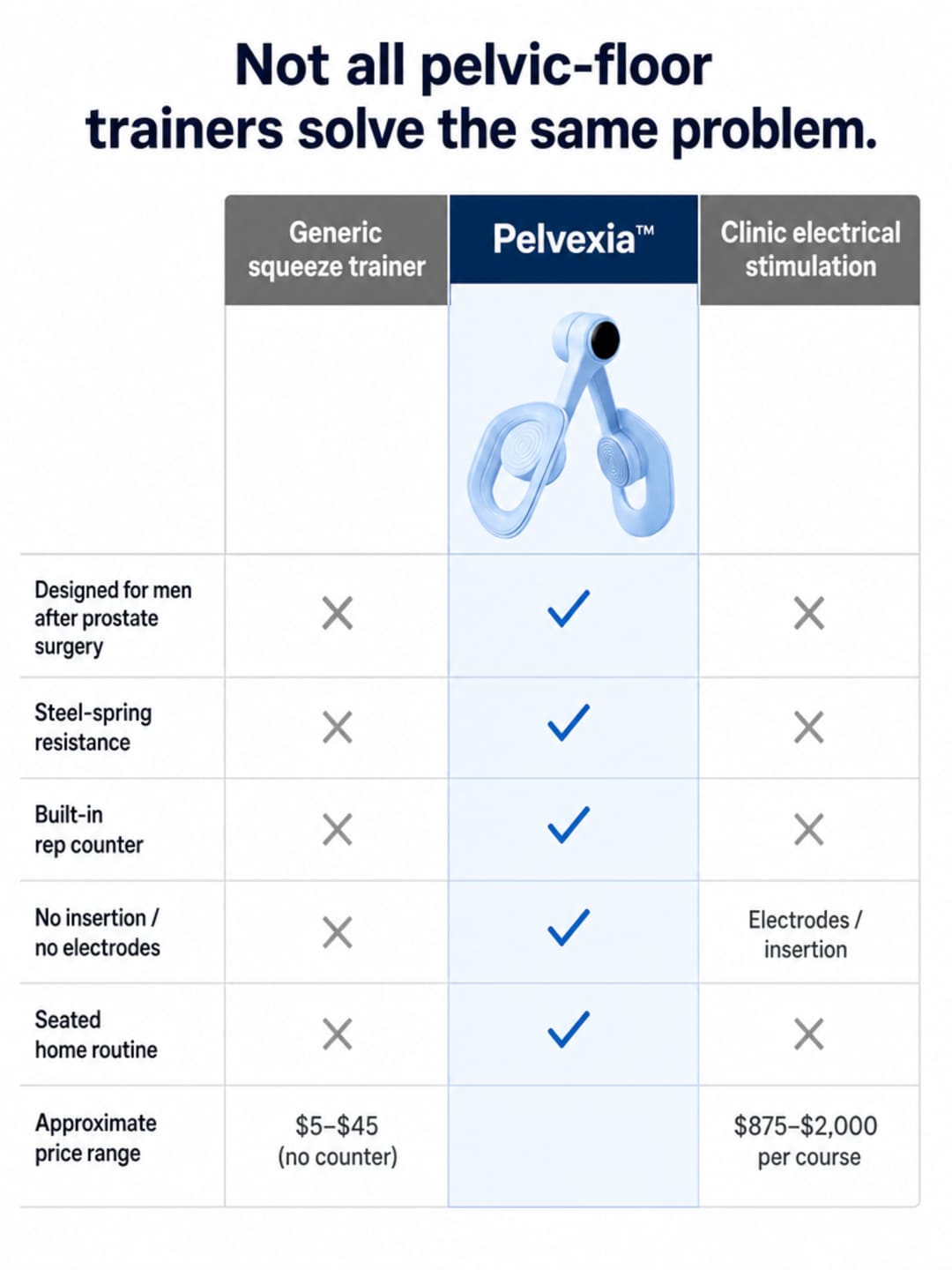
Then there are the treatments men try when the handout fails. One course of Emsella — an electrical stimulation chair used in some clinics — runs between $875 and $2,000 depending on the provider and the number of sessions. "I found it to be a waste of $1,800," one man wrote on a prostate-health forum, describing the gap between what was implied and what he experienced. The kGoal biofeedback device, marketed for pelvic-floor training, is priced around $179. "Please don't buy the kGoal," wrote one man who had. "I've got one in my bedside drawer." The investment is not the point. The point is what happens when a solution does not address the structural gap — a man spends more money, has nothing to show for it, and becomes more certain that nothing will work.
The American Cancer Society estimates 333,830 new prostate cancer cases in the US in 2026. Roughly 90,000 men in this country undergo radical prostatectomy each year. A significant number of them will receive a handout and a wish of good luck, and they will spend money — on pads, on devices, on clinic visits — trying to close a gap that the handout alone could not close.
The cost of staying in the guessing phase is not just the price of pads. It is the accumulated outlay of treatments that keep solving the symptom without touching the training problem underneath it.
And when men begin comparing what they have tried against what the training problem actually requires, a pattern becomes visible — one that changes how the whole landscape looks.

What Happens When You Line Them Up
It helps to look at the options side by side. Not as a sales exercise, but because men who have already spent money on this problem deserve to know what they are comparing.
Generic knee-squeeze trainers — the kind sold on Amazon and Walmart, mostly pink, priced between five and forty-five dollars — exist. Several men have tried them. The reviews tell a consistent story: "Followed the directions, but felt nothing. Better off doing the old-time kegels with your own muscles." "I purchased the pelvic-floor exerciser but after I received it I could barely squeeze it. There is no way to change the tension." These products were not designed for men recovering from prostate surgery. They were designed for postpartum women, they are marketed to postpartum women, and the resistance calibration and the lack of any rep-tracking mechanism reflect that design brief. A man squeezing a pink device with no counter is still squeezing against the wrong thing with no way to know he did anything.
At the other end of the spectrum: electrical stimulation devices require electrodes, an app, or insertion. Clinic-based treatments require appointments, co-pays and, in some cases, a willingness to spend the equivalent of a monthly mortgage payment for a course of sessions that a urologist in one forum thread called "a GIMMICK — not proven at all."
The category gap is real. What it leaves room for is a men-specific resistance trainer — no insertion, no electrodes, no app, no clinic visit — with a steel spring that gives the exercise a physical load and a digital counter that makes the rep count legible. Soft TPE rubber cushioned pads on both contact surfaces mean the frame sits against the knee without the plastic-on-bone discomfort that Walmart reviewers reported. It is a seated routine. You do it in your chair. You watch the counter. You do roughly forty reps, per Mayo Clinic Health System guidance, and you stop before you fatigue the muscle rather than working against it.
The comparison is not between a cheap gadget and an expensive one. It is between a training tool built around the mechanism of the exercise, and everything that ignores that mechanism.
Once the mechanism is in place — resistance, reps, consistency — the question left is what that actually looks like to live, and what it makes possible on the other side of the training.
What Training Actually Looks Like
Raymond's physio — the second one, the one who had actual experience with men after prostatectomy — said something that stuck with him. She told him the exercise was never the problem. The problem was that there was no way to know whether he was doing it, how much of it he was doing, or whether he was fatiguing the muscle instead of conditioning it. Without resistance to confirm the effort and a number to confirm the volume, he was not training. He was hoping.
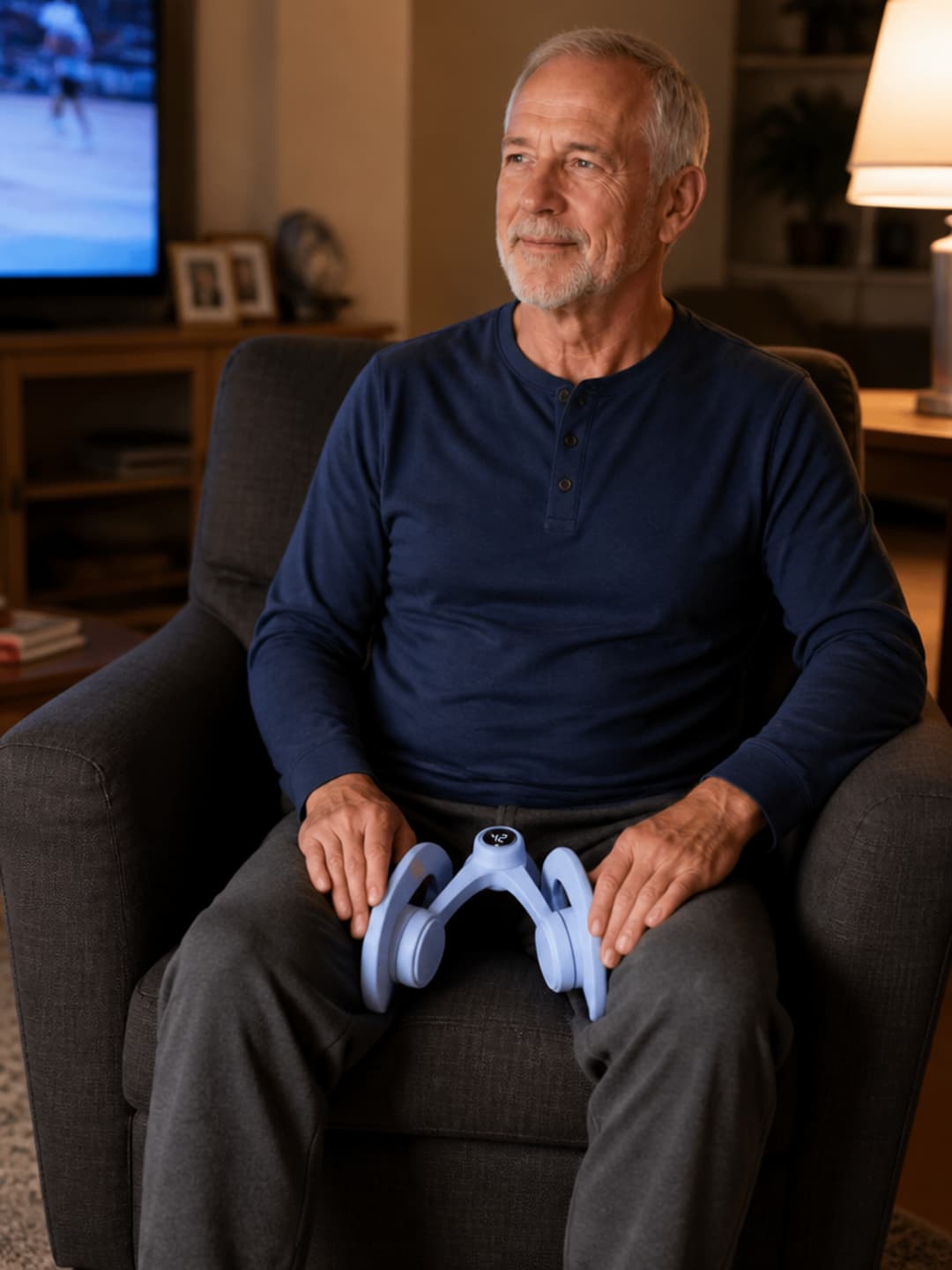
The routine with Pelvexia is not complicated. You sit down — in your armchair, at the kitchen table, during the morning news or the evening one. You place the trainer between your knees. You squeeze inward against the spring and lift the pelvic floor at the same time; the printed guide walks through the combined movement so the coordination becomes second nature within a few sessions. You watch the counter. Somewhere around 38, 39, 40, you stop. Not because forty is a magic number, but because Mayo Clinic Health System guidance is explicit: more than four sets of ten in a day risks fatiguing the muscles you are trying to build. The counter is not just an accountability tool. It is also a brake.
"The resulting graph showed the gradually decreasing volume over time despite daily ups and downs," wrote one man on Mayo Clinic Connect, describing how he had tracked his own progress. "This gave me confidence I was improving." That sentence matters because it identifies what was missing from the handout: visible evidence of direction. A number that trends the right way over weeks is not a cure. It is the thing that keeps a man doing the work, because the work is no longer invisible.
"I wanted to move the muscles myself," wrote another man, choosing a resistance-based approach over electrical stimulation. "I favor learning how to control these muscles rather than looking for some way to not learn, by having some device just do it for you." The distinction he is drawing is the right one. Electrical stimulation acts on a passive body. Resistance training asks the body to act. The first replaces effort; the second builds capacity.
That is the honest version of what a pelvic-floor trainer can do. Not a cure. Not a guarantee. A structured, countable, resistance-based daily routine that gives the underlying exercise what a photocopied sheet cannot — something to push against, and proof that you pushed.
For the full routine — how many reps, how to find the right combination of knee squeeze and pelvic floor lift, and how to build from the first session — the printed guide that comes with Pelvexia walks through it in detail.
What Customers Are Saying
"Finally something that actually gives me something to push against. The counter is the part I didn't know I needed — now I know exactly when I've done my reps and I stop second-guessing myself."
D. Harmon, Phoenix AZ
"Well built, straightforward to use, and the guide made the routine clear from day one. I do it during the morning news and I'm done in ten minutes. Practical and no fuss."
Robert M., Nashville TN
"I was skeptical after spending money on other things that did nothing. The difference here is that it's just a resistance trainer — no gimmicks, no electrodes, no app. Solid quality and the pads are comfortable on the knees."
T. Weston, Columbus OH
Fourteen Months of Kegels. Still Reaching for a Pad.
Here is what those fourteen months actually cost, outside of the pads and the devices:
- Every morning starting with doubt — not "will today be different," but "what's the point of doing this again."
- A routine that produces no signal — no resistance, no number, no confirmation that effort became result.
- The progressive narrowing of daily life — the golf invitation you hedge on, the car trip you plan around bathrooms, the social situation you exit early.
- Money spent on solutions that solve the symptom — and nothing spent on training the muscle.
- The slow settling of "this is just how it is now" — the most expensive outcome, because it ends the attempt.
The thing about the handout is that it was never designed to prevent any of those things. It was designed to communicate the existence of an exercise. The exercise is real. The protocol around it — resistance, volume, feedback — is what makes the difference between doing it and training it.
That distinction is visible now. The steel spring gives the movement a load. The counter gives the volume a number. The printed guide gives the routine a structure that fits inside ten minutes in a chair. None of that promises an outcome nobody can guarantee. What it promises is that tomorrow morning, for the first time, you will know whether you did the exercise — and you will have done it against something.
That is where it starts.
Pelvexia™ is a pelvic floor exercise aid. It is not intended to diagnose, treat, cure or prevent any disease. Talk to your doctor or pelvic floor therapist, especially after surgery.