Your Hair Is Clean. So Why Does It Feel Like This?
There is a specific moment you probably know well.
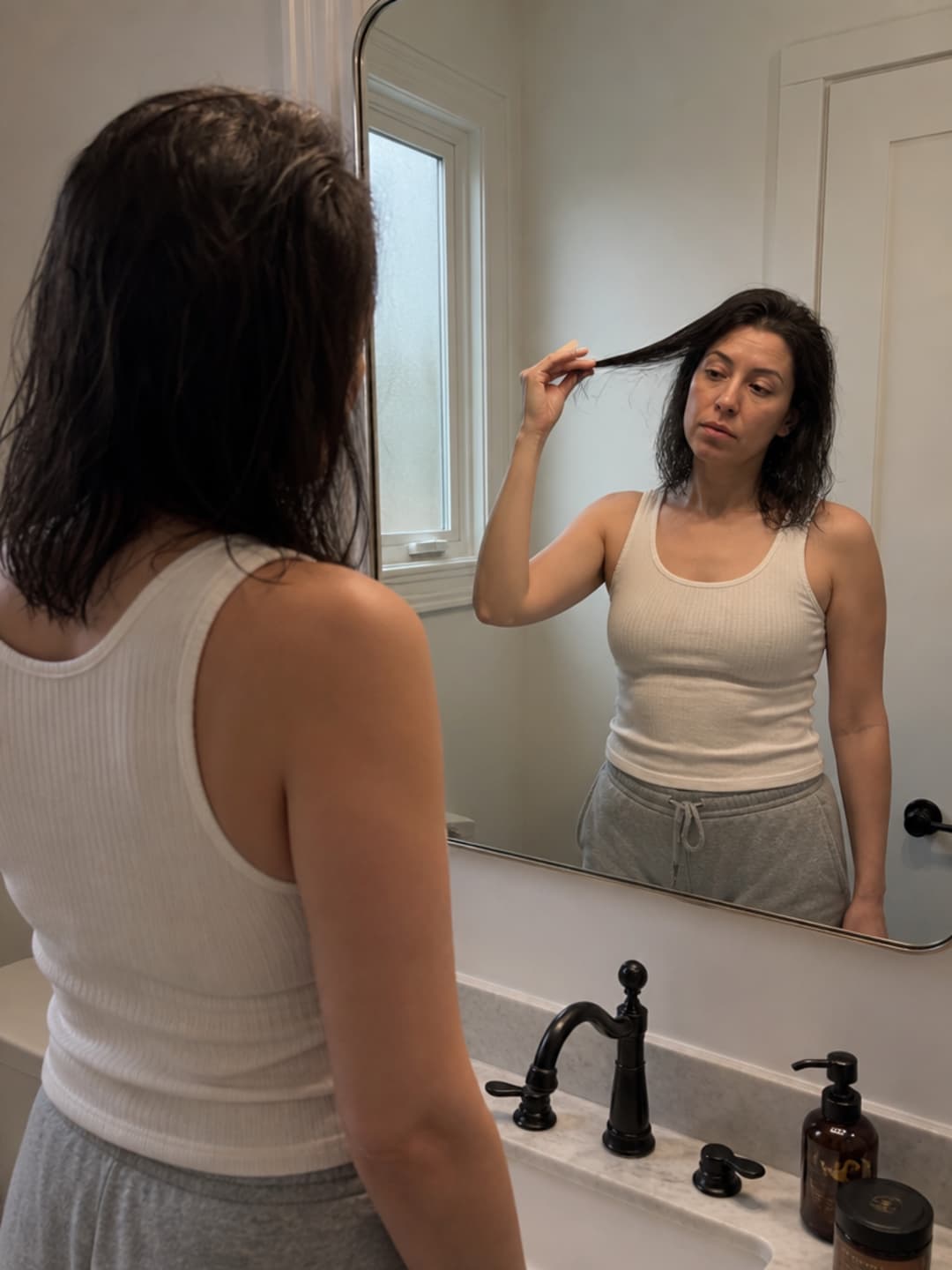
You step out of the shower. Your hair is freshly washed, conditioner still slightly fragrant, and you reach up to run your fingers from root to ends. Somewhere around the midpoint, they stop. Not because of a tangle. Because the hair itself feels coated — waxy, almost gummy — like it has a film sitting on top of it that the shampoo never quite reached. You try again. Same result. You look at your ends. Dry. Almost straw-like. You just washed your hair two minutes ago.
So you reach for a different product. A clarifying shampoo. A protein mask. A leave-in. Maybe you switch brands entirely — drugstore to salon, salon to online — and for about four days something feels slightly better. Then the texture is back. Coated. Gummy. That same drag between your fingers.
Here is what nobody says out loud: there is a version of that problem that no shampoo can fix. Not because the shampoo is cheap, and not because your hair is damaged. But because every time you wash, you are rinsing with the same water that put the coating there in the first place.
The question worth asking is not which product to try next. It is what, exactly, is in the water your hair spends eight minutes soaking in every morning.
The Finger Test You Stopped Trusting Yourself About
Most women who notice the texture problem eventually stop mentioning it. Not because it goes away. Because they become convinced the fault is theirs — fine hair, hormonal changes, too much heat, not enough protein, hard water they already knew about and assumed was just a fact of life to live around. The coating becomes background noise. Something you manage.
But spend enough time on any hair forum — the ones where women are genuinely troubleshooting, not selling anything — and a specific description repeats with almost eerie consistency. "Run your fingers through your hair. Do they get stuck halfway?" Yes. Every time. After washing. After conditioning. After air-drying with a $38 leave-in. The fingers stop at the same spot. On some days the residue is almost visible on the fingertip.
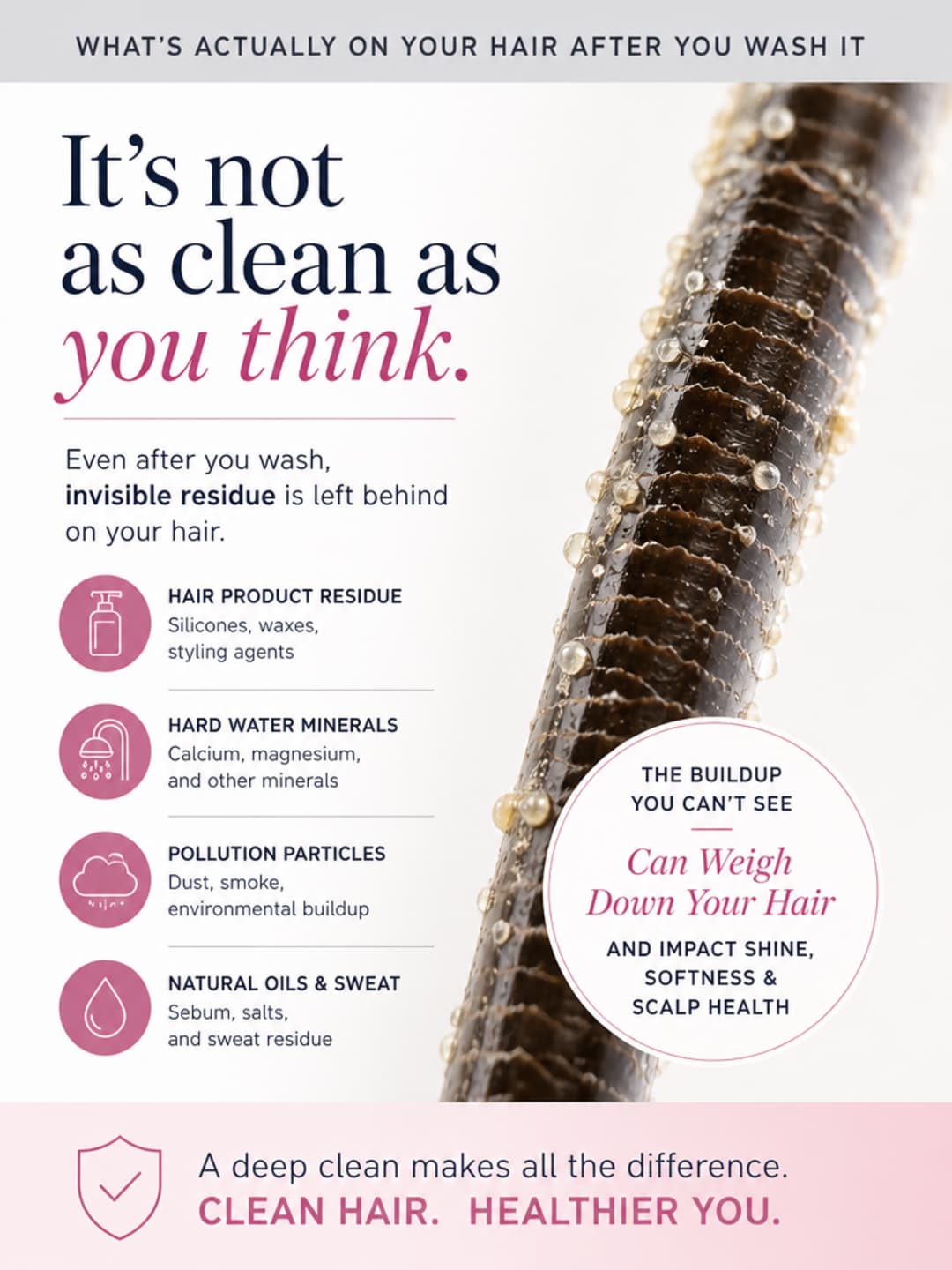
What most of those women do not yet know is that the drag has a specific cause. Municipal tap water in the vast majority of US cities is treated with chlorine — the EPA documented chlorination across roughly 64% of US community water systems, and that number does not account for the chloramine systems (a chlorine-ammonia compound used in cities like Phoenix, Las Vegas, and parts of Los Angeles) that are even harder to rinse off hair and skin. Chlorine reacts with the proteins in hair. Metals — iron, copper, lead traces — carried in tap water bind to the hair shaft and sit there. Neither washes out with shampoo. Shampoo is designed to clean dirt and oil from hair. It was not designed to pull a mineral bond off the cortex.
The texture you have been feeling is not your hair failing. It is residue from the water you are washing with, redeposited every morning.
And here is what makes that important: the same shampoo that has been "not working" on your water-coated hair would almost certainly work fine on filtered shower water. The product is not the problem. The medium is.
What Shampoo Was Never Designed to Fix

There is a reasonable assumption most people make about the shower: that washing is washing. That shampoo cleans hair, water rinses it, and the only variable is the quality of the product in the bottle. Cosmetic companies have spent decades reinforcing that assumption — because the product in the bottle is the one they sell.
What the model leaves out is the medium. Every ounce of shampoo, every drop of conditioner, every treatment you apply — you rinse it with tap water. And if that tap water is carrying chlorine, chloramines, iron, copper, or other dissolved metals, those compounds interact with hair the second the water hits it. The shampoo cannot stop that interaction. It happens during the rinse.
The mechanism is not complicated: chlorine oxidizes the cuticle of the hair shaft, roughening it. Metal ions — particularly iron and copper — bind to hair protein and sit there. The buildup accumulates with each shower. Hair that is repeatedly exposed to chlorinated, metal-carrying water develops a coating that makes it feel waxy, look dull, and resist the slip conditioner is supposed to provide. Hard water (the kind carrying elevated calcium and magnesium) adds a separate layer of mineral deposit that sits on top of the strand.
Aquava's filter sits between the shower arm and the water that hits your hair. The filter media inside the stainless-steel body reduces chlorine, heavy metals, and other water-borne contaminants before the water exits the head. You are still using the same shampoo. The water reaching your hair is different.
The distinction matters because it means the solution does not require changing your routine at all. Same shampoo. Same schedule. The variable that changes is the one that was never visible — the water itself.
The Math on What You Have Already Spent Trying to Solve This
At some point the cabinet becomes evidence.
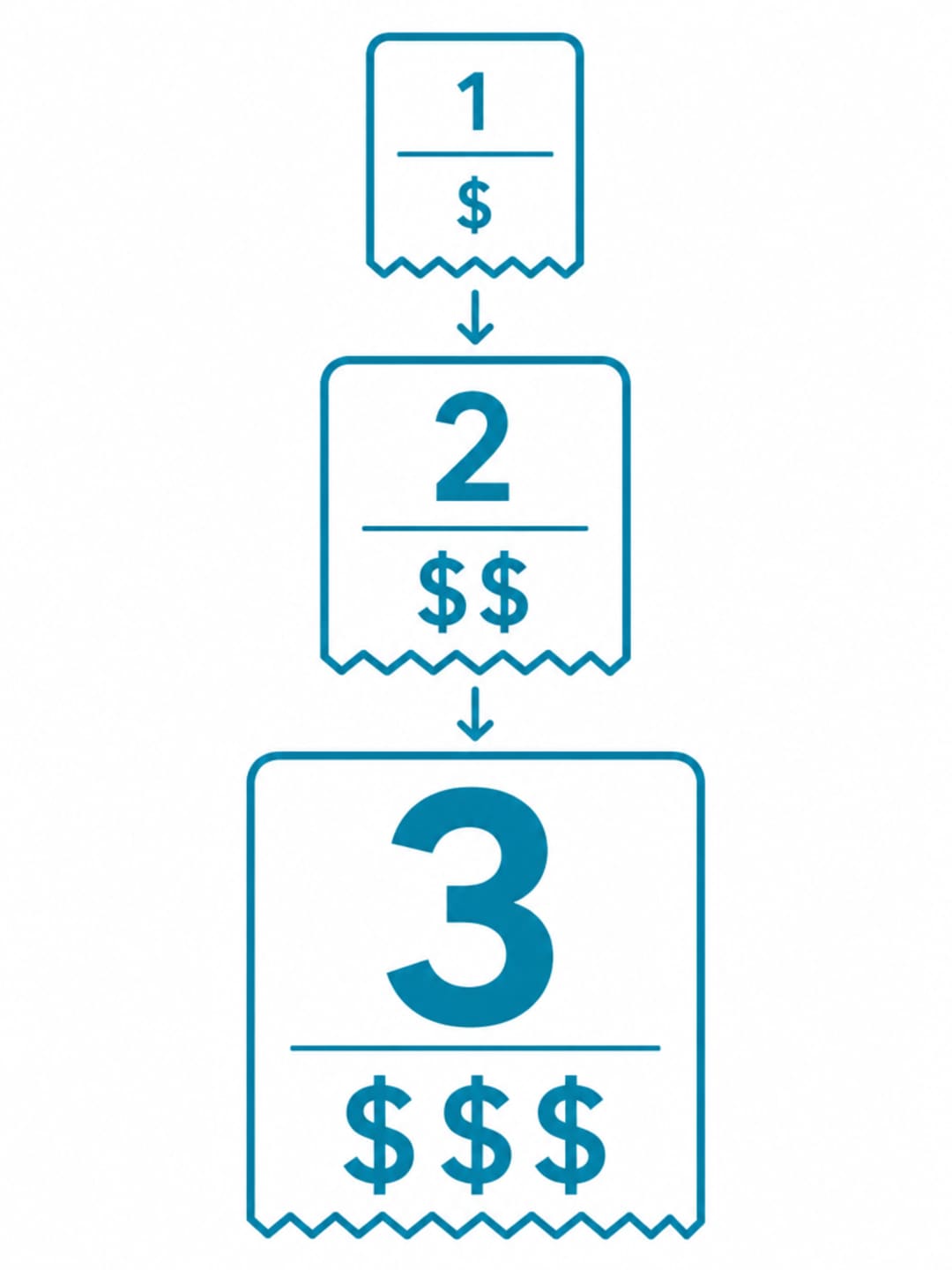
Half a bottle of clarifying shampoo — the one that helped for three days. A chelating treatment, salon brand, $34. A protein mask. A bond-repair system you found on a Reddit thread. Two different conditioners open at the same time because one of them was supposed to fix what the other left behind. A scalp oil someone on TikTok swore by. If you are honest about what the running total looks like, it is almost certainly over $200. For many women in the category, it is well over $400.
The American Academy of Dermatology notes it is normal to shed 50 to 100 hairs per day — a fact worth knowing because it puts the "more hair in the drain" panic into context. What is less normal is hair that feels actively coated after every single wash, regardless of what you put in it. That version of the problem is not one that additional product will solve if the water causing the buildup is still the water you rinse with.
There is a specific failure loop that emerges in this situation: you buy a new product because the old one stopped working. The new product produces a few days of improvement — possibly because the fresh surfactant formulation gives a temporary clean — and then the coating is back. So you conclude the new product is also not working, and you move on. The loop continues. The water does not change.
The Waterlyst review dataset captures it precisely in the "tried" column: even women who added a whole-home water softener to their house — a $7,500 installation — sometimes report their hair still "didn't really work" afterward, because softeners address calcium and magnesium hardness but do not remove chlorine. Different problems. Different fix.
The point is not to make you feel bad about the cabinet. The point is that the cabinet got built because nobody told you the thing you were buying products to fix was happening in the water, not in the hair.
Why the $15 Shower Filter You Already Tried Did Nothing
This objection deserves a direct answer, because a significant number of women who are reading this have already tried a cheap shower filter and returned it.
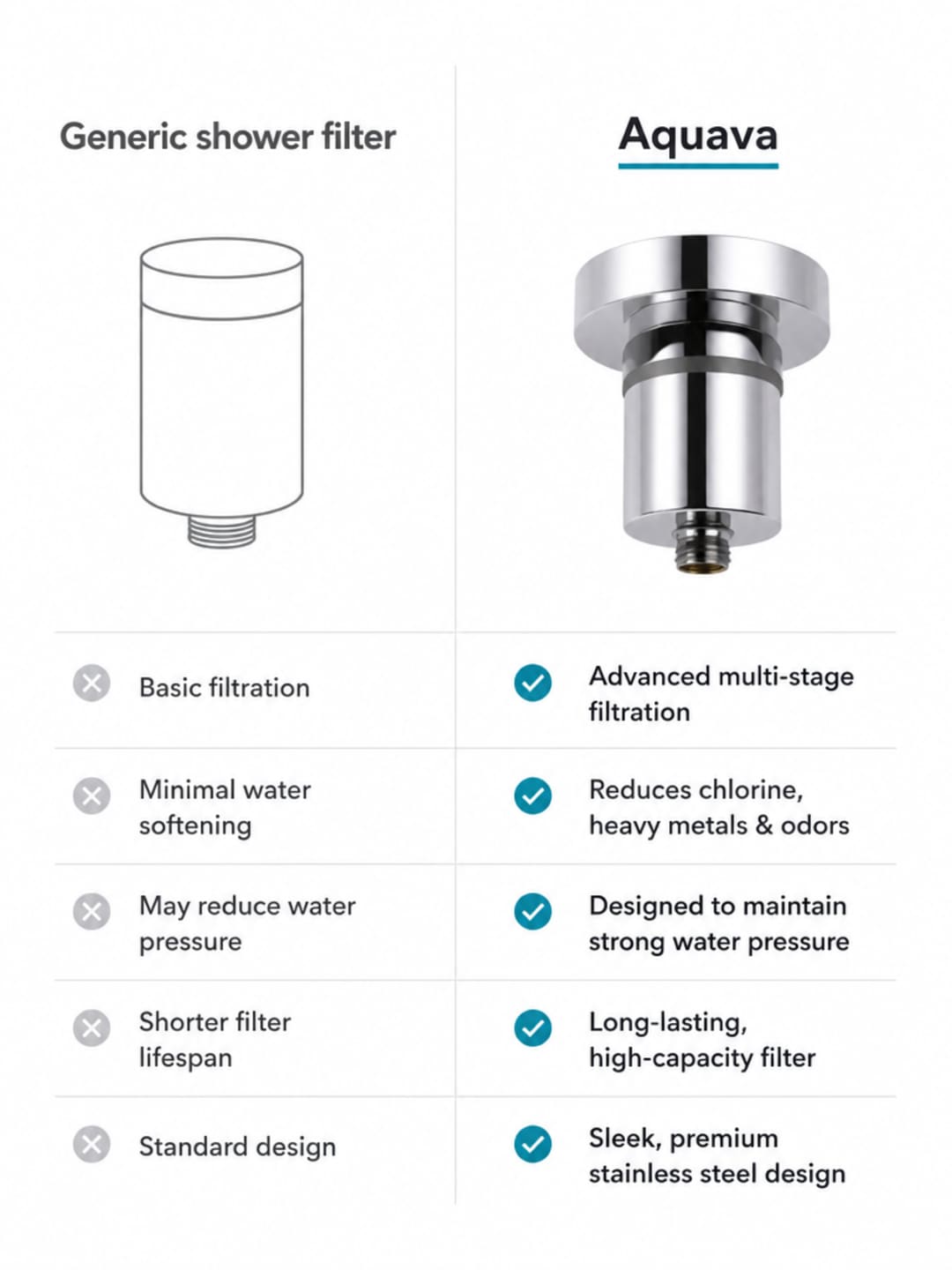
The "did nothing" report is real, and it is not entirely the customer's fault for trying. The category at the low end — the $8 to $20 units that appear in Amazon searches and Instagram ads — has a well-documented pattern in the review record. Pressure drops within two to four weeks as the media inside clogs. The filters are made of white plastic, use a small volume of loose media pellets, and the housing is thin enough that it deforms under normal water pressure. Several review platforms document units that broke within a month, leaked at the connection point, and in some cases produced no measurable change in water quality at all. One Newegg listing annotated by a reviewer summarizes it: "Most have a handful of useless pellets… to justify calling each pellet type a 'filtration stage'… Don't fall for this scam."
The marketing around cheap shower filters has also borrowed a specific trick from the supplement industry: stage inflation. When a brand claims "15-stage" or "20-stage" or "36-stage" filtration, they are in almost every case counting each type of pellet — or even each layer of the same material — as a separate stage. It is a number that sounds like engineering and means nothing.
Aquava is a different category of object. The body is stainless steel — not plastic, not coated plastic, not plastic with a metallic finish. The stainless body is a functional signal: it does not deform under pressure, it does not degrade against water and humidity the way ABS plastic does, and it does not look like something you would replace in six months. The filter cartridge is a separate replaceable component — the housing stays, the media gets swapped when it has done its job. That distinction is what separates a product built around repeat performance from one that ships once and fails quietly.
The women who report that filtered shower water changed their hair's texture are not experiencing a placebo. They are experiencing hair that is no longer being coated with chlorine and metal residue every morning, because those compounds are being captured by the filter media before the water exits the head. The mechanism is not exotic. It is the same basic logic as filtering drinking water — applied to the eight minutes your hair spends in the shower.
→ If you want to understand exactly what it removes — and what it honestly does not — the full details are on the Aquava page.
What Changes When the Water Changes

The first thing most women notice is not what they expected.
They expected the dramatic before-and-after they have seen in product videos — the limp hair miraculously thick, the dull hair suddenly shining. What actually happens in the first one to two weeks is subtler and, in its own way, more convincing: the finger test changes. The fingers slide. Not like a shampoo commercial. Like clean hair — the way their hair felt at the last hotel they stayed in, which they probably wrote off as better water pressure or a fancier shampoo at the time. (It was the water.)
The coated feeling, if it was primarily chlorine and metal-driven, tends to reduce once the accumulation is no longer being refreshed daily. Hair that is not being coated with residue every morning is not doing the things residue-coated hair does — it does not feel heavy at the roots, it does not separate into thick clumps when wet, it does not snag at the midpoint when dry. The texture problem was not a texture problem. It was a chemistry problem. Remove the chemistry, and the texture normalizes.
The sensory shift is, by design, something you notice privately before you can see it. The moment most women describe is the one two weeks in: standing at the same mirror, reaching for the same section of hair out of pure habit — and the fingers don't stop. They just keep going. It is quiet. It is not a commercial. But it is the clearest possible signal that what you were trying to fix was always in the water.
What Customers Are Saying
"I was skeptical after trying two other filters that did nothing. The stainless build felt different from the moment I unboxed it. Two weeks in, the waxy feeling after washing is noticeably gone — I keep doing the finger test just to confirm."
Rachel T. — Phoenix, AZ
"Easy to install, probably took five minutes. My hair still feels a bit different depending on the day, but it's definitely less coated right after washing than it used to be. Happy with it for the price."
D.M. — Long Island, NY
"I appreciated that the brand is upfront about what it does and doesn't do — it's a filter, not a softener. That honesty made me trust it more. Hair feels less dull and the shampoo seems to work better now."
Priya K. — Bay Area, CA
You Have Been Running the Same Experiment Every Morning for Months
Every morning: same shower, same shampoo, same fingers hitting the same drag point in the same hair. The product changes. The water never does.
That is what the cabinet full of almost-empty bottles actually documents — not that you made bad choices, but that you were solving for the wrong variable. Shampoo cannot fix what water deposits. Conditioner cannot strip what chlorine bonds to the shaft. The medium you are washing with is the one thing none of those products touch.
- Hair that no longer has chlorine residue and metal ions deposited on it every morning
- The finger test that stops catching halfway
- The coated/gummy feeling that the $34 chelating treatment temporarily masked — gone at the source
- A stainless-steel fixture that installs on any standard shower arm in minutes, no plumber, no landlord, no commitment to a single address
- A replaceable cartridge that tells you when it has done its job — because a filter that fills up is a filter that worked
If you have already tried the $15 filter that did nothing — the pressure-drop, plastic-shell, pellet-count one — this is not that. The body is stainless. The cartridge swaps. The mechanism is the same one that works for drinking water, applied to the eight minutes your hair spends in the shower.
You do not need a new shampoo. You need different water.