You Didn't Lose That Hair. Your Shower Took It.
If your drain has been collecting more than it should — and you've blamed everything except the water — this is for you.
There's a particular kind of dread that happens in the shower. Not a big dramatic moment. Just you, standing there, watching the water run toward the drain — and seeing what goes with it.
You pull your fingers through your hair and look at what came away. You tell yourself it's normal. You googled "how much hair loss is normal" at 11pm on a Tuesday and the number — 50 to 100 strands a day, which sounds insane but apparently isn't — gave you approximately two days of relief before you noticed the drain again.
So you changed your shampoo. You added a scalp serum. You went to the dermatologist, who looked at your head for four minutes and said the word "stress" like it explained everything. Maybe you did a blood panel. Maybe you started biotin. Maybe you stopped biotin because someone in a forum said it made things worse. You have, by this point, spent real money and a significant portion of your mental bandwidth trying to answer a question that has not been answered.
Here is the thing nobody told you to check: the water coming out of your shower.
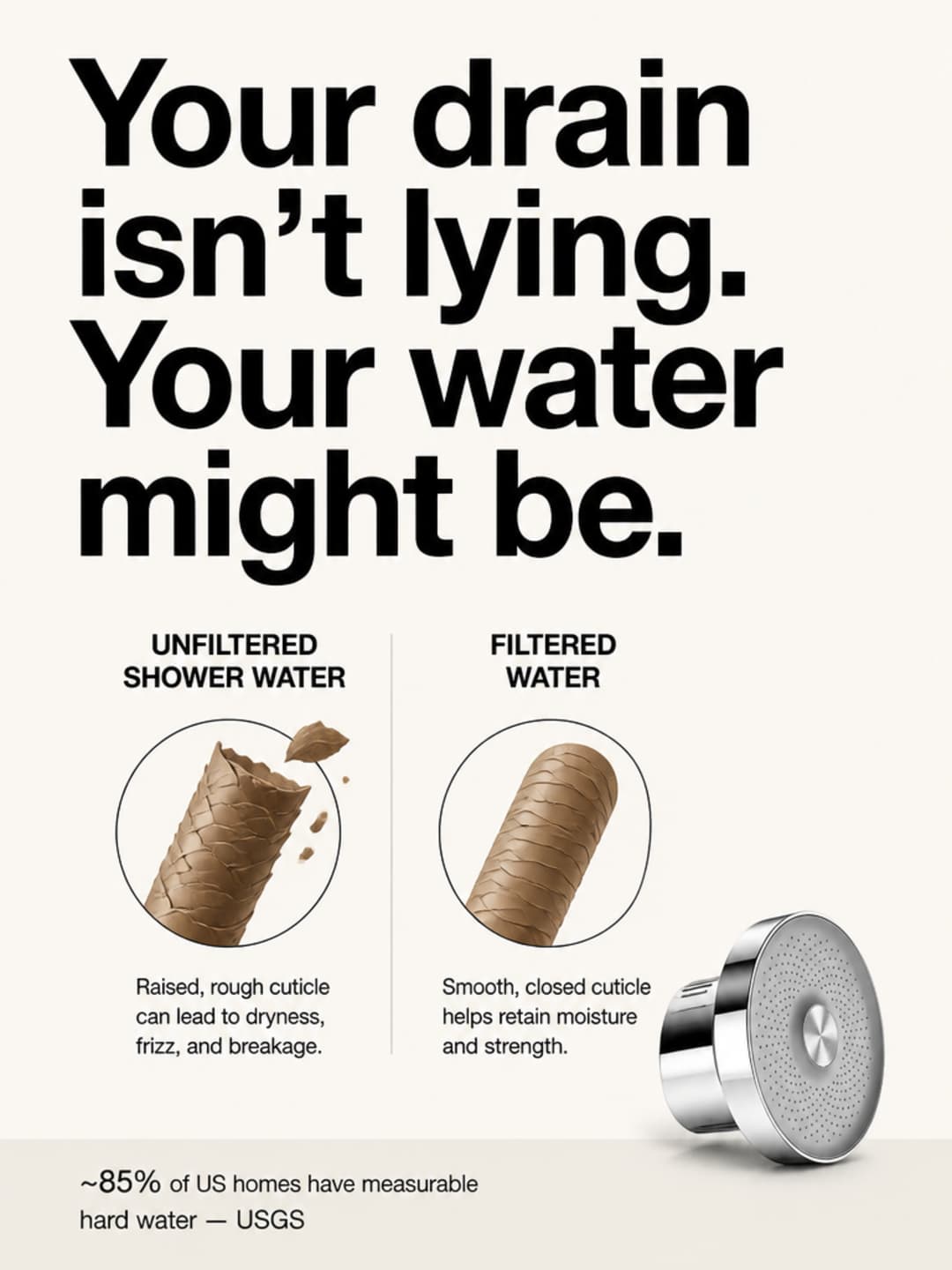
Not what's in your pipes in some abstract sense. The actual water — the stuff landing on your scalp every morning, soaking your hair shaft for eight minutes while you wash, condition, and rinse. Most shower water in the United States is chlorinated tap water. Chlorine is added to kill biological contaminants in the municipal system, and it does that job well. What it does less well is stay harmless once it's saturating your hair. Chlorine strips the proteins and natural oils that keep the hair cuticle lying flat. A raised, roughened cuticle snags. It breaks. It sheds more visibly when you brush. And it comes off in the drain.
That's the variable you haven't changed yet.
R1 — The Hairbrush She Hides in the Cabinet
Maya keeps her hairbrush in the back of the cabinet under the sink now. Not because she's organized. Because she doesn't want to see it every time she reaches for her moisturizer.
This is what nobody talks about: the secondary anxiety of the evidence. The drain you rinse clean before your partner showers. The screenshot of your hairline you take in the bathroom mirror and then immediately close, as if the phone itself shouldn't know. The way you describe it to your doctor as "some shedding" because calling it what you actually think it is feels too scary to say out loud.
The American Academy of Dermatology documents that it is normal to shed between 50 and 100 hairs per day. That number is genuinely hard to square with the visual reality of a drain full of hair — because 50 to 100 strands, collected in a single wet clump, looks catastrophic when it's yours. But here's the distinction the number doesn't capture: shedding from the root is one thing, and breakage along the shaft is another. They look identical in the drain. They have very different causes. And only one of them has anything to do with the water.
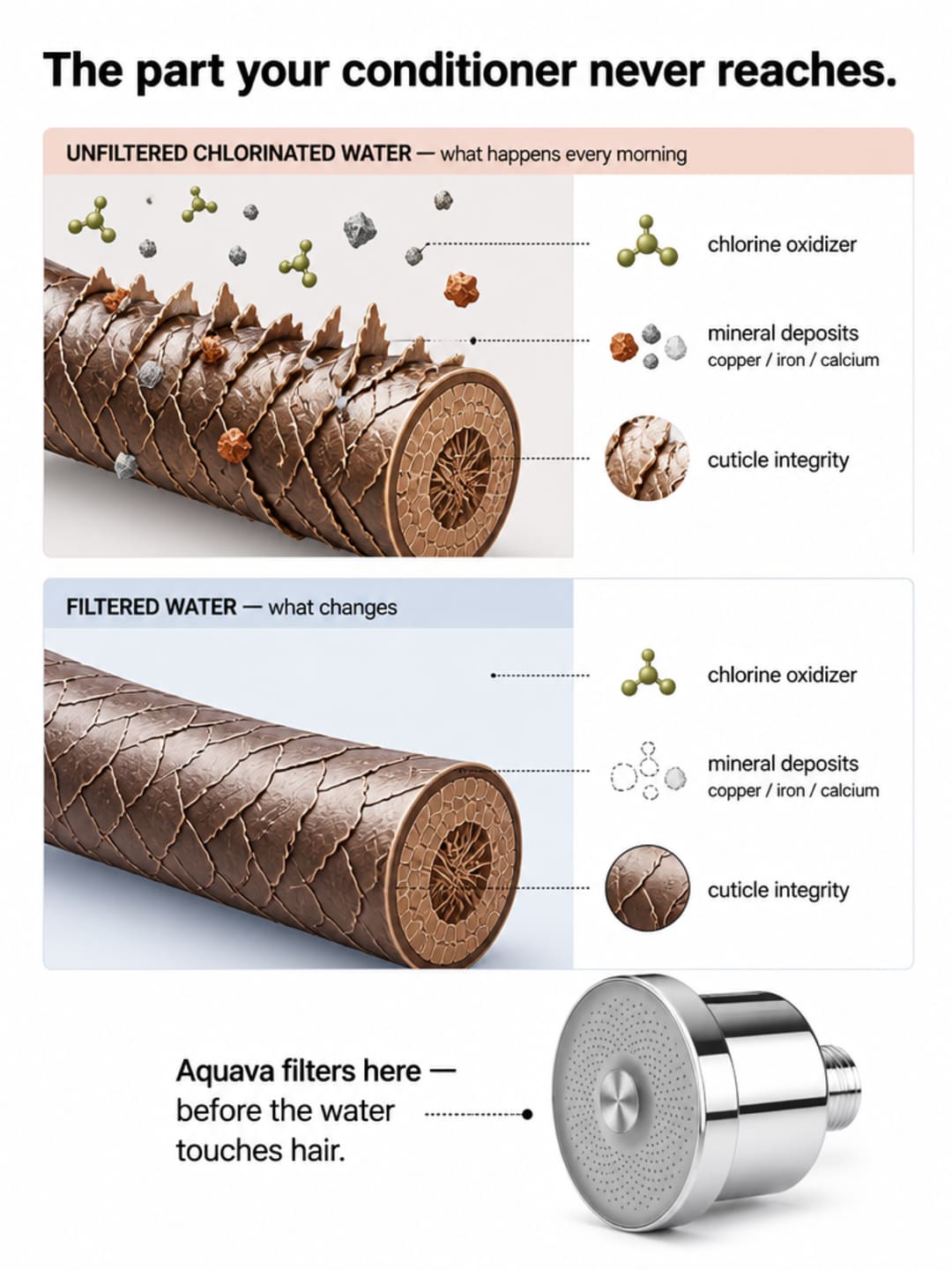
When chlorinated water — and particularly water carrying dissolved heavy metals like copper and iron, which leach into the supply through old pipes — contacts the hair repeatedly, it doesn't cause the follicle to release. It attacks the shaft. The cuticle, the outer protective layer of the hair strand, is made of overlapping scales. Chlorine oxidizes the proteins holding those scales down. The cuticle lifts. The strand becomes mechanically weaker at every point of friction: the brush, the pillow, the fingers running through it after a shower. The breakage is real. The hair that comes away is real. The cause is not stress, not hormones, not the new climate, not thirty-something-ness asserting itself. It's repeated chemical exposure at the one moment every day when your hair is most vulnerable — wet, stretched, and soaked.
Maya moved to the Bay Area eight months ago. She hasn't changed her diet, her sleep, her stress level in any dramatic way. What she changed was the water her hair soaks in every morning.
"Since I have moved to the Bay Area I have seen a lot of hair fall. Don't know if it's the water here." That's a direct quote from a woman on a professional tech forum — not a beauty community, not a brand's testimonials page — trying to make sense of exactly this pattern. She was right to look at the water.

R2 — What Chlorine Actually Does to a Hair Strand (It's Not What Shampoo Fixes)
Diane has been in the same Phoenix house for eleven years. Phoenix water is harder than almost anywhere in the continental US — high mineral content, high chlorine dose — and Diane's colorist started mentioning "breakage" at appointments maybe three years ago. Diane heard "breakage" and bought a protein treatment. That's a reasonable response. It was also the wrong variable.
Here is what the mechanism actually is, in plain terms.
Chlorine is an oxidizer. It does its job in the municipal supply — it kills bacteria and biological material so the water reaching your tap is safe to drink. But it does not stop being an oxidizer when it hits your shower. It continues reacting with whatever organic material it contacts, and your hair is organic material. The outer layer of a healthy hair strand — the cuticle — is made of protein structures called keratins. Chlorine degrades keratin bonds. Repeatedly. Every morning. For years.
A degraded cuticle doesn't just feel rough. It behaves differently in every interaction: it absorbs water unevenly, so it swells in irregular patterns and dries in irregular patterns. It picks up dissolved minerals — particularly the calcium, copper, and iron compounds present in hard water — and those minerals deposit along the shaft. This is the "coated" or "waxy" texture that no conditioner resolves, because the conditioner sits on top of the mineral crust, does its job during the shower, and then rinses away — leaving the crust exactly where it was. The next morning, same water, same deposition, same coating. The conditioner was never touching the problem.
What Aquava does is intercept that process at the point of contact. The filter media inside the stainless-steel body removes chlorine and dissolved heavy metals from the water before it exits the head and reaches the hair. Not after. Not in the conditioner. Before the water touches the strand. The cuticle is no longer receiving the same daily chlorine oxidation load. The mineral deposition from metals decreases. The shaft that was breaking mechanically along its weakened points has a different starting condition every morning.
It doesn't undo years of accumulated damage overnight — nothing honest does. But it changes what is happening to the hair in the shower, which is the only variable that was never addressed by any product in the cabinet.
R3 — The Real Cost of the Loop She's Been In
Here is a rough accounting of what the "I'll try this next" cycle costs, and this is not a hypothetical — it is the pattern documented in the same communities where women are describing their drains.
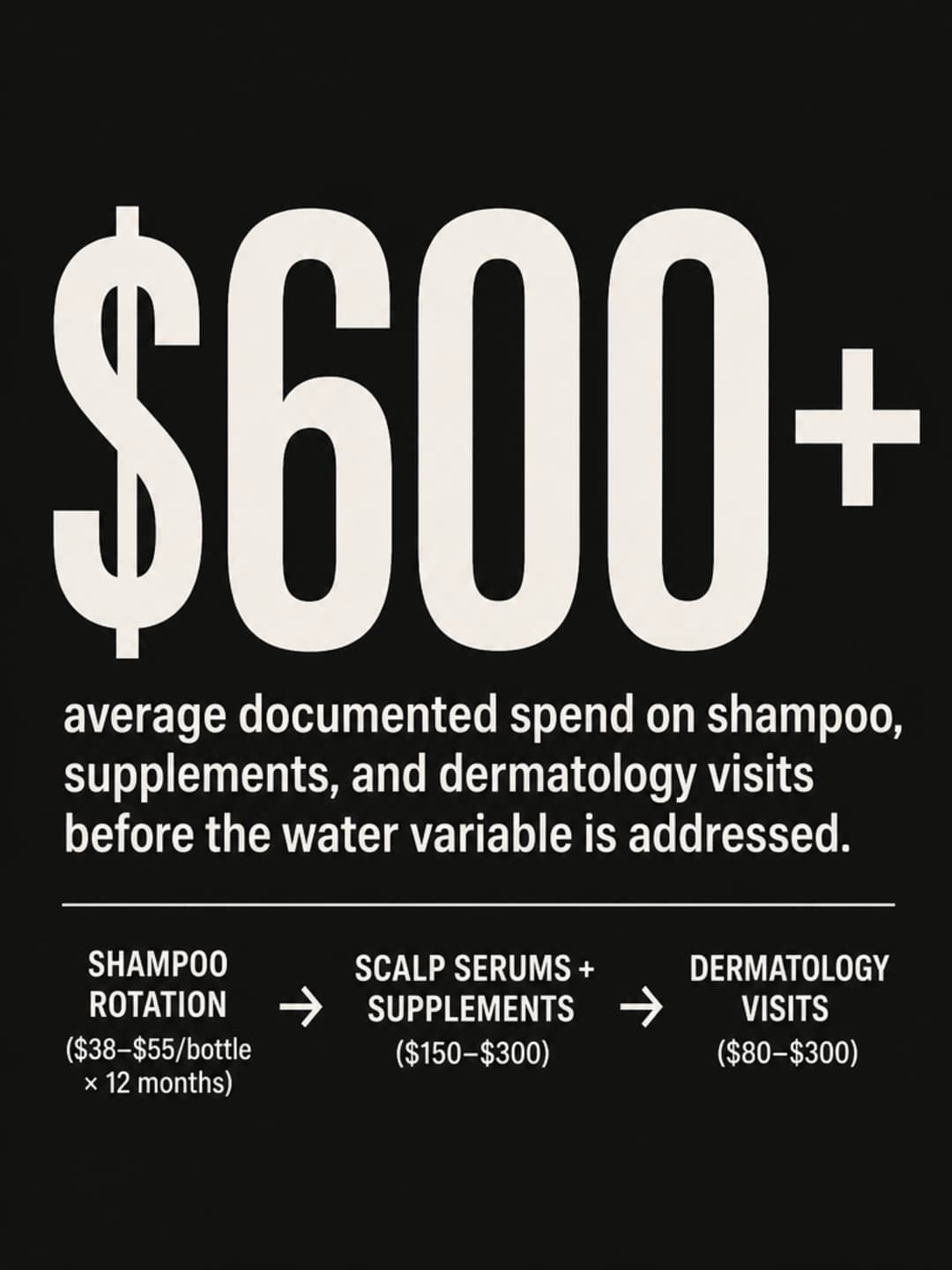
Dermatologist visit, out of pocket or copay: anywhere from $80 to $300, depending on insurance. Outcome in the majority of cases documented in the customer research for this category: the word "stress." Blood panel: another $100 to $200 if not covered. Outcome: iron levels fine, thyroid fine, hormones "within range for your age," which is a sentence that closes no loops. Premium shampoo and conditioner rotation — the switch from the $9 bottle to the $38 bottle and then the $55 salon brand, each one tried for six weeks before being judged: accumulated spend over twelve months can clear $400 without feeling like an extravagance, because each bottle was only $38. Scalp serums, biotin supplements, hair masks, bond-repair treatments: add another $200 to $500 depending on how deep into the rabbit hole the search went. And at the end of this: "My proven methods did nothing to help." That is a verbatim quote from a real buyer reviewing a product in this category. Not performed frustration. A person reporting an outcome.
The aggregate spend on solutions that work upstream of the actual variable — that address the hair rather than the water the hair is soaked in every day — can easily reach four figures over two to three years. This is not a character flaw. It is the entirely logical behavior of a person who never received the correct framing for the problem. The shampoo companies have an interest in her believing the issue is her shampoo. The supplement companies have an interest in her believing it's a deficiency. The dermatologist's differential is broad and does not routinely include "check the shower water."
The single forum post that probably started your most recent research spiral — the one that said "looked for a water softener and it's like $7,500, don't wanna spend that much right now" — that person understood intuitively that the water was the variable. They just thought the fix cost $7,500. It doesn't.
But there's something else in the loop that costs more than money. Every failed attempt adds weight to a specific, quiet conclusion: that this is just aging. That this is just her body. That there isn't a fix. That conclusion is the most expensive outcome of all, because it's the one that stops the search before it reaches the right answer.
R4 — Every Option on the Table, Honestly
There are four real options for a woman in this situation. Laid out without marketing language, they look like this.
A whole-home water softener. This removes calcium and magnesium hardness — the minerals that make water "hard" — through an ion-exchange process. It requires professional installation, a dedicated space for a tank, permission from a landlord if you rent, and a starting cost of several thousand dollars. It does not remove chlorine. A softener and a chlorine problem are different problems requiring different solutions. This is documented clearly in the same plumbing forums where women research their options.
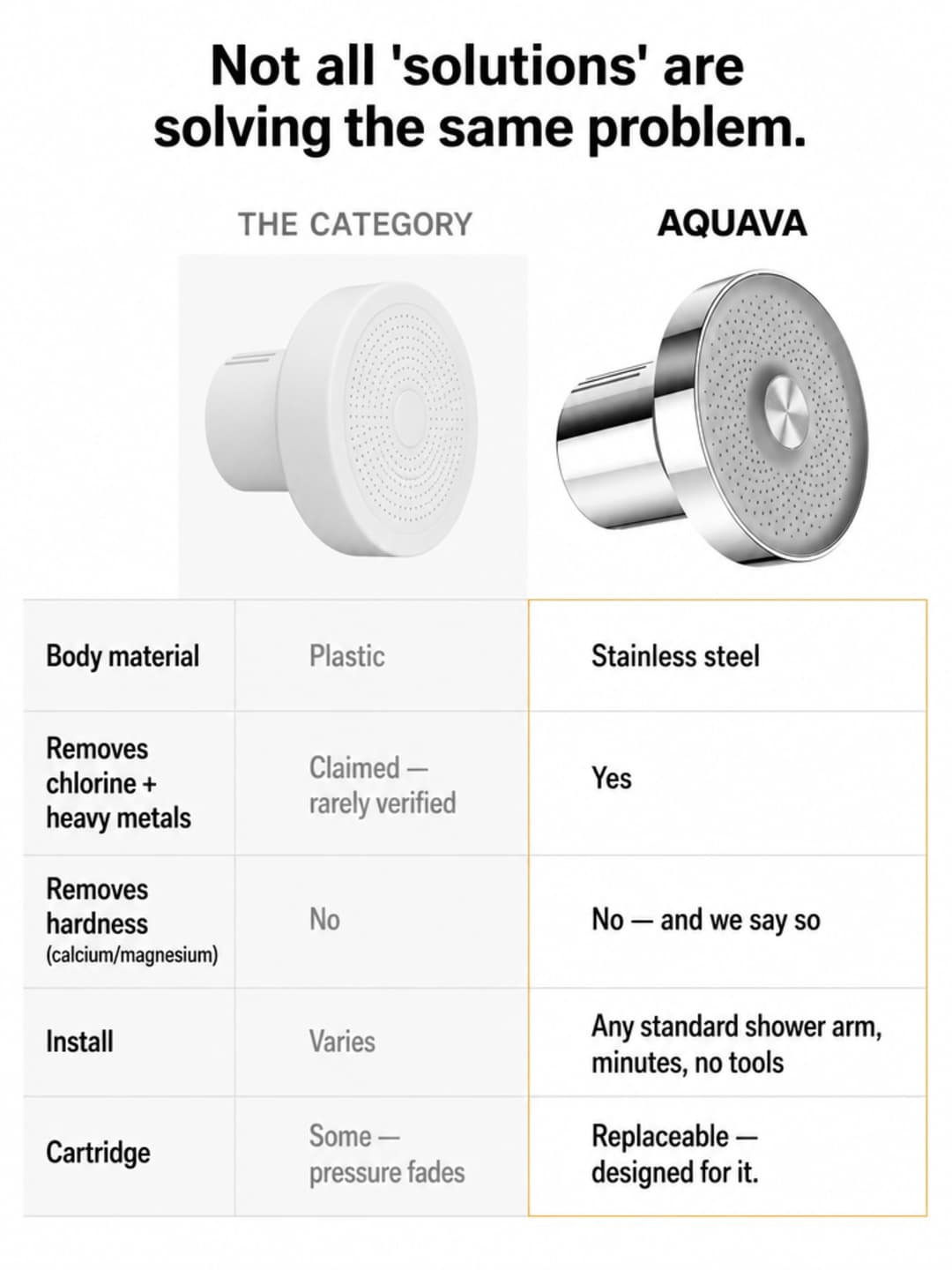
A generic shower filter from a large online retailer. These exist at $15 to $35 and make claims that are difficult to verify — "15-stage," "36-stage" filtration, which is a count of filter media types, not a meaningful performance metric. The documented failure pattern: reduced water pressure within two to three weeks as the media clogs, no perceptible change in hair or skin feel for many users, plastic housing that degrades, and in some cases subscription traps buried in the checkout. The reviews that say "did nothing" and "broke after a month" and "I bought an expensive one off Instagram and it did nothing" are describing this tier.
A premium DTC shower filter at $115 to $169. These exist, several of them, and some of them work. The pricing reflects brand margin and marketing spend more than a proportionally better mechanism or build. The housing is generally still plastic. Lab test data is rarely published by brands in this tier, and the certification situation across the category is opaque.
Aquava at $79.99. The difference the copy in this category almost never leads with: the body is stainless steel, not plastic. In a category where every other unit is a colored plastic shell housing a filter cartridge, the material distinction is real and functional — stainless steel doesn't degrade, doesn't leach, and doesn't look like a $15 unit after three months on your shower arm. It installs on any standard shower arm in minutes, no plumber, no landlord permission needed. The cartridge is replaceable, which matters: a filter does its job precisely because it fills up, and a replaceable cartridge is a feature, not a hidden cost. It ships from a US warehouse in two to three business days — not a three-week wait from an overseas fulfillment center.
What Aquava does not do is worth stating plainly, because the category rarely states anything plainly: it is a filter, not a softener. It removes chlorine, heavy metals, and other water-borne contaminants. It does not remove calcium and magnesium hardness. If the primary problem is calcium scaling on shower doors and fixtures, a whole-home softener addresses that; Aquava addresses the chlorine and metal load hitting the hair. For most women whose hair started changing after a move to a chlorinated, metal-bearing city — that is the relevant variable.
R5 — The Morning She Stopped Holding Her Breath
Maya is not thinking about her drain right now.
That is not a small thing. The low-grade background vigilance — checking, photographing, calculating, worrying quietly while conditioning — takes up a specific kind of mental bandwidth that is hard to quantify and very easy to notice when it's gone.
What the transformation looks like in the category's own language, stripped of brand voice: "I don't feel that itchiness at all now." Not a dramatic before-and-after. A specific absence. The thing that was there every morning — the itch, the snag, the dread at the drain — is no longer there. That is what the experience is reported to feel like: a morning that proceeds without the moment she was bracing for.
Hair that has stopped being soaked daily in chlorinated, metal-bearing water doesn't transform in a weekend. The strands that broke are gone. But the strands growing from an undamaged follicle that are no longer being assaulted at the cuticle every morning — those start behaving differently within weeks. The texture changes first: less rough when dry, less coated when wet, fingers that move through the length instead of stopping halfway. Then the volume follows, because hair that isn't breaking mid-shaft along its weakest points is accumulating length instead of shedding it into the drain.
This is not a cure. It is a removal of a cause. Those are different things, and the distinction matters: a cure implies something was wrong with the hair. What Aquava changes is what the hair is exposed to. The hair, given a different environment, does what hair does when it isn't being chemically compromised — it grows.
The drain still catches some hair. Fifty to one hundred strands a day, which is normal, which is what Maya read at 11pm that Tuesday. The difference is that she doesn't pause anymore. She doesn't do the mental math. The thing in the drain is no longer evidence of something she can't explain.
That's the shower she's been trying to get back to.

What Customers Are Saying
"I'd been blaming my shampoo for two years. Switched to Aquava and my hair just feels different after a few weeks — less rough when it dries, easier to run my fingers through. I wish someone had told me to look at the water sooner."
S.M. — Phoenix, AZ
"Moved to the Bay Area last spring and my hair went downhill fast. This was the first thing that actually made a difference. The stainless steel body also looks and feels much more solid than the cheap filters I tried before."
Rachel T. — San Francisco, CA
"I appreciated that they're upfront about what it does and doesn't do. It's a filter, not a softener — they say so clearly, and it does exactly what it says. Easy install, well made, and my skin feels less tight after every shower."
D.L. — Washington, DC
The Drain Is Not the Problem. It Was Always the Water.
You have tried the expensive shampoo. You have tried the serums and the supplements and the dermatologist and possibly the silk pillowcase and the microfiber towel. You have lived with the vigilance — the checking, the photographing, the explaining-away. And the drain has not changed.
Every morning you step into the same shower. The same chlorinated, metal-bearing water soaks your hair for the same eight minutes. The best conditioner in your cabinet does its job — on the coating, on the surface — and washes away. The water stays. The exposure stays. The result stays.
What you have not yet changed is the water.
Not the whole house. Not a $7,500 softener you'd need a plumber for and a landlord's permission to install. The water in the thirty-six square inches of shower arm above your head — the one place where every strand of your hair is soaked, opened, and exposed, every morning, before any product you own has a chance to do anything.
- The drain photo you've been taking stops being evidence of something unfixable — and starts being evidence of something you changed.
- Hair that breaks mid-shaft from a compromised cuticle stops breaking the same way when the cuticle isn't receiving a daily chlorine load.
- The texture test — fingers through the length, catching halfway — has a different result when the water isn't depositing a mineral coating the conditioner can't reach.
- The "stress" diagnosis stops being the only explanation on offer. The shower was always a variable. Now it's one you've addressed.
- Installs on any standard shower arm in minutes. Comes with you when you move. No plumber. No landlord. No $7,500.
Tomorrow morning you will take the same shower you took this morning. The water will be the same temperature. The routine will be the same. The only thing that will be different is what the water carries — or doesn't — by the time it reaches your hair.
The mechanism, the specs, the exact details of what the filter removes and what it honestly doesn't — they're on the next page. Go see for yourself.