That $10 Bag of Specialty Flour Isn’t $10. Keep Buying It Weekly and You’re Looking at $2,600.
Home bakers who already pay premium prices for organic whole wheat, rye, spelt, and einkorn keep funding the mill, the bag, the brand, and the shelf. GRAIN BLOOM is $79.99. The only question left is whether the grain itself was ever the expensive part.
You already bake. You already know which flours you like. You’re not hunting for a new hobby.
You’re standing in the baking aisle — or clicking “Add to Cart” on another 2-pound bag of organic whole wheat, rye, spelt, or einkorn — and feeling that familiar sting. Not because bread is a luxury. Because the same ingredients you use every week keep showing up at specialty prices.
You didn’t switch to cheaper white flour. You didn’t quit sourdough. You just keep paying retail for grain that was already ground, bagged, branded, and marked up before it ever reached you.
Most bakers never run the numbers. They treat each bag like a one-off. It isn’t. It’s a subscription you never signed up for.
If you’re already spending real money on specialty flour, the next decision isn’t “Do I want a mill?” It’s “How much of this price is the grain — and how much am I paying someone else to grind it?”
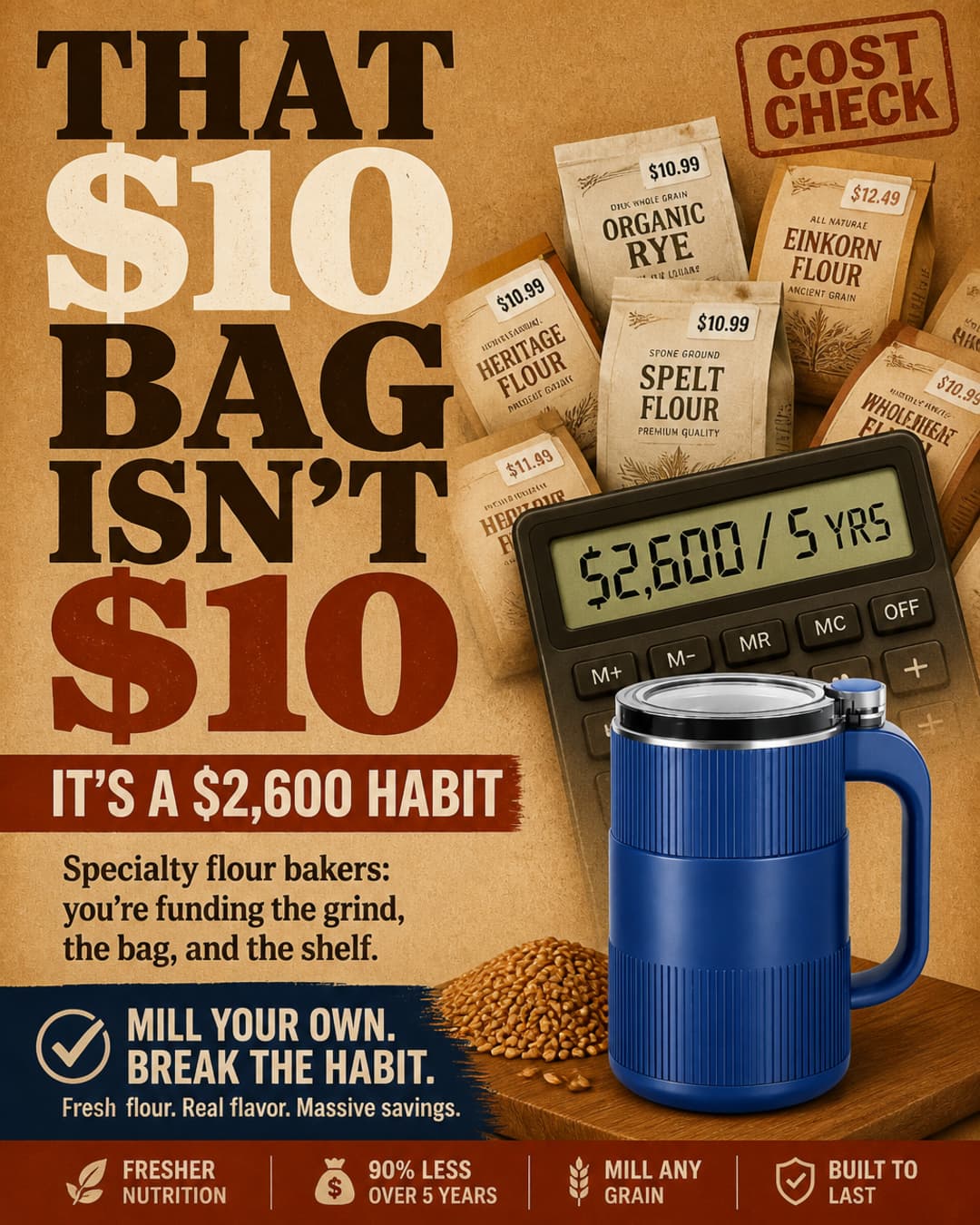
How much money are you throwing away every time you buy another bag?
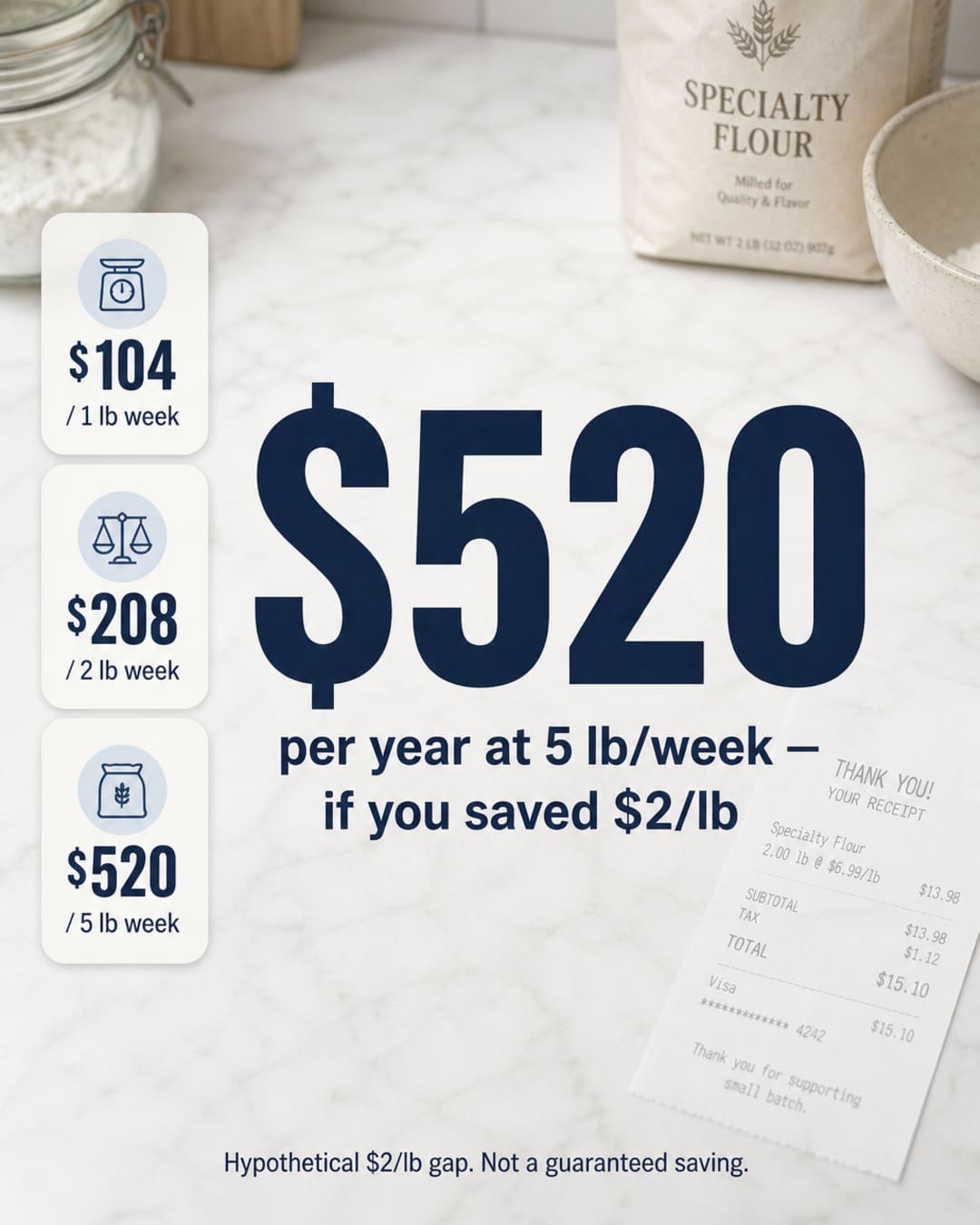
A few extra dollars per pound doesn’t feel like a crisis at checkout. It feels like “that’s just what good flour costs.”
Run it annually and it stops looking like a rounding error.
If buying whole grain and milling it at home saved you even $2 per pound — a hypothetical, not a promise — that’s:
- $104 a year if you go through one pound a week
- $208 a year at two pounds a week
- $520 a year at five pounds a week
That’s before you count the mill, electricity, or any milling loss. It’s also before you count the years you keep repeating the same purchase.
GRAIN BLOOM is $79.99. One unit. Free shipping. 90-day guarantee.
You don’t need a spreadsheet to see the tension: if you bake with specialty flour regularly, you may already be spending more in a single year of bags than it costs to find out whether the grain itself is cheaper.
Most bakers never compare delivered whole-grain prices with the flour they already buy. They just keep hitting “buy now.” That’s how a “$10 bag” becomes a five-year habit.
You’re not paying for flour. You’re paying someone else to grind your grain.
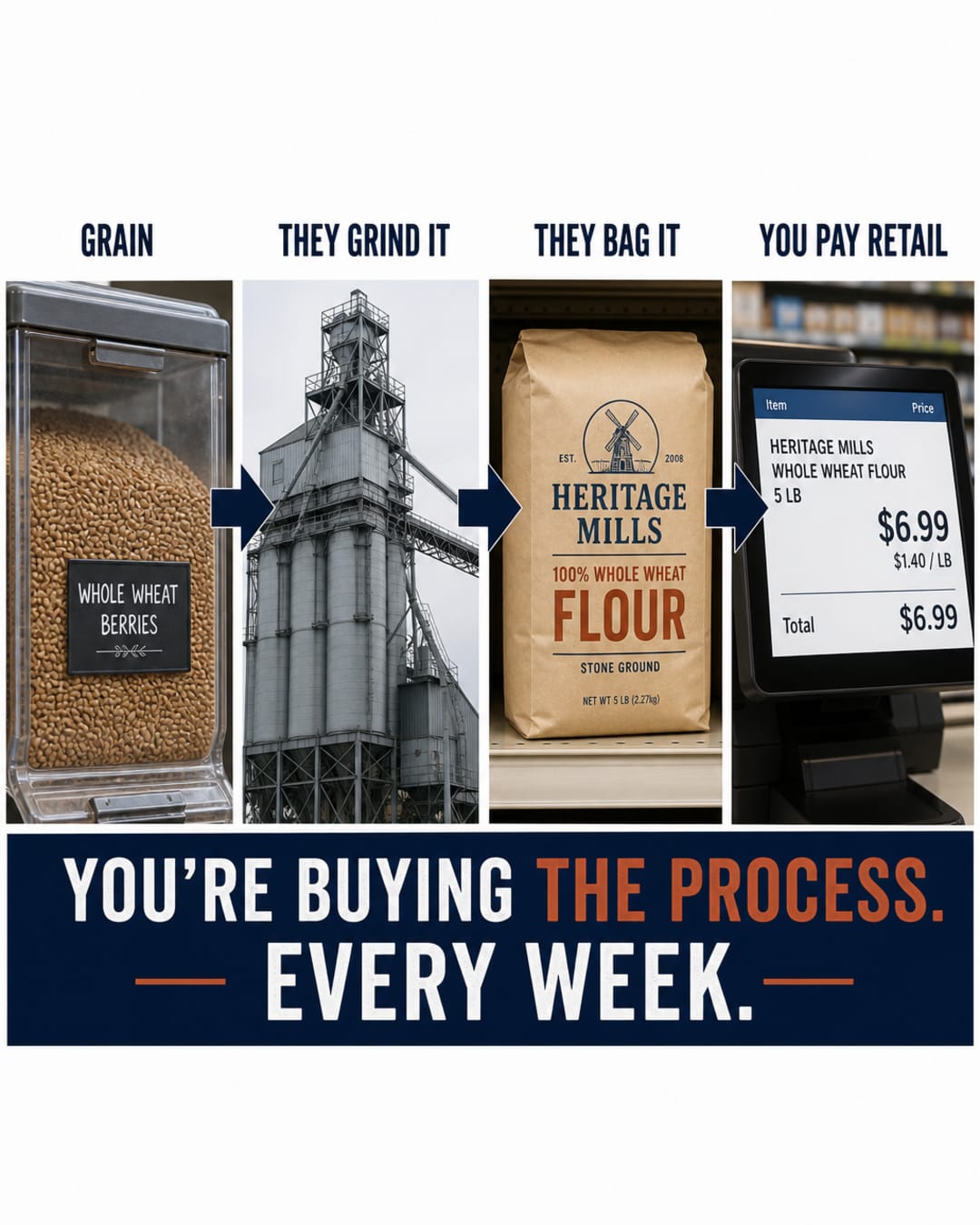
Look at what that bag actually is.
Someone grew the grain. Someone milled it. Someone packed it in a branded bag. Someone shipped it through a warehouse. Someone put it on a shelf and charged you the finished-goods price.
You already do the hard part — the dough, the ferment, the bake. The one step you keep outsourcing is the grind. And you pay retail for that step every single week.
That’s the markup you’re funding: milling + packaging + branding + distribution. Not a magical extra loaf. Not a better oven spring. Process.
With GRAIN BLOOM, you buy compatible whole grains and run the milling step in your own kitchen. When the grain price actually undercuts the bagged flour you already use, you’re no longer paying a premium for a job you could do at home.
This is not “all specialty flour is a scam.” Some of that price is real grain, real organic certification, real shipping. The question is narrower and more useful: how much of what you pay is the grain, and how much is the factory already having ground it for you?
Until you check equivalent whole-grain prices — including shipping — you’re guessing. And guessing is how bakers keep overpaying.
Stop paying small-bag prices for flour you use every single week.
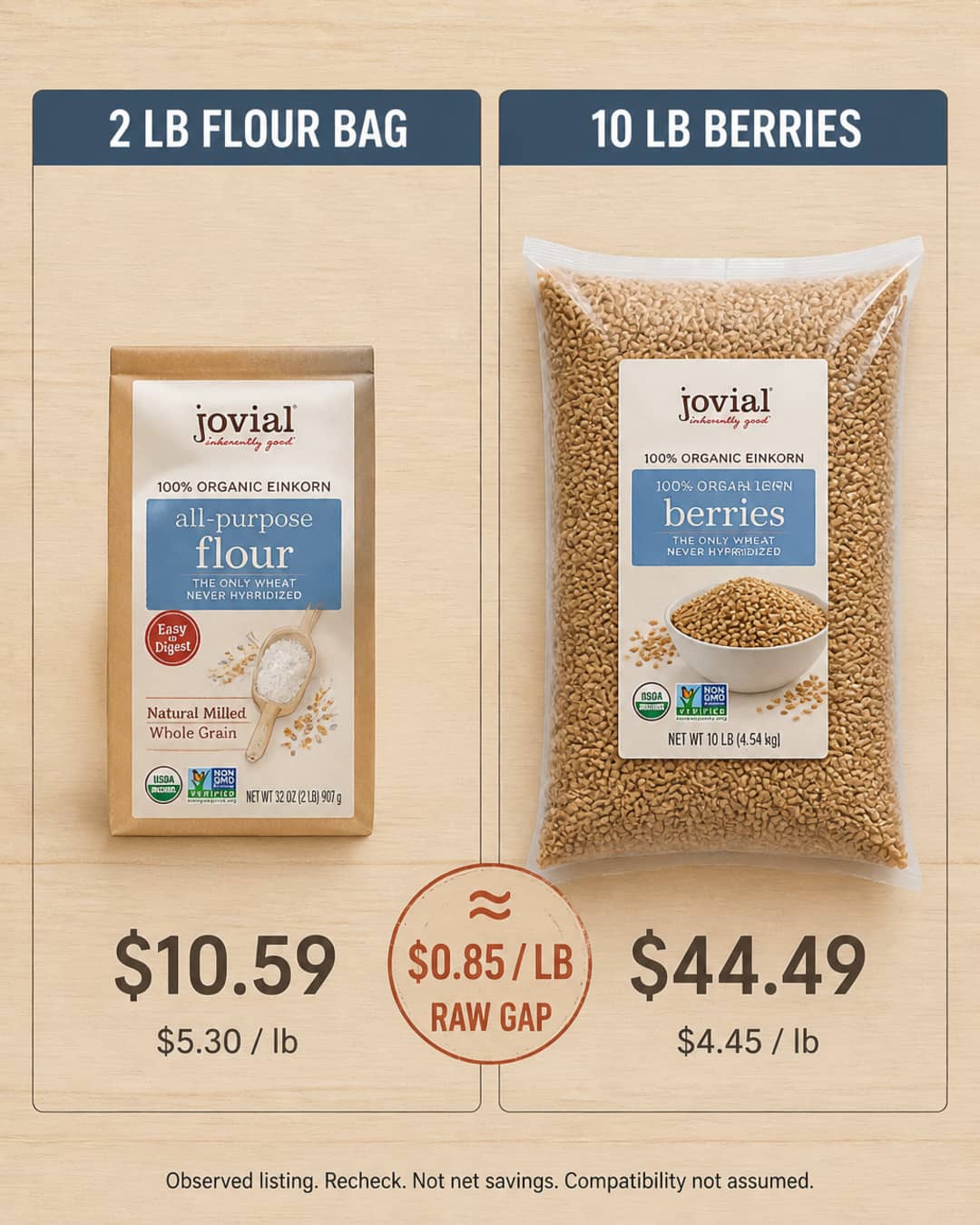
Specialty flour loves the 1–2 pound bag. You love baking every week. Those two facts do not get along.
Small packages are convenient. They’re also how you keep buying at the worst unit price.
One observed retail snapshot (it will move — recheck before you treat it as gospel): a 2 lb bag of whole-grain einkorn flour at $10.59 — about $5.30 per pound. A 10 lb bag of whole einkorn berries at $44.49 — about $4.45 per pound. That’s roughly $0.85 per pound less for the grain before shipping, milling cost, yield, and electricity.
That’s not “you will save $0.85.” That’s a raw-material gap on one listing, on one grain, on one day. GRAIN BLOOM’s compatibility with einkorn has to be verified before anyone should mill it as a selling point. The point of the example is the pattern: you keep paying small-bag flour prices for an ingredient you use like a staple.
If you bake with organic whole wheat, rye, spelt, or another premium grain on a schedule, you are not a “try it once” customer. You are a repeat buyer. Repeat buyers get punished by 2-pound bags.
The smarter comparison is cost-per-pound of the same grain, delivered, versus the flour you already put in the cart. If the berries win, milling at home is no longer a lifestyle flex. It’s arithmetic.
Why spend $400 to save money on flour? That’s $320 you have to earn back first.
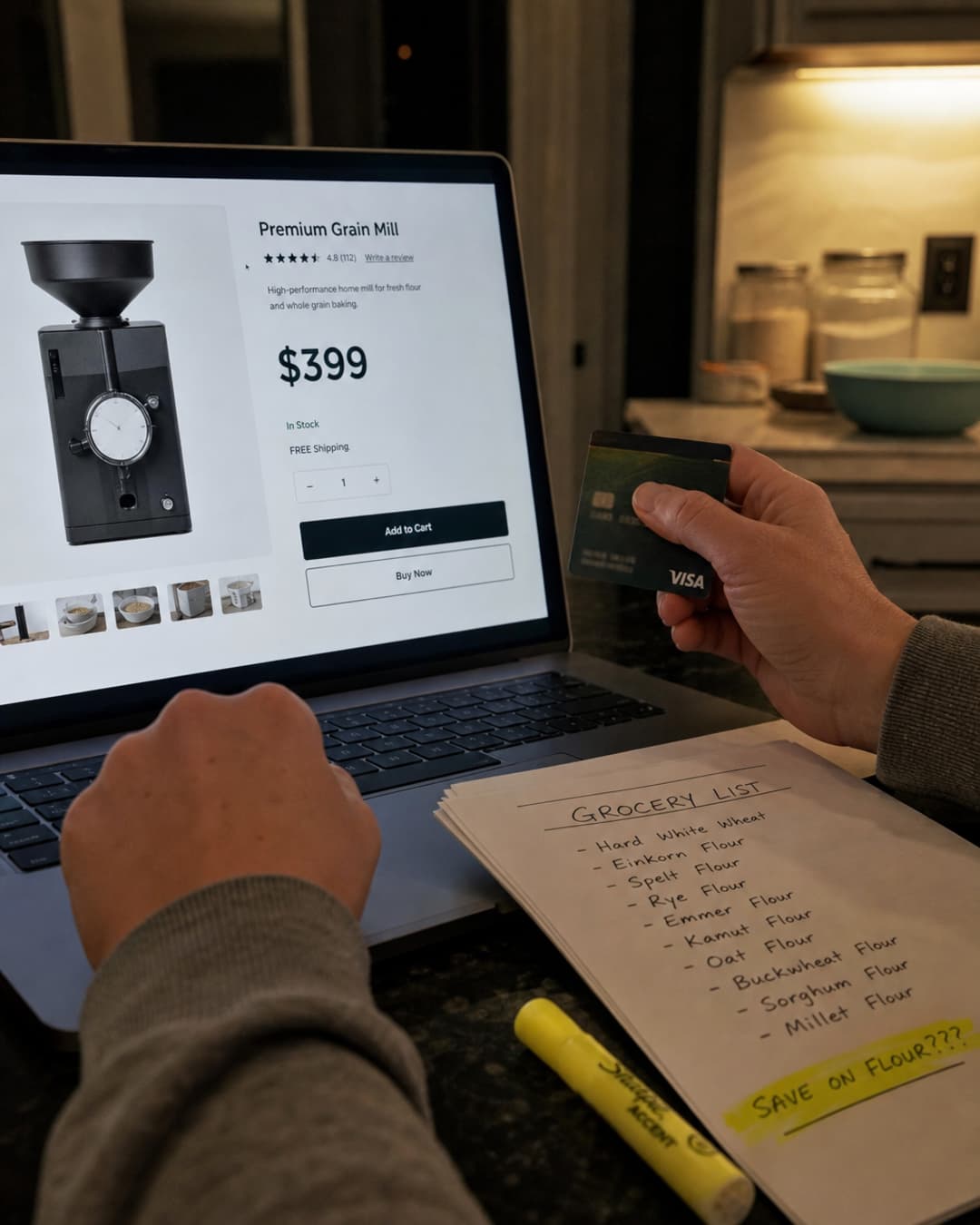
Here’s the trap premium mills set for cost-conscious bakers:
You want to stop overpaying for flour… so you start by spending $400.
GRAIN BLOOM is $79.99. That’s $320.01 less sitting on the counter before you’ve milled a single cup.
If your whole reason for buying a mill is to spend less on the flours you already use, a $400 machine makes you win a race you haven’t started. At a hypothetical $2-per-pound net ingredient advantage, that extra $320 is about 160 more pounds of flour you have to mill just to get back to even with the cheaper machine — assuming comparable running costs, which have not been proven.
This is a purchase-price argument, not a claim that GRAIN BLOOM matches a $400 stone mill in capacity, fineness, durability, or lifespan. Those haven’t been established. What has been established is the offer: $79.99, two units for $139.99, free shipping, 90-day guarantee.
If you’re trying to find out whether home milling can cut your flour bill, you don’t need to finance a piece of bakery equipment first. You need a low enough entry price that the experiment can actually pay.
That $10 bag doesn’t cost you $10. It can cost you $2,600 over five years.
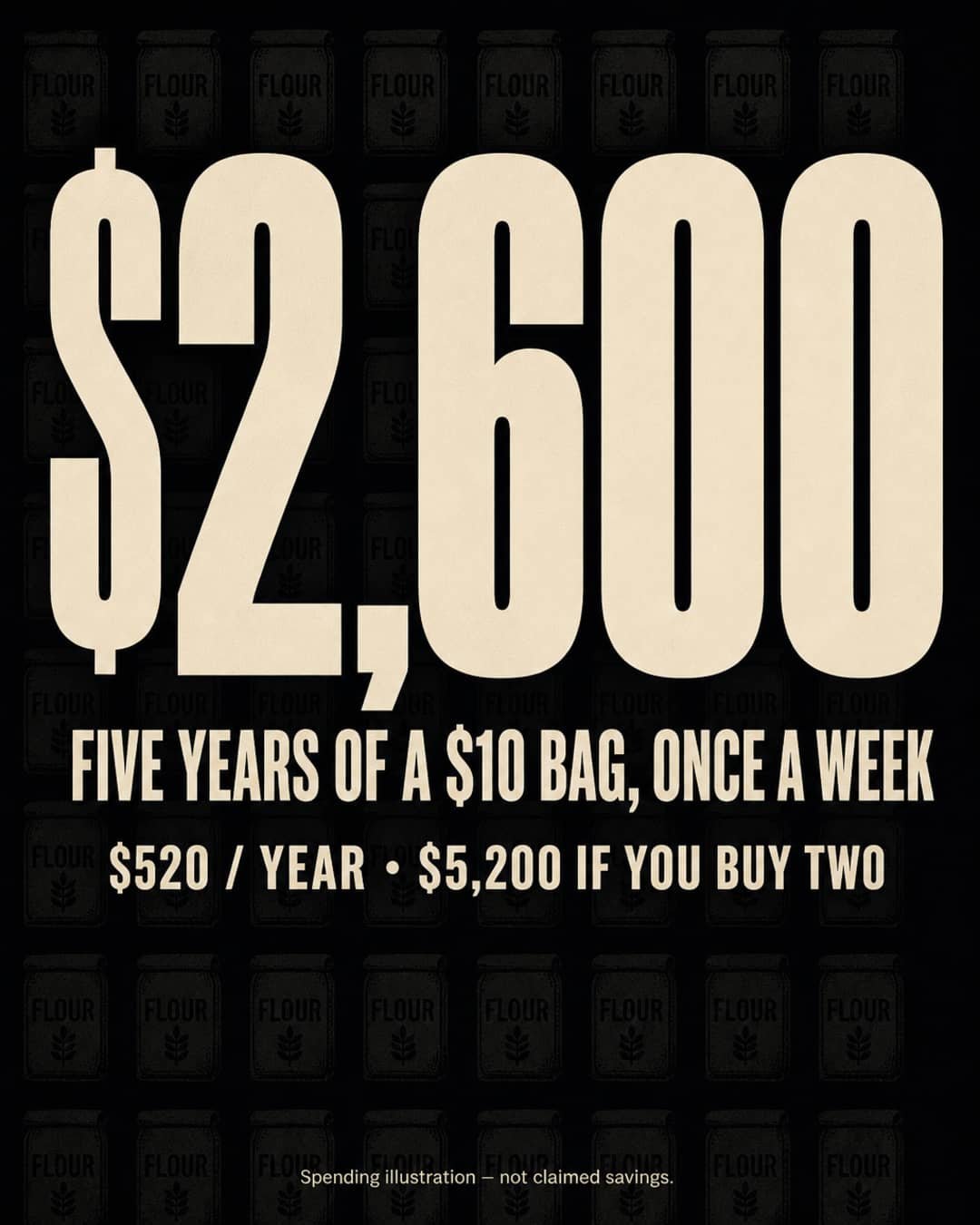
Ten dollars feels harmless. Weekly it isn’t.
- One $10 bag a week = $520 a year
- Five years of that = $2,600
- Two bags a week = $5,200 over five years
That is not “money GRAIN BLOOM saves you.” That is money you are already spending on flour if that pattern matches your kitchen. Savings only exist if equivalent whole grains, after shipping, yield, power, and the $79.99 machine, actually land cheaper. Some bakers will run those numbers and stay with bags. Others will wonder why they never checked.
If you bake on a schedule, flour is not a treat. It’s overhead. Overhead deserves a cost check.
GRAIN BLOOM exists so you can mill compatible whole grains at home instead of automatically repeating the expensive bag. Whether it wins on your specific rye, spelt, einkorn, or organic wheat is a math problem you can only solve by looking at your suppliers — not by hoping the next 2-pound bag goes on sale.
What bakers are saying
"Clear and practical. I finally compared bulk berries with the bags I kept reordering, instead of assuming specialty flour just has to cost that much."
Megan R., Portland
"I didn’t want a $400 mill just to test the math. This was straightforward to use and made the cost check feel doable."
Chris T., Austin
"Well made for the price. I still bake with the same grains I like — I just wanted a cheaper path than another small bag every week."
Elena M., Chicago
The decision isn’t “Do I love baking?” You already do. The decision is whether you keep paying finished-flour prices for a step you could run at home.
If any of this is your kitchen:
- You buy the same specialty flours on a loop and hate the register total
- You suspect you’re funding milling, bags, and branding more than the grain itself
- You don’t want a $400 machine just to start asking whether the economics work
- You want a $79.99 way to test whole grains against the flour you already use
…then the next click isn’t a leap of faith. It’s a cost check.
GRAIN BLOOM is a home grain mill at $79.99, two for $139.99, free shipping, 90-day guarantee. Grain compatibility, flour fineness, and real-world yield have to be confirmed for your grains. The offer is built for bakers who are tired of paying specialty-bag prices without ever comparing the berries.
See the offer. Run your own numbers. Decide if the bag is still worth it.