They Don’t Sell You a Grain. They Sell You What’s Left After They’re Done With It.
You already distrust processed food. You read labels. You skip the junk. Then you scoop industrial flour into every loaf, pancake, and pizza like it’s nothing.
You know the ritual.
You turn the jar around. You squint at the fine print. You put one brand back and pick another because the first one had a list of ingredients you wouldn’t feed a dog.
You do that with sauces. With oils. With snacks your kids ask for. You do it because you’ve stopped trusting a food system that turns a simple ingredient into a science experiment.
Then you go home and bake with flour.
Not grain. Flour. A bag that was already milled, already processed, already sitting in a warehouse before it ever touched your counter. You didn’t choose the wheat. You didn’t see what was removed. You didn’t see what was added. You didn’t mill it. You just assumed “flour” still meant what you think it means.
That’s the contradiction sitting in your pantry.
You will interrogate a granola bar. You will not interrogate the ingredient that shows up in half the meals your family actually eats.
Industrial flour is built for that. It is designed to look harmless, taste familiar, and ask zero questions. Convenience is the product. The grain is just the raw material they started with.
Once you look at what happens between the field and that paper sack, “flour” stops feeling like a simple staple. It starts feeling like a finished product you never agreed to buy.
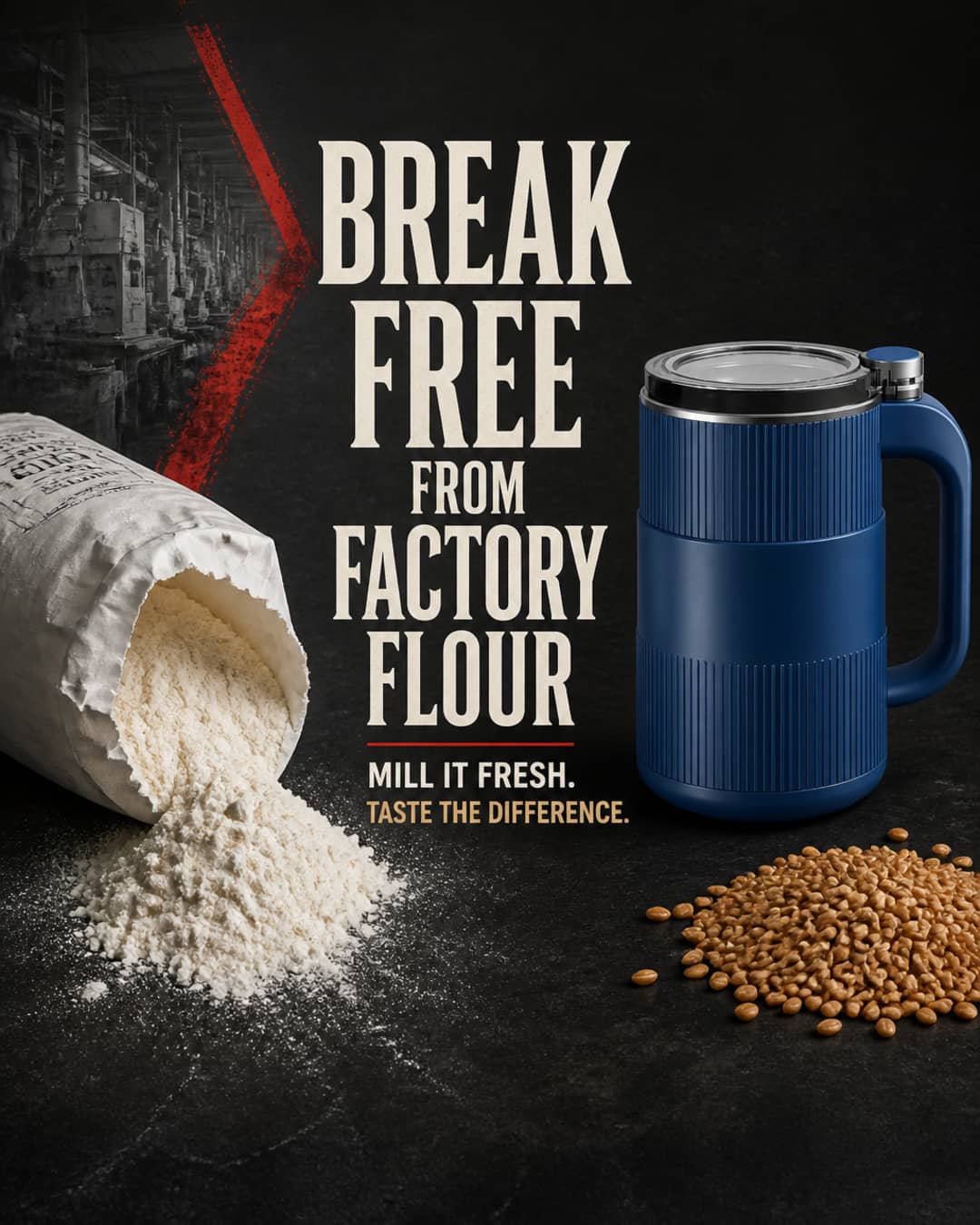
They Remove the Best Parts of the Grain. Then They Sell You What’s Left.
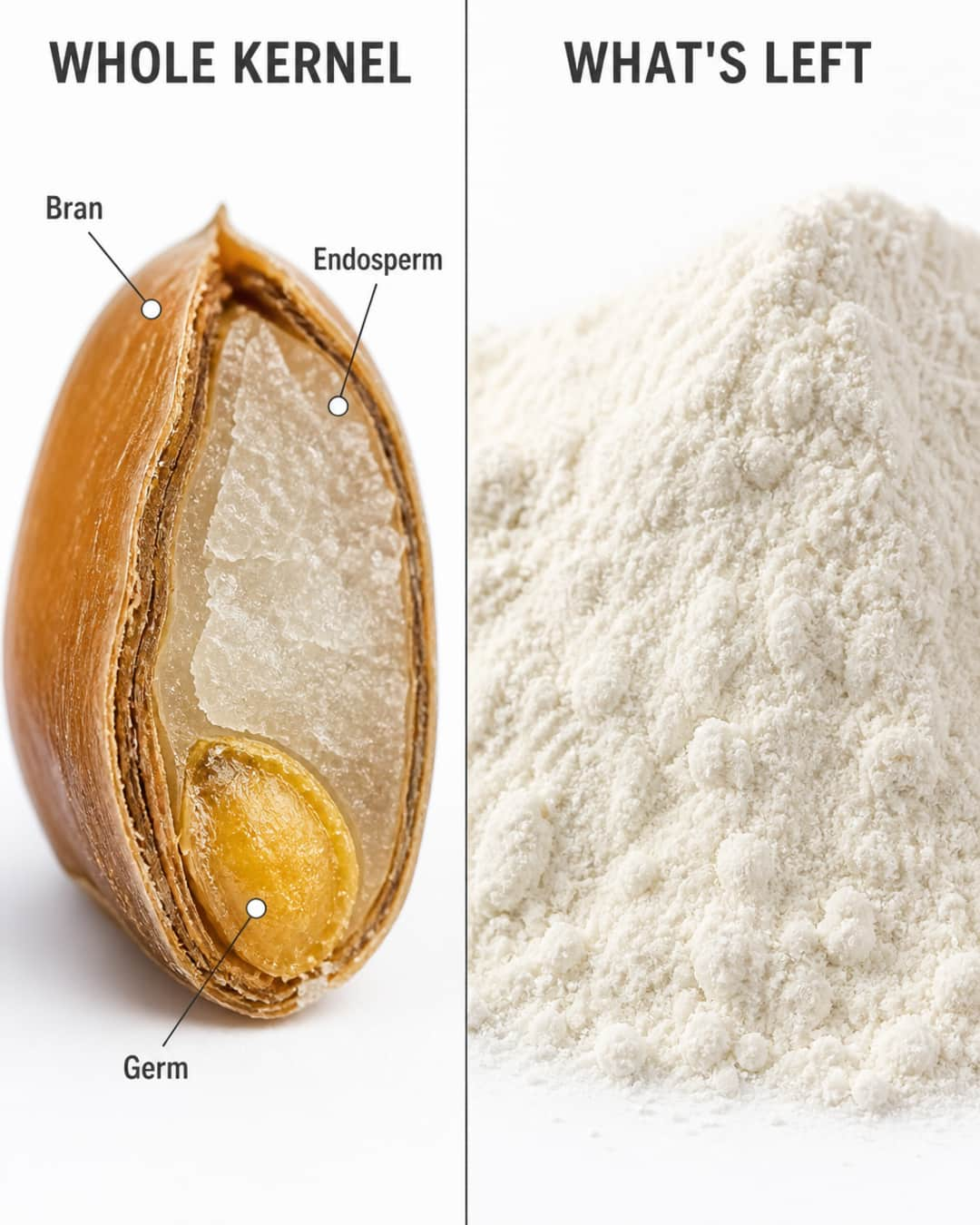
A wheat kernel is not white dust.
It has three parts: bran, germ, and endosperm. The bran is the outer layer. The germ is the nutrient-dense core. The endosperm is the starchy middle.
That is the whole ingredient.
Conventional refined white flour is not the whole ingredient. It is what remains after much of the bran and germ have been separated out. The parts that carry fiber and other naturally occurring components of the grain get pulled away so the flour can be paler, finer, and more shelf-stable.
Then that leftover middle gets bagged, branded, and sold back to you as if nothing important happened.
If you are already trying to eat less-refined food, this is the part that should bother you. You are not “just buying flour.” You are buying a grain that has already been taken apart.
You would never accept an apple after someone removed the skin and the seeds, bleached the rest, and called it “apple.” But that is the logic of refined white flour: start with a whole food, strip it, and sell the remainder as the original thing.
GRAIN BLOOM does not pretend to rewrite agriculture. It does something simpler. It lets you start with whole grains you choose and mill them at home. If you use that flour without sifting, the components of the grain stay together — because you never asked a factory to take them apart.
You don’t need a lecture about “superfoods.” You need to stop confusing what’s left of a grain with the grain itself.
Why Does Your Flour Need Chemical Treatments in the First Place?
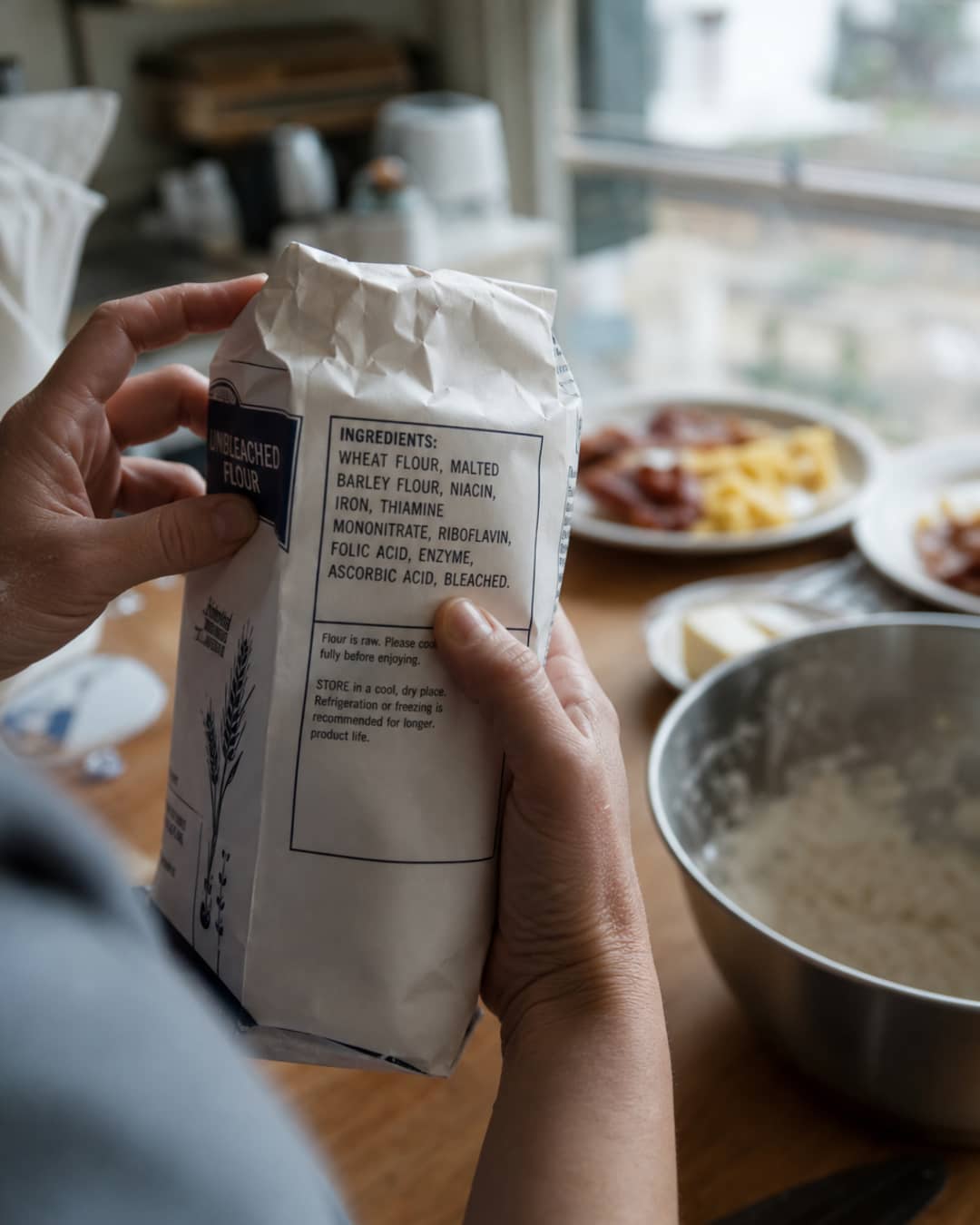
Some commercially produced flours are treated with permitted bleaching agents and flour-treatment chemicals. Not every bag. Not every brand. But enough of them that “flour” is not a clean, untouched ingredient by default.
Those treatments exist because industrial milling has industrial goals: appearance, uniformity, processing speed, baking performance at scale. The flour is being engineered to behave a certain way on a production line and on a store shelf.
If you prefer food that has been handled as little as possible, that should make you pause.
You don’t have to claim the treatments are poison. You don’t have to pretend every loaf in America is a chemistry set. The honest question is smaller and sharper:
If you wouldn’t add bleaching agents to food in your own kitchen, why are you fine with someone else adding them before you buy it?
Approved use is not the same thing as “I wanted this in my family’s food.” Plenty of things are legal. That does not make them the way you cook.
With GRAIN BLOOM, you can choose suitable whole grains and mill them yourself. You are not depending exclusively on flour that was processed to satisfy a factory, a warehouse, and a supermarket aisle.
You are taking the milling step back. That is the point. Not a panic story. Control.
Do You Know What Was Sprayed on the Wheat That Became Your Flour?
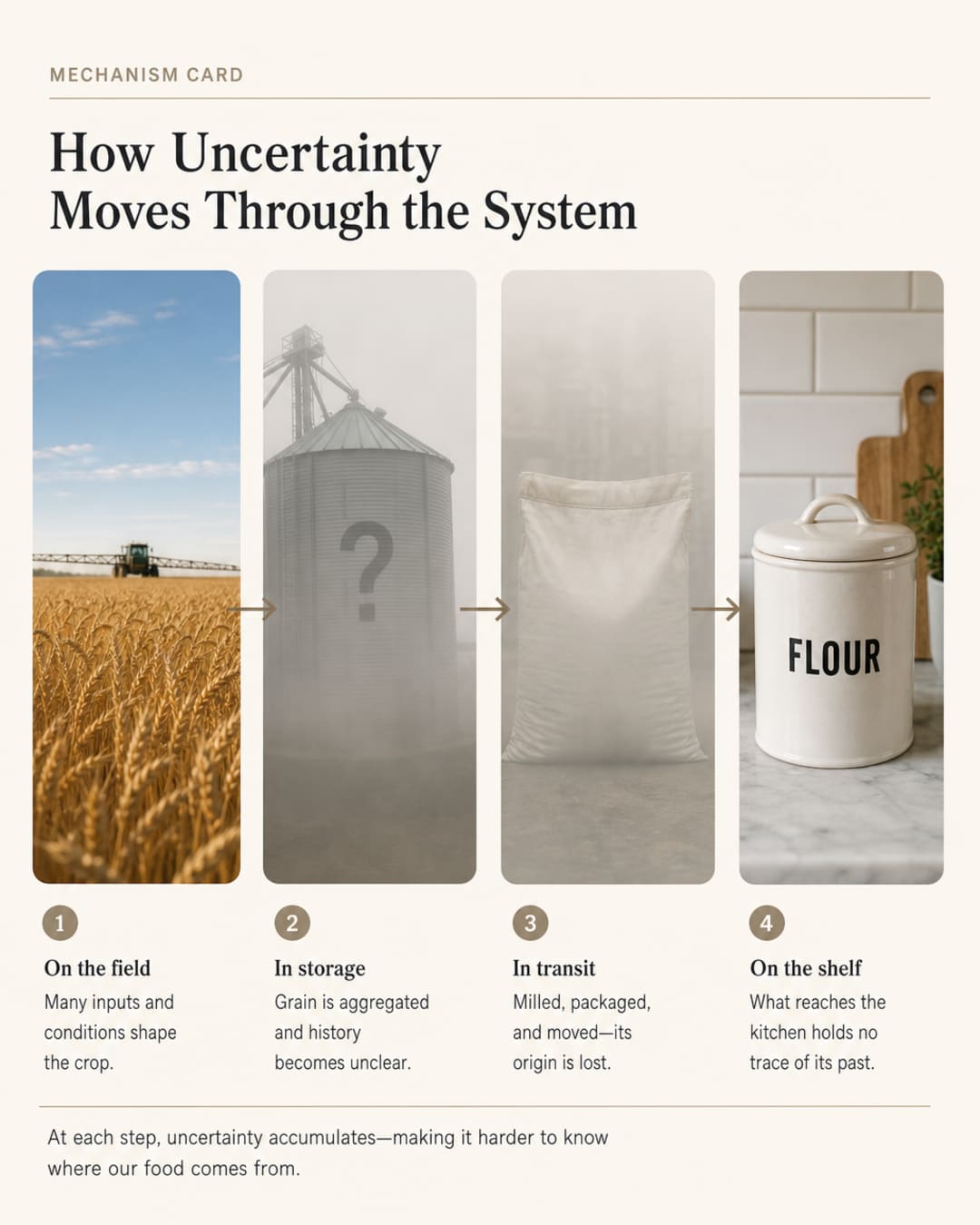
Before flour is flour, it is a crop.
It grew in a field. It was sprayed, or it wasn’t. It was grown with practices you would approve of, or practices you would never choose if you saw them. Residue rules exist for a reason. That does not mean you know anything about the specific wheat inside the bag on your counter.
Most people who care about pesticides stop at produce. They wash strawberries. They buy organic apples. Then they bake all week with wheat they cannot trace past a brand name.
If knowing how your food was grown matters to you, wheat is not a free pass. It is one of the most frequently eaten crops in an American kitchen. Bread. Tortillas. Pancakes. Cookies. Pizza. It is not a side dish. It is the base layer.
GRAIN BLOOM does not wash a field. Milling grain at home does not erase whatever was already on the crop. Anyone who tells you otherwise is selling you a fairy tale.
What it does give you is a different starting point. You can select whole grains from suppliers whose growing practices you can actually look at — including organic certification where that matters to you — and mill those grains yourself.
You move the question upstream. Away from a finished bag with a pretty farm illustration. Toward the grain you decided to bring into your house.
If you already care what was sprayed on your food, stop pretending flour is exempt.
You Check Every Food Label. But Do You Know Where Your Flour’s Wheat Came From?
You already do the work.
You compare products. You look at ingredients. You avoid the ones with a paragraph of additives. You feel responsible when you put food on the table.
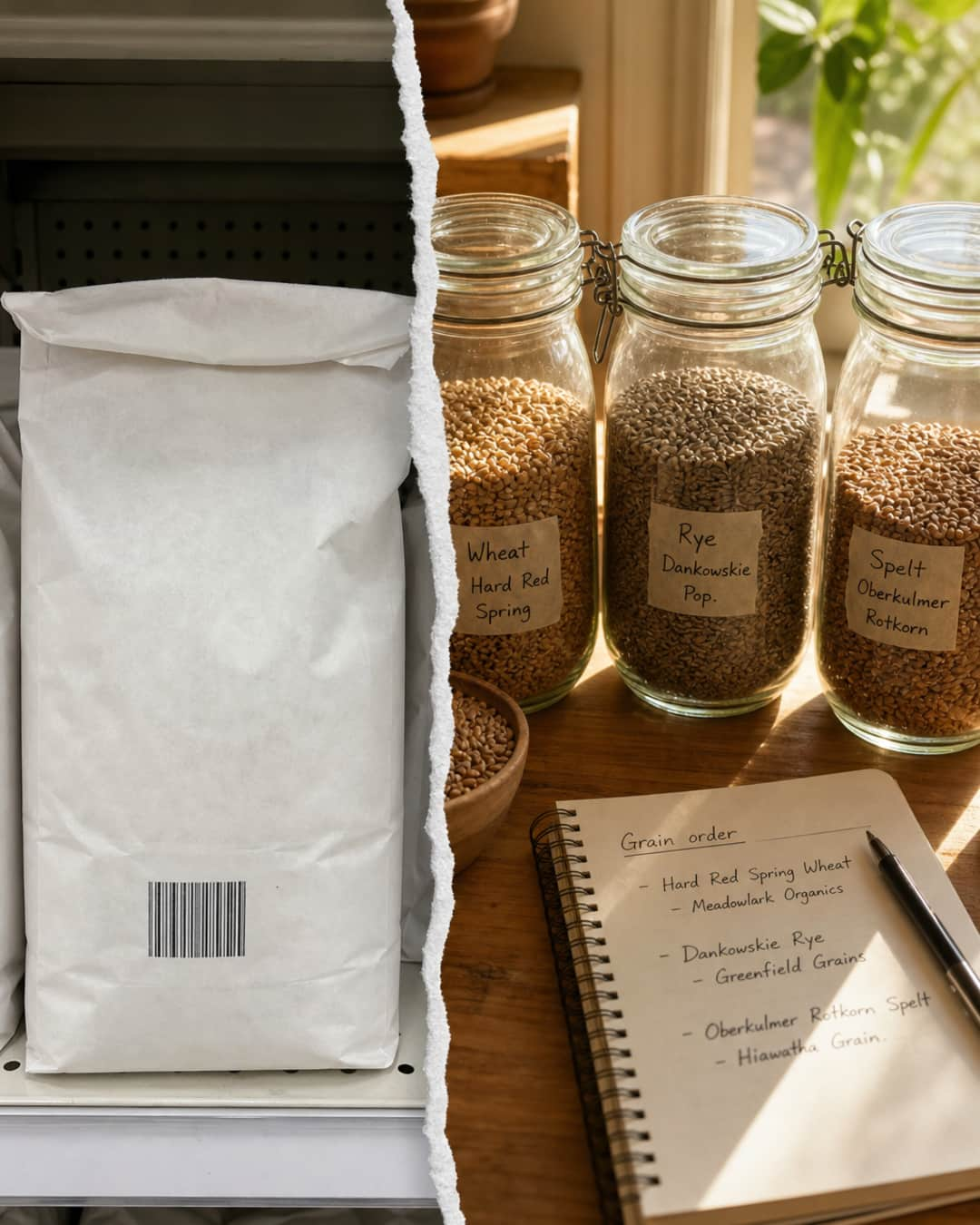
Now try this: pick up the flour you used last week and name the wheat.
Not the brand. The wheat. Where it was grown. What variety it was. Which supplier milled it. Whether it was one farm or a blend from wherever was cheapest that month.
You can’t. Almost nobody can. The bag tells you “wheat flour” and maybe a vitamin list. That is not origin. That is a category.
That gap should bother a person who already shops the way you shop. You will research a $8 jar of honey. You will not research the grain behind the food your family eats every day.
GRAIN BLOOM is not a detective. It does not magically verify a farm. What it does is change the order of operations. You begin with whole grains you selected. You know which bag of grain went into the mill. You know you milled it. The supply chain gets shorter by one giant, opaque step: “someone else turned this into flour before I ever saw it.”
If traceability matters, start acting like it. Stop treating flour like it has no biography.
Your Flour Was Milled Before You Bought It. Why Not Mill It When You Need It?
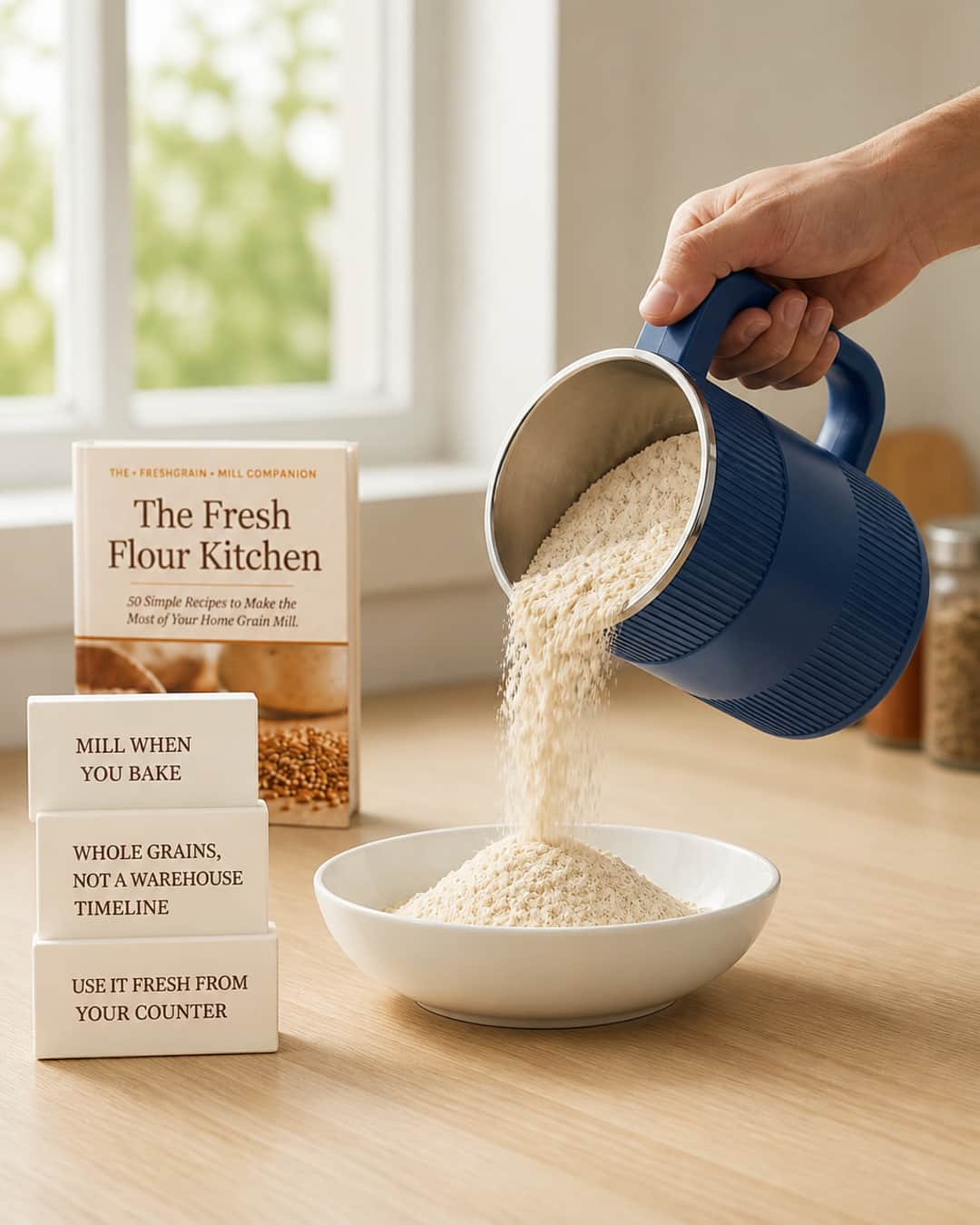
Once a grain is milled, it is no longer a sealed seed. It is a powder. Air, light, heat, and time treat it differently.
Whole-grain flour contains natural oils. Those oils can go rancid if the flour sits around. That is not a scare line. It is why people who already mill at home talk about storage, and why whole-grain flour is not the same as a white bag that can live in a pantry like concrete.
You care about ingredient quality. Then the timing of milling is not a trivia fact. It is part of the ingredient.
Packaged flour is convenient because the milling already happened — days, weeks, or longer before you opened it. You did not decide that timeline. A manufacturer and a supply chain did.
GRAIN BLOOM lets you mill compatible whole grains when you are ready to use them, instead of relying exclusively on flour that was milled in advance. You are not promised a miracle loaf. You are given a choice about when the grain becomes flour.
If you are serious enough to pick better ingredients, you are serious enough to stop treating “already milled” as a neutral default.
They Take Nutrients Out. Then They Add Some Back. Why Not Start With the Whole Grain?
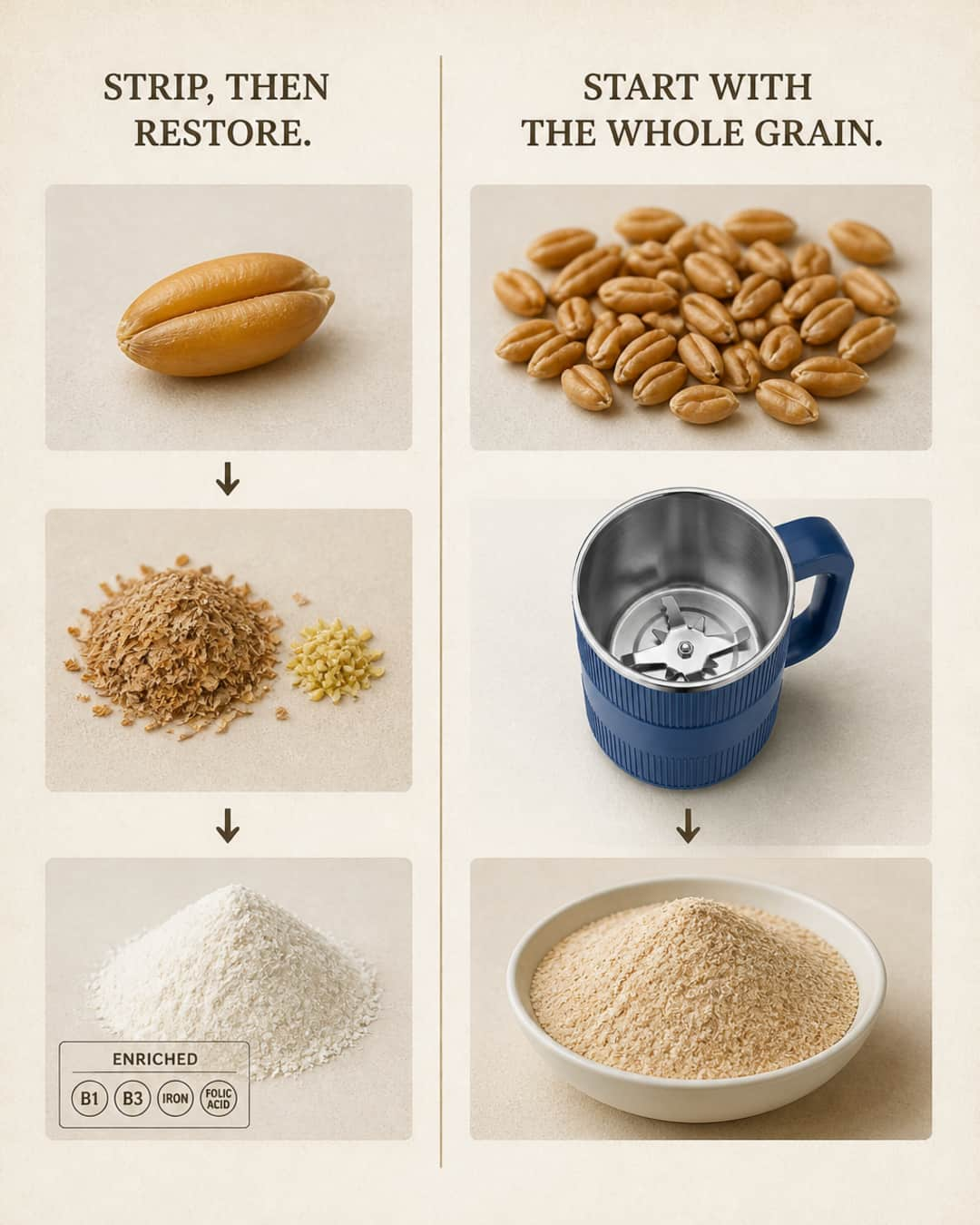
Refining conventional white flour does not just change the color. When bran and germ are removed, some of the naturally occurring nutrients go with them.
Then enrichment puts selected vitamins and minerals back in.
That sequence gets sold as if nothing was lost. It is not nothing. Enrichment can be nutritionally useful. It is also not the same thing as using the whole grain. Adding back a short list of nutrients does not rebuild every component of the original kernel. It rebuilds the ones the process decided to restore.
If your goal is flour made from the whole ingredient, enrichment is the wrong conversation. The right conversation is: why start with a process that removes parts of the grain and then tries to patch it?
GRAIN BLOOM lets you begin with whole grains you choose and prepare unsifted whole-grain flour at home. You are not “beating the food industry at nutrition science.” You are refusing the strip-then-restore routine as your only option.
Enriched flour is still a processed product. Whole-grain flour you mill yourself is a different starting point. If you already prefer whole foods, that difference is the entire argument.
What Home Cooks Are Saying
“I already read every label. This just made it practical to start with whole grains I pick myself instead of another anonymous bag.”
Mara K., Portland
“Clear and easy to use. I mill what I need for pancakes or bread and I know which grain went in.”
James R., Austin
“Felt less overwhelming than I expected. Practical, not complicated, and it does what it says.”
Elena P., Cleveland
You Don’t Need Another Kitchen Gadget Speech. You Need a Decision.
Either you keep buying a finished powder you cannot trace, cannot mill, and cannot fully account for — or you start with a grain you chose and take the milling step yourself.
GRAIN BLOOM is the mill that makes that second option realistic in a normal American kitchen, at $79.99, with free shipping and a 90-day guarantee.
- Start with whole grains you select, not a factory’s leftover.
- Mill at home when you want flour, not when a warehouse already did.
- See the ingredient. Run the step. Know what went into it.
That is not a personality makeover. That is control over one of the most used ingredients in your house.
If you want to see how GRAIN BLOOM actually mills, and whether it fits the way you already cook, look at the details next.