You've Been Trying to Get It Out by Pushing It In
There's nothing wrong with your ears. There's something wrong with the direction.
Most people never question the tool they've used since childhood. You reach for it automatically. You use it quickly. You feel marginally better, for a little while, and then a few days later — that same muffled, full, slightly-off feeling is back.
It isn't your fault. Nobody explained the physics. Nobody pointed out that the thing you've been using your whole life moves in exactly the opposite direction from what you're trying to accomplish.
You want something out.
Your tool goes in.
That's not a minor detail. That's the whole problem.
The honest, almost embarrassing truth about traditional ear cleaning is that the direction of force works against the goal. You aren't removing the buildup — in many cases you're compressing and relocating it, pushing it further down where your body can't clear it as easily. Then you repeat the same routine. Then it comes back. And at no point does anyone stop to ask the obvious question: why are we still pushing things inward when we're trying to get something out?
There's a different approach. It works in the direction you actually want. And once you understand the logic, the old method becomes very hard to go back to.
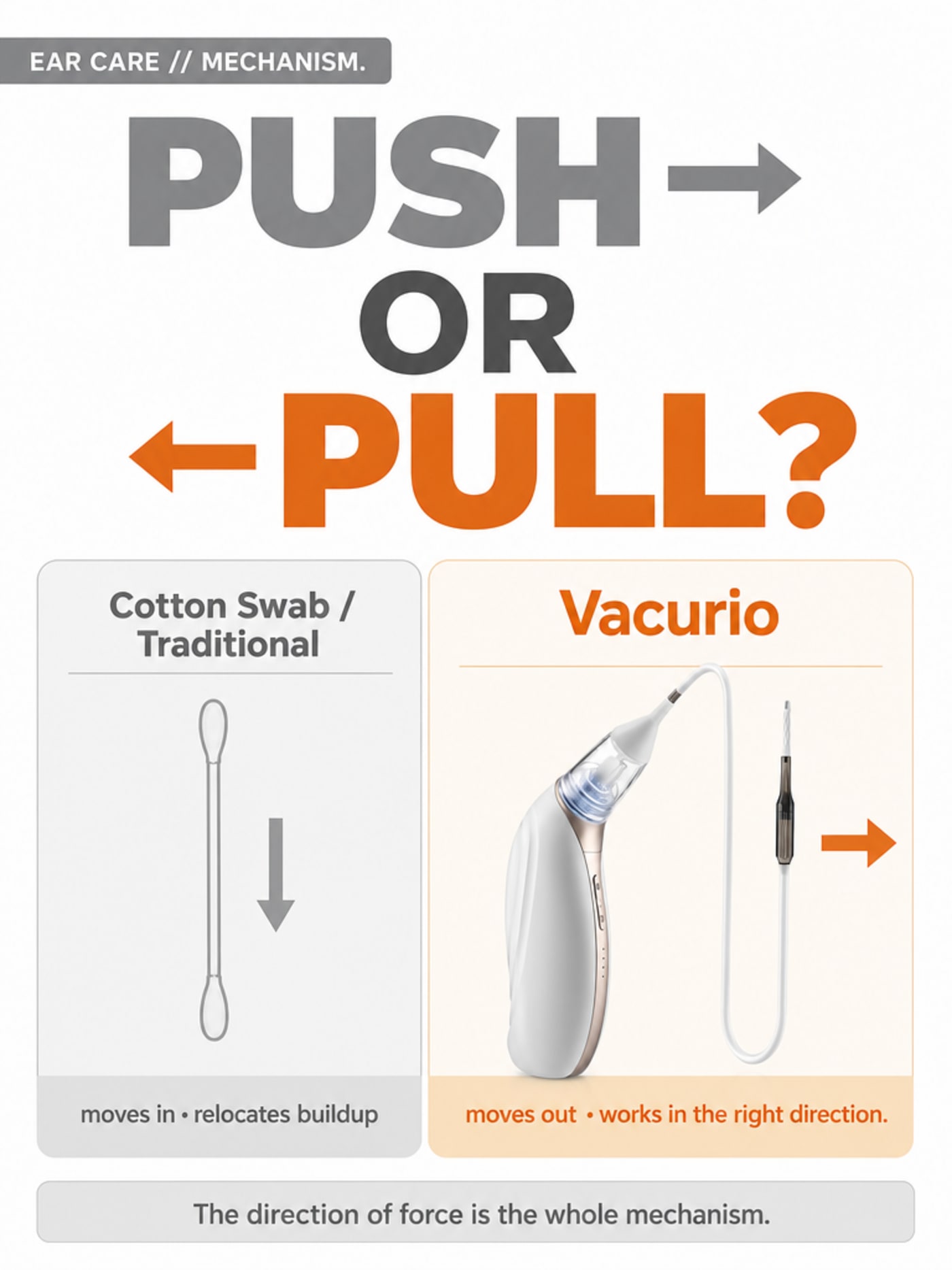
That Blocked Feeling Isn't Just Wax. It's Wax That Has Nowhere Left to Go.
There's a specific, slightly miserable quality to the feeling of an ear that won't quite clear. It's not sharp. It's not usually painful. It's more like static — a low-level wrongness that sits at the edge of your awareness and won't leave.
Marcus knows the feeling exactly. After a morning shower, cotton swab in hand, going through the routine he's had since he was a teenager. The swab comes out with something on it, which always seems like evidence that the process worked. But an hour later — still that same full, slightly-muffled sensation. Like something is still there, just further back, compressed into a spot the swab can't reach anymore.
This happens because the tool that most people reach for doesn't extract. It displaces. The narrow, firm tip of a traditional cotton swab moves inward. Anything soft and loose in its path doesn't get lifted out — it gets pushed ahead of the swab tip, compacted slightly, relocated toward the deeper canal where the ear's natural clearing mechanism has less room to work.
You feel like you cleaned your ears. You cleaned the accessible surface. The rest is still there, redistributed.
The body's own natural process — the slow outward migration of wax from the deeper canal toward the opening — is now working against what you accidentally moved inward. The result is that persistent, recurring full feeling that swabbing never fully resolves, and that you keep going back to treat with the same tool that caused it.
The frustrating thing is how long most people spend in this cycle before anyone points out that the tool is moving in the wrong direction.
And here's the part that makes the mechanism question unavoidable: you can't push something out by pressing into it. Which means something about the standard approach has to change — and it isn't your ears.
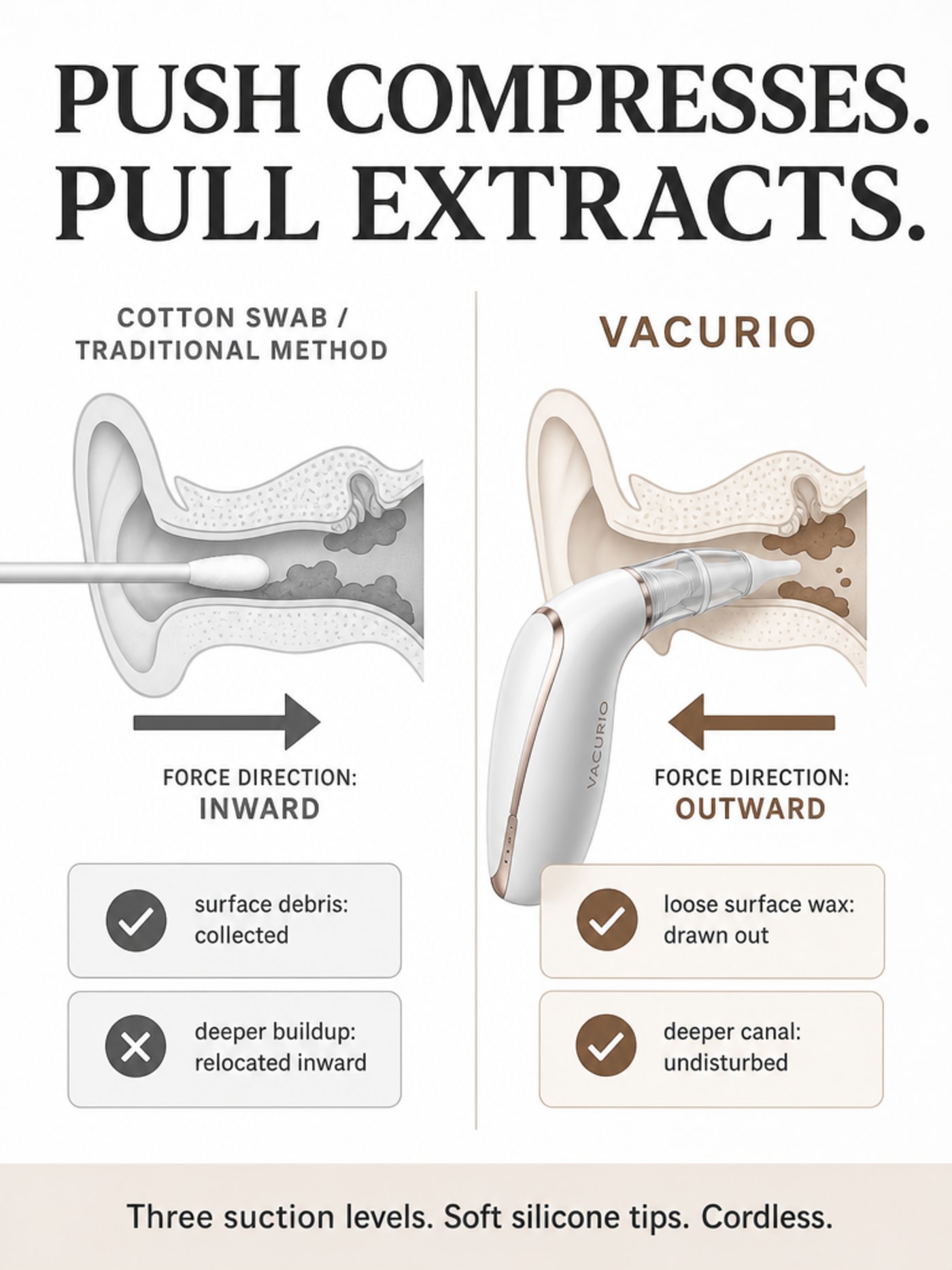
The Direction of Force Is the Entire Conversation
Here's the mechanism explained simply, because once you see it you can't unsee it.
A cotton swab is a compression tool. Its job, mechanically, is to make contact with a surface and move debris in the direction the hand is traveling. When the hand travels inward — which it does, because that's how you insert it — the debris travels inward too. Whatever the swab collects on its tip at the outer surface is useful. Everything behind the tip is being pushed.
Diane had been doing drops-then-swabs for years before someone described it this way to her. She thought she was doing the thorough version of ear cleaning. Drops to soften, swabs to clear. But the swab is still moving inward. The drops soften everything, which means when the swab arrives, everything is more mobile — including things that then get pushed further and more easily than they would have been dry.
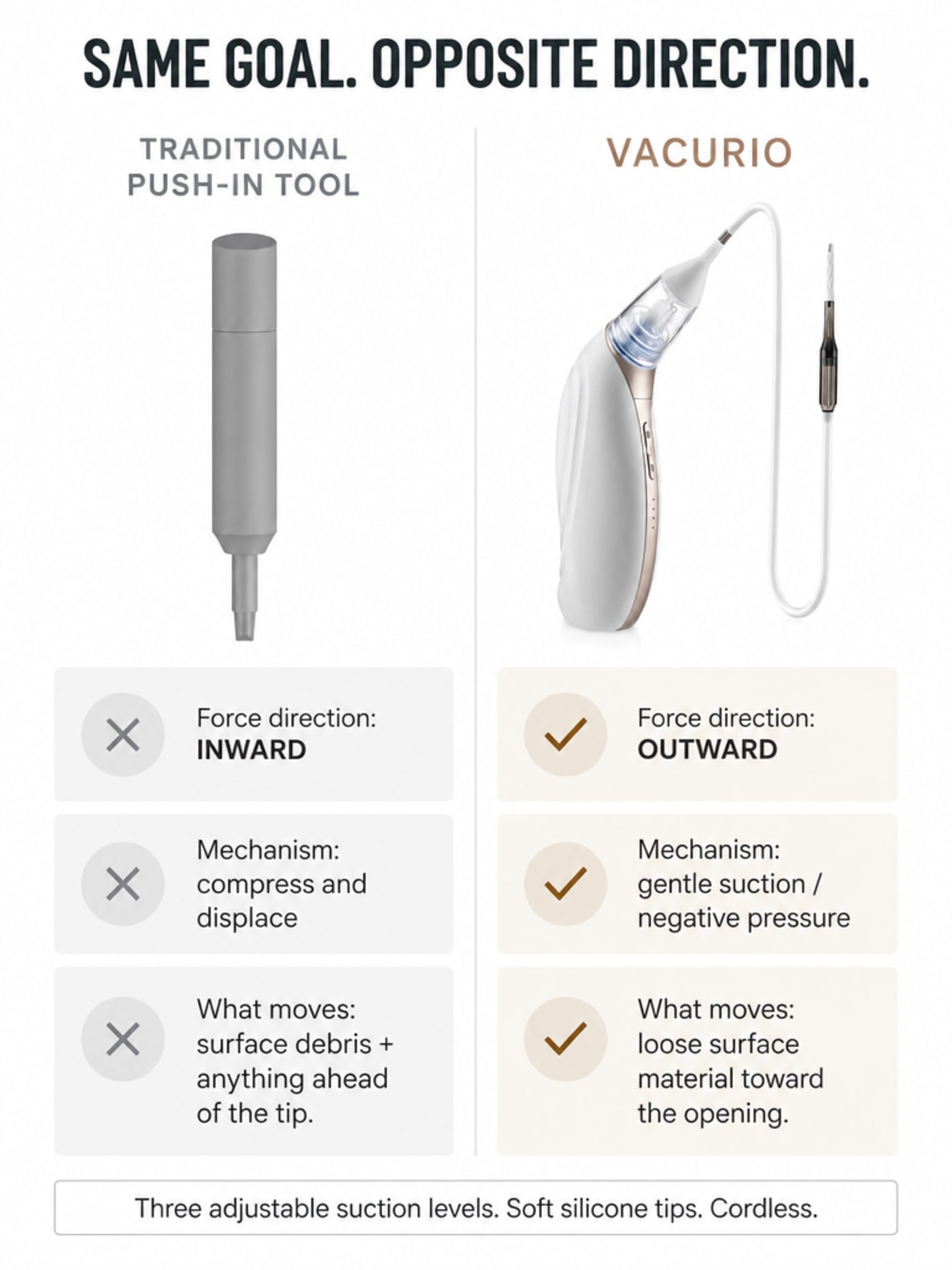
The mechanism of Vacurio is the opposite. It applies gentle suction — negative pressure — at the ear opening. Negative pressure means the direction of force is outward. Loose, soft material near the canal surface is drawn toward the opening rather than compressed away from it. This is how the physics of removal are supposed to work: you create a gradient that moves the target in the direction you want it to go.
Three adjustable suction levels give the user control over the amount of pull. The soft silicone tips create a gentle seal at the ear opening without inserting pressure into the canal. The device is cordless and fits in one hand — there's no preparation, no standing over a basin, no timing the drops.
The mechanism isn't complicated. PUSH moves things in. PULL moves things out. The question is only which one you've been using, and whether you want to keep using it.
What nobody told Diane — what most people are never told — is that this distinction matters just as much for what you don't push in as for what you manage to pull out. The deeper consequence of repeated inward pressure is something that shows up not in a single session, but over months of the same routine.
If you want to understand the full mechanism and see how it works in practice, the details are laid out below — and on the next page.
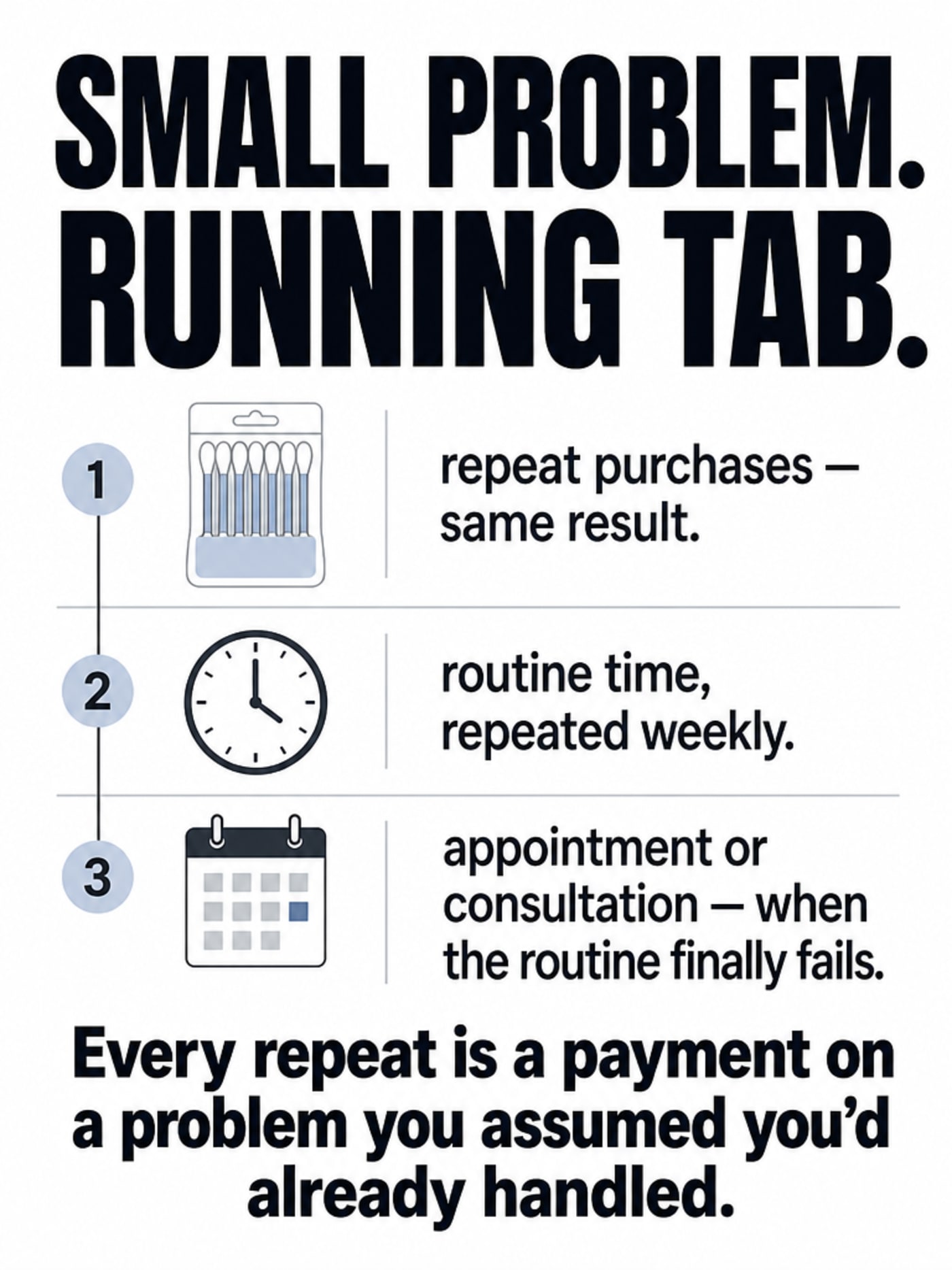
The Running Tab on a Problem You Assumed You Were Handling
Jordan works in audio. His ears aren't a casual concern — they're an instrument. So when the muffled, slightly-off sensation showed up during a session last spring, he took it seriously. He tried the drops. He tried flushing. He tried sitting patiently for the wax to migrate on its own. He went through three different styles of ear-cleaning tools from a pharmacy display.
None of them pulled.
The cost of a problem that seems minor but keeps returning isn't usually dramatic. It accumulates quietly. It's the repeated pharmacy purchases for products that don't resolve the underlying issue. It's the appointment time — scheduling, traveling, waiting — for something that feels like it should have a simpler answer. It's the distraction cost of a sensation you keep noticing at the wrong moments. It's the time spent in a bathroom repeating a routine that partially works, then repeating it again.
Most people never add it up. The individual instances feel too small to count. But the routine that doesn't work still costs something every time you repeat it — in time, in money spent on supplies that displace rather than remove, and in the particular low-grade frustration of a problem you thought you'd handled already.
Vacurio is designed for routine at-home maintenance — for the kind of loose, soft surface buildup and trapped water that a push-in tool smears around rather than removes. It isn't a treatment for a medical condition. What it is, very practically, is an answer to the question of why you keep dealing with the same issue after using a mechanism that was never designed to address it.
The math on that is worth doing. Not dramatically — just honestly. Because every time you buy another pack of the same thing and get the same partial result, you're paying to repeat an approach you already know doesn't work all the way.
Side by Side, the Difference Is the Direction
The question that most product comparisons avoid is the obvious one: what is the mechanism actually doing?
Pull up two objects. A cotton swab on the left. Vacurio on the right. The cotton swab's design logic has not fundamentally changed in decades — a soft tip on a narrow handle, designed to absorb and wipe. The absorbing-and-wiping happens on whatever the tip makes contact with at the moment of insertion. Anything beyond the tip's contact point is pushed.
Vacurio's design logic is different at the principle level. Suction creates negative pressure. Negative pressure at the ear opening draws surface-level material toward the opening — outward, in the direction of removal. The soft silicone tips create a gentle seal without entering the canal with inward force. The three adjustable suction levels let the user set the amount of pull to what's comfortable for them.
This isn't a marginal improvement on the same mechanism. It's a different mechanism. One presses inward; one pulls outward. One smears the target area; one draws from it. Both feel like "cleaning" in the moment. The difference is what happens to the material you're trying to remove — where it ends up.
Diane put it simply: "I genuinely thought I was doing it right. I had no idea the tool was moving everything the wrong way."
The comparison doesn't require detailed technical argument. It only requires noticing the direction. Once you've noticed it, it's the only thing you see.
What Clear Actually Feels Like When the Mechanism Is Working With You
Marcus went back to the bathroom — same counter, same light, same time of morning. This time without the cotton swab.
The difference he described wasn't dramatic the way a product advertisement usually promises dramatic. It was quieter than that. The sensation of a seal, then a gentle pull, then nothing — no push, no packing-in feeling, no wondering whether he'd just moved the problem further down. He tilted his head, felt the small release of trapped water drawing clear. The full, muffled quality that had been there for two weeks was gone.
Not "better." Gone.
That's what the mechanism difference produces in practice. Not a more efficient version of the same result — a genuinely different result, because the process worked in the right direction from the start. Surface-level loose material drawn out, not compressed in. The ear's own natural clearing process no longer working against something that was pushed against it.
The three suction levels matter here because different people need different amounts. A lighter setting for general daily maintenance. A slightly stronger setting when there's more to clear. The silicone tip creates a seal at the opening — not a probe, not pressure inward — so the pull happens from the outside in, precisely where it needs to.
Routine at-home ear maintenance, done with a mechanism that actually reflects what you're trying to do: remove something, not relocate it.
The "why does this keep coming back" question has an answer. You were treating the symptom with a tool that was contributing to the cycle. The question now is only how long you want to keep the cycle going.

What People Are Saying
"I never thought about direction before reading this. Makes complete sense once you do. The pull approach is noticeably different — that muffled feeling I'd been chasing with swabs for months finally cleared."
— R.M., Austin
"I'd been doing drops then swabs for years thinking I was being thorough. The mechanism explanation here was the first thing that made the recurring issue make sense. Simple to use, well made."
— Carolyn T., Portland
"Practical, straightforward, and does exactly what it says. Having three suction levels means I can actually control what I'm doing instead of just hoping for the best."
— D.K., Chicago
You've Spent Years Pushing In What You Were Trying to Get Out. Here's What Happens When You Stop.
The full feeling in your ear after swabbing. The routine that needs repeating. The low-level, persistent awareness that something isn't quite right in there — even after you just cleaned them. Those aren't signs that your ears are unusually difficult. They're signs that the mechanism you've been using was never designed to do what you were asking it to do.
You were trying to remove something. The tool was pressing inward.
That's the whole problem. And it has a solution that is — genuinely, simply — a different direction.
What changes when the mechanism works with you:
- The direction of force matches the goal: loose surface material is drawn out, not pushed further in
- The "full" feeling that swabbing temporarily masks but doesn't resolve has an answer — one that doesn't require repeating the same routine
- Routine ear maintenance takes less time, less preparation, no water, no basin, no waiting for drops to soften
- Three suction levels mean you're in control of how much pull — not guessing, not hoping the cotton absorbed enough
- Soft silicone tips at the opening — no inward pressure, no packing, no compressed aftermath
You've already understood the mechanism. The cotton swab moves in. Vacurio pulls out. Everything you've tried that partially worked and then needed repeating had the same design flaw — the direction.
The question isn't whether this makes sense. You already know it does. The question is whether you want to go back to the bathroom tomorrow morning with the tool you've been using, knowing what you know now.
The next page has the full details.