Why Do Your Ears Keep Feeling Blocked — No Matter How Often You Clean Them?
It might not be how often you're cleaning. It might be the direction.
For anyone who has dealt with the same ear-care problem — and cleaned their ears, felt better, and then found themselves dealing with it all over again.
There's a particular kind of frustration that doesn't announce itself loudly. It doesn't arrive as a crisis. It arrives as a quiet, familiar sense of: again?
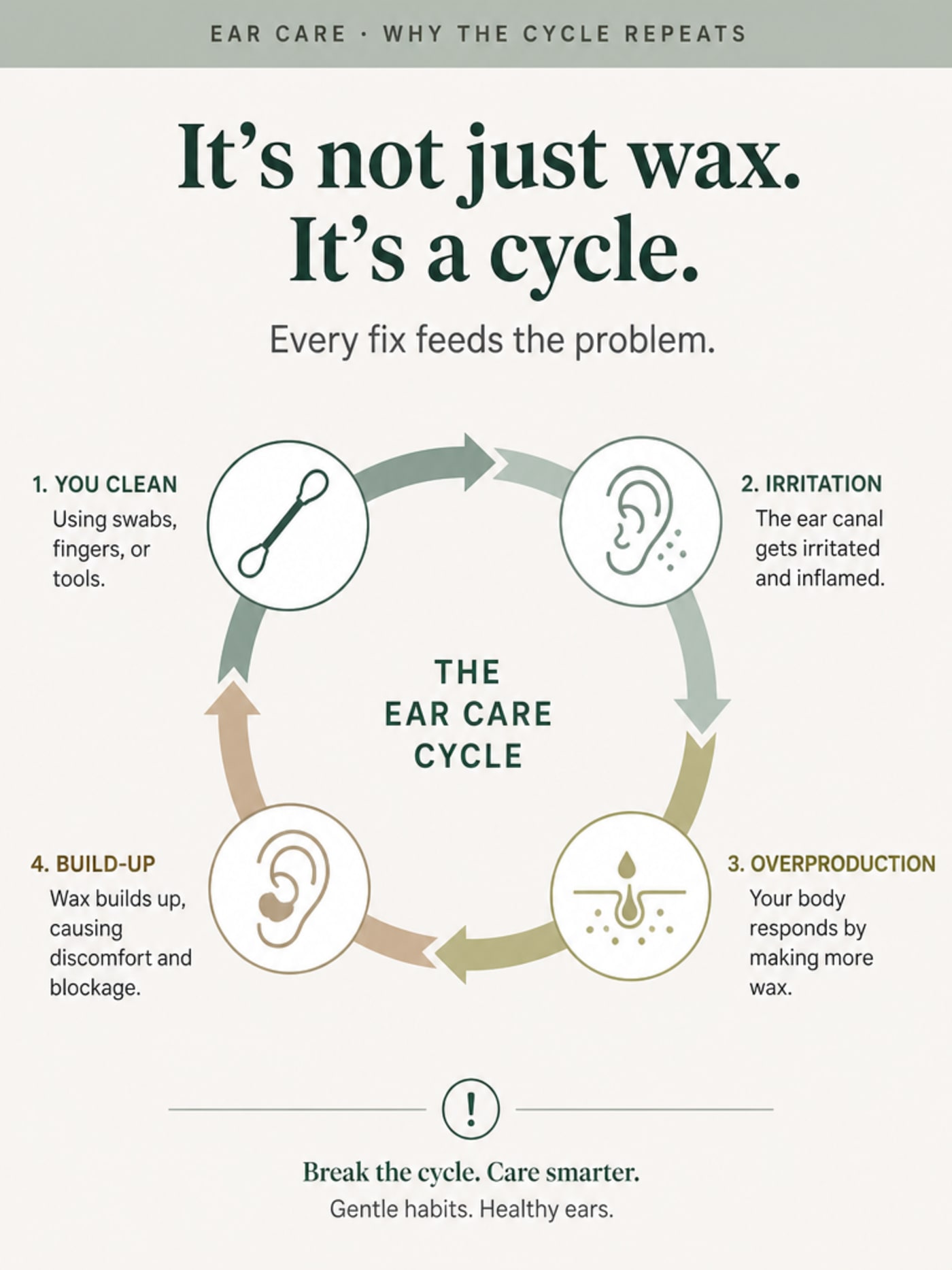
Your ears feel full. Muffled. A little off. Not painful, just — there. So you do what you've always done. You clean them. Things feel better for a few days. Then, somewhere around the end of the week, that same slightly-blocked sensation is back. You find yourself reaching for the same thing you've always reached for, going through the same motions you've been going through for years, and arriving at the same temporary result.
Most people in this situation assume the problem is their ears. That their body just produces more than usual, or that they're somehow more prone to this than other people. So they clean more often, or they try a different product, and the cycle continues.
But the question worth sitting with isn't how often you're cleaning. It's whether the method you've been using for your entire adult life is actually designed to remove the problem — or just move it somewhere else.
That question is worth a few minutes of your time. Because the answer changes what you do next — and whether next week looks any different from this one.
The Moment You Recognize the Cycle — and Realize You've Been Here Before
There's a specific moment most people recognize instantly when they hear it described.
You're going about your day — working, listening to music, maybe just sitting quietly — and you notice it. That slightly muffled quality. The faint sense of pressure or fullness that wasn't there yesterday, or maybe was there yesterday but you'd stopped noticing. It's not dramatic. It's not painful. It's just that familiar low-level "oh, this again" feeling.
So you do what you've always done. You grab a cotton swab. Or you hold your head under the shower. Or you use the drops you keep under the bathroom sink for exactly this occasion. You do the thing. It helps — a little, or sometimes quite a lot. You move on.
And then, within a few days, sometimes within a week, the sensation is back.
This is the moment that accumulates. Not any single instance of it, but the repetition — the steady drumbeat of the same minor problem, returning on roughly the same schedule, requiring the same response, delivering the same temporary result. At a certain point, the frustration isn't really about your ears. It's about the fact that nothing has actually changed.
What most people in this cycle don't stop to examine is the logic of what their cleaning method is actually doing. Not whether it feels like it's working in the moment — it often does — but whether the mechanism of the tool is designed to move the problem outward, or simply to compress it and redistribute it. That distinction turns out to matter more than most ear-care routines ever acknowledge.
And that's exactly where the cycle's engine is hiding — in the mechanics of the tool itself.

You've Been Trying to Get It Out by Pushing It In
Here is the contradiction that most people, once they see it, cannot unsee.
When your ear feels blocked or full, your goal is removal. You want what's there to come out. That's the entire point of the exercise. So you reach for your cotton swab — which is a push-in instrument. You insert it, move it around, and withdraw it. Some material comes out on the tip; you feel better. Case closed, seemingly.
But what happens to the material that wasn't on the tip? A cotton swab compresses as it enters. It can collect surface material, but the compression action also packs softer wax further in and against the canal wall. This is not a particularly controversial claim — it's the reason ear, nose, and throat specialists have spent decades suggesting people not use cotton swabs inside the ear canal at all. The tool's mechanism runs counter to the stated goal.
The direction matters. If you want something out, a push-in instrument is working against you by design.
Vacurio's mechanism is the opposite. Rather than inserting and compressing, it uses gentle suction — meaning it draws outward, toward the surface, in the direction of the goal rather than away from it. The soft silicone tip makes contact without the rigidity of cotton on a wooden or plastic stick. Three suction levels allow adjustment based on what's actually needed on a given day.
The mechanism itself is simple. It just happens to run in the correct direction.
Understanding this doesn't require accepting any dramatic claim. It only requires noticing that the tool you've been using for years was designed to apply makeup and clean keyboards — not to reliably remove material from an ear canal — and that a different mechanism, designed specifically for the direction of the task, produces a different result.
What that difference compounds into — in time, in expense, in repeated inconvenience — is the part of this that rarely gets calculated clearly.

The Real Cost of a Problem You Keep Calling "Minor"
When a problem repeats itself on a regular schedule, the habit of calling it minor becomes a way of not adding it up.
Consider what a single cycle costs in real terms — not in medical bills necessarily, but in the currency people actually spend: attention, time, and the low-level mental load of a recurring inconvenience.
You notice the blockage. You locate your supplies. You try one approach. It helps partially. You try another. You wait for drops to work. You repeat the process the following morning because last night's attempt only did so much. You spend several minutes, possibly several separate sessions, across a week, dealing with something that is supposed to be simple personal care.
Multiply that by the number of times this cycle has run in the past year. Multiply it by the purchase cost of the supplies you've cycled through — cotton swabs, drops, warm-water solutions, combinations of all three. None of them individually expensive. But the accumulation, over months and years, is a tangible number. And the time spent — the minutes of active attention, the mental overhead of "I need to deal with my ears again" — is a real cost that doesn't appear on a receipt but drains from something.
For anyone who has eventually found the cycle escalating to an inconvenient level — seeking professional irrigation because the home routine stopped making a dent — the cost becomes concrete in a different way: appointment scheduling, travel, time off, the particular indignity of needing a clinic appointment for something you had assumed you'd be able to handle at home.
Vacurio is not positioned as a medical device. It is designed for routine at-home maintenance — for the kind of regular ear care that should, by reasonable expectation, be handleable without building a supply cabinet or blocking out a morning.
The honest question to ask is not whether the problem is minor. It's whether the accumulated cost of repeatedly dealing with it — in time, materials, and inconvenience — is proportionate to how minor it actually is.
The answer, for a lot of people who run that calculation honestly, is no.
And once you've seen the number, the cost of a different approach looks quite different than it did before.

The Difference Between a Tool That Compresses and a Tool That Clears
Most people have never stood the two mechanisms side by side and thought about what each one is actually designed to do.
A standard cotton swab is a cleaning implement designed for external surfaces. It collects material on contact. When used inside an ear canal, it applies that same surface-collection logic to a confined space with a direction constraint — the only direction it can meaningfully work is inward, deeper. The swab gathers some material at the surface; it redistributes the rest. The softness of the cotton does not change the direction of travel.
Ear drops work on a different principle: chemical softening, then gravity-assisted drainage. The process requires time, positioning, and — if the drops are doing their job — a period of waiting followed by a flushing stage. It works for some people in some circumstances. It requires setup, patience, and the acceptance that you will be lying on your side with a small pool of liquid in your ear canal for several minutes.
Neither method is designed specifically to pull. To draw outward, from the point of contact toward the surface, in the direction of removal.
Vacurio uses gentle suction. The mechanism is directional by design — outward, not inward. The soft silicone tip makes contact without compression. The three suction levels mean the approach can be adjusted rather than fixed at one intensity regardless of what's actually there on a given day.
The comparison isn't a matter of brand preference. It's a matter of mechanism logic. A tool designed to draw outward, used for a task whose goal is outward movement, is better aligned with the job than a tool designed to clean external surfaces.
That alignment is what makes the next morning — and the morning after that — start to look different.

What Happens When the Cycle Actually Stops
The change, for most people, doesn't arrive dramatically.
It's not a single transformative moment. It's more like a subtraction — something that used to occupy a slot in your week quietly stops occupying it. You go several days and don't notice that particular muffled sensation returning. You get to the end of the week and realize you haven't reached for anything. The mental real estate that used to hold "I need to deal with my ears again" is simply vacant.
Marcus — who'd been running the same cotton-swab cycle for years, noticing the blocked feeling return on a near-weekly schedule — describes the change as less about the product itself and more about the loop stopping. The routine shrank to something quick, consistent, and actually maintained. Not a temporary improvement that reset itself. Just a settled baseline.
That's the target state the recurring problem angle is describing. Not a cure, not a medical outcome — simply a routine that works in a direction aligned with the goal, producing a result that holds, at home, without a supply cabinet or a scheduled appointment or the low-grade ongoing frustration of watching the same problem return on schedule.
Vacurio is cordless, designed for at-home use, with soft silicone tips and three suction levels to adjust based on what's actually needed. The mechanism is consistent: gentle outward suction, designed to draw rather than push. It works within a realistic daily or weekly routine — not a medical procedure, not a complicated ritual.
The question isn't whether your ears will ever require attention. They will. The question is whether next week, and the week after, the routine you reach for is working with the direction of the task — or against it.

If you've recognized this cycle at any point — the repetition, the temporary relief, the return — the full details on how Vacurio's mechanism works are worth looking at before you run the same routine again next week.
What Customers Are Saying
"I'd been going through the same routine every week for years and just accepted it as normal. Using Vacurio made me realise there was a simpler way. It does exactly what it says."
— Sarah M., Portland
"Well made, easy to use, and genuinely practical. The three suction levels are a nice touch — I use the lowest setting for regular maintenance and it works consistently."
— D. Okafor, Chicago
"Honestly just relieved to have something that feels like it's doing the right thing rather than making the problem worse. The soft tip is comfortable and it doesn't feel complicated at all."
— James T., Austin
Still Dealing With It? Here's What Another Round of the Same Routine Actually Costs You
Next week, the sensation returns. You reach for the same thing. You feel better for a few days. Then you're back.
The cycle you've been running isn't a flaw in your habits. It's a flaw in the direction of the tool — a push-in instrument being used to get something out. The mechanism has been running against the task the entire time.
Here's what changes with a different approach:
- The blocked, muffled feeling stops returning on the same weekly schedule — because the method is designed to draw outward, not compress inward
- The supply cabinet gets simpler — no drops, no warm-water basins, no multi-step ritual that requires a free ten minutes and a towel
- The mental overhead disappears — the routine becomes brief, consistent, and finished, not a recurring item on a mental to-do list
- The repeated small expenses stop accumulating — swabs, drops, and replacement supplies bought on a cycle add up quietly over months and years
- At-home maintenance stays at home — no scheduling, no travel, no waiting room, no inconvenience that outgrows the size of the problem
The next time that familiar muffled sensation appears, you'll reach for something. The question is whether what you reach for is designed to push or to pull.
You've already seen what the push-in cycle produces. It produces another version of this week, then another, then another. The full details on how Vacurio's pull mechanism works — and what routine at-home maintenance can look like when the direction is right — are one click away.