That "Little Ear Problem" Has Been Quietly Costing You More Than You Think
You probably didn't think much of it the first time.
A blocked feeling. A little fullness in one ear. You grabbed a cotton swab, did what you've always done, and moved on. No big deal. Except it came back. So you dealt with it again. And again. And somewhere along the way, something that started as a two-minute bathroom fix turned into a recurring expense you never planned for — a drawer stocked with solutions that didn't quite solve anything, a co-pay here, a half-day there, and the low-grade frustration of realizing you've been throwing money at a problem that keeps showing up on schedule.
The thing about ear buildup is that it rarely announces itself as serious. It's too easy to file under "minor inconvenience" right up until the moment it isn't. The drops sit on the counter. The irrigation kit lives under the sink. The clinic visit gets rescheduled once, twice, and then — fine — you go. You sit in the waiting room. You spend money you didn't budget. And the doctor tells you nothing you couldn't have handled at home, if you'd had the right tool.
This is not a story about a dramatic health crisis. It's a story about the quiet, steady cost of dealing with the same problem the same way and expecting a different result. It's about all the small amounts that added up to something you'd rather have back. And it's about why the reason most people stay stuck in that cycle comes down to one thing: they're trying to remove something by pushing something in — and that mechanical mismatch keeps the cycle running.
Once you understand what the cycle is actually costing — in hours, in products, in appointments that shouldn't have been necessary — the case for a different approach becomes very hard to argue with.
Reason 1: The Moment a Small Problem Stops Feeling Small
There is a specific moment most people remember.
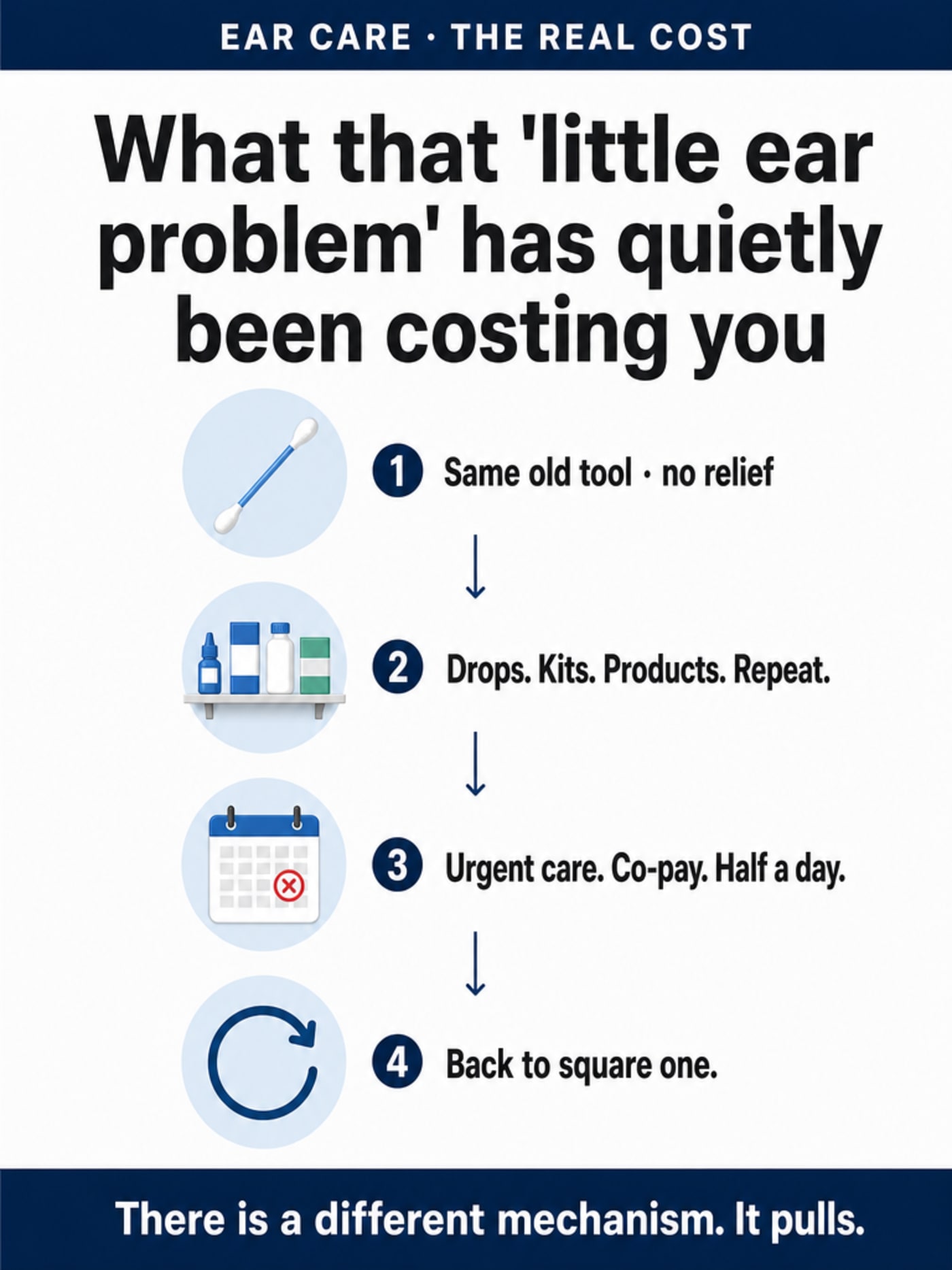
They're sitting in an urgent-care waiting room, or standing at a pharmacy counter scanning the aisle of ear-care products for the third time in as many months, or opening a text from the doctor's scheduling line — and something clicks. How did I end up here again? The ear problem didn't feel like a medical situation. It felt like something you handle yourself, quickly, privately, in the bathroom before work. Except this time it didn't resolve. So you tried something else. Then something else. And now there's a co-pay involved, a parking charge, a chunk of a Tuesday afternoon, and a slight sense of embarrassment that something this basic required a clinic visit.
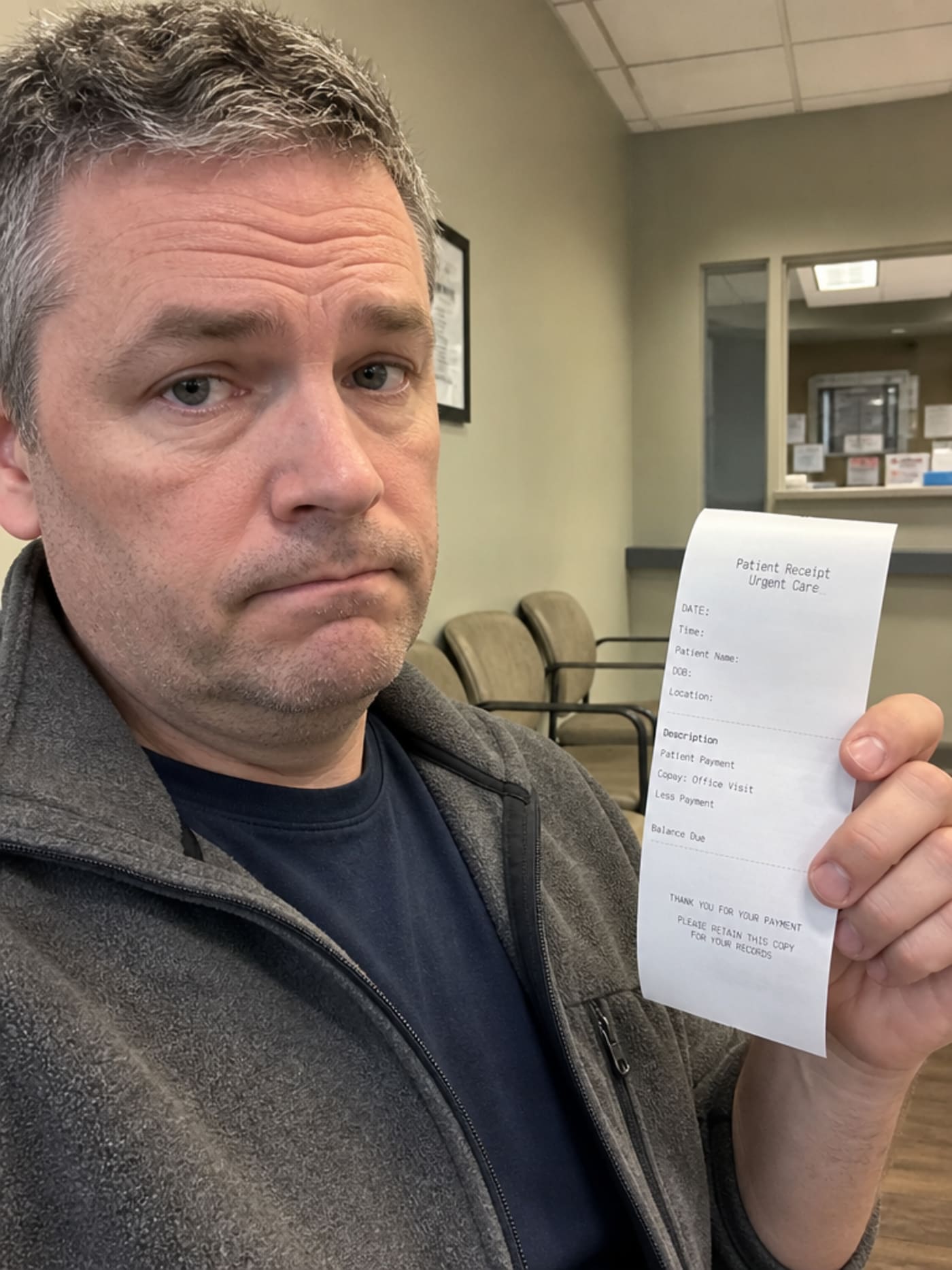
Marcus — 44, otherwise healthy, not someone who spends much time in waiting rooms — had that moment in October. A full, plugged feeling in his left ear had been bothering him for eleven days. He'd used cotton swabs. He'd tried a couple of drops from the pharmacy. Neither changed much. When the receptionist slid the co-pay slip under the glass, he looked at it for a moment longer than necessary. For earwax. The doctor irrigated the ear in about four minutes and sent him home with a pamphlet about not using cotton swabs.
The pamphlet was not wrong. Cotton swabs are not designed to extract. They're designed to clean surfaces. When you use one inside the ear canal, the tip moves inward — which means whatever it contacts gets nudged further in, not out. The wax that was sitting near the surface gets compressed. The feeling of fullness doesn't resolve because the mechanical action is moving in the opposite direction from the result you want. You want something out. The tool goes in. The mismatch is that straightforward, and it's been the source of the cycle for most of the people reading this.
The visit Marcus had was not unusual. It just made the cost of the cycle impossible to ignore.
And the cost of the cycle is exactly what deserves a closer look — because the co-pay is only one part of it.
Reason 2: You've Been Trying to Get It Out by Pushing It In
This one takes about four seconds to understand, and then it's difficult to un-see.
When wax or trapped water builds up in the ear, the goal is removal — getting something out. A cotton swab enters the ear canal with the tip pointing inward. The mechanical action is a push. Everything the tip touches gets moved further in, toward the eardrum, not outward toward the opening. If you're lucky, some loose surface material clings to the cotton as you withdraw. But anything that's already sitting further in — anything causing that full, muffled, blocked sensation — has just been pushed slightly deeper and, over time, compacted.
This is not a design flaw in cotton swabs. It's a design mismatch. Cotton swabs were built for outer ear cleaning. They work well for what they were built for. The problem is that the clinical ear-care routine most people were never actually taught left a gap — and a push-in tool filled it by default, because it was there.
Vacurio was built around a different mechanical direction: suction. Rather than inserting material and pushing, the device creates a gentle pulling force. The soft silicone tip sits at the opening; the suction draws loose, soft surface wax and trapped water outward. Three adjustable suction levels let the user control the intensity. The mechanism is not complicated — it's simply the direction that the task actually requires.
On a practical level, this matters for two reasons. First, the approach aligns with what the ear actually needs for routine surface maintenance. Second — and this is the part that becomes economically significant — a method that works with the natural direction of the problem tends to require less repetition, fewer backup products, and fewer escalations to outside help.
The mechanism is not a marketing claim. It is a direction. Out is not in.
Understanding the mechanism is one thing. Seeing what the wrong mechanism has already cost — that is a different kind of reckoning.

Reason 3: The Number Most People Have Never Added Up
Nobody sits down to calculate the total cost of a recurring ear problem. That is exactly how it stays invisible.
But run the numbers — loosely, conservatively, over eighteen months — and the picture changes.
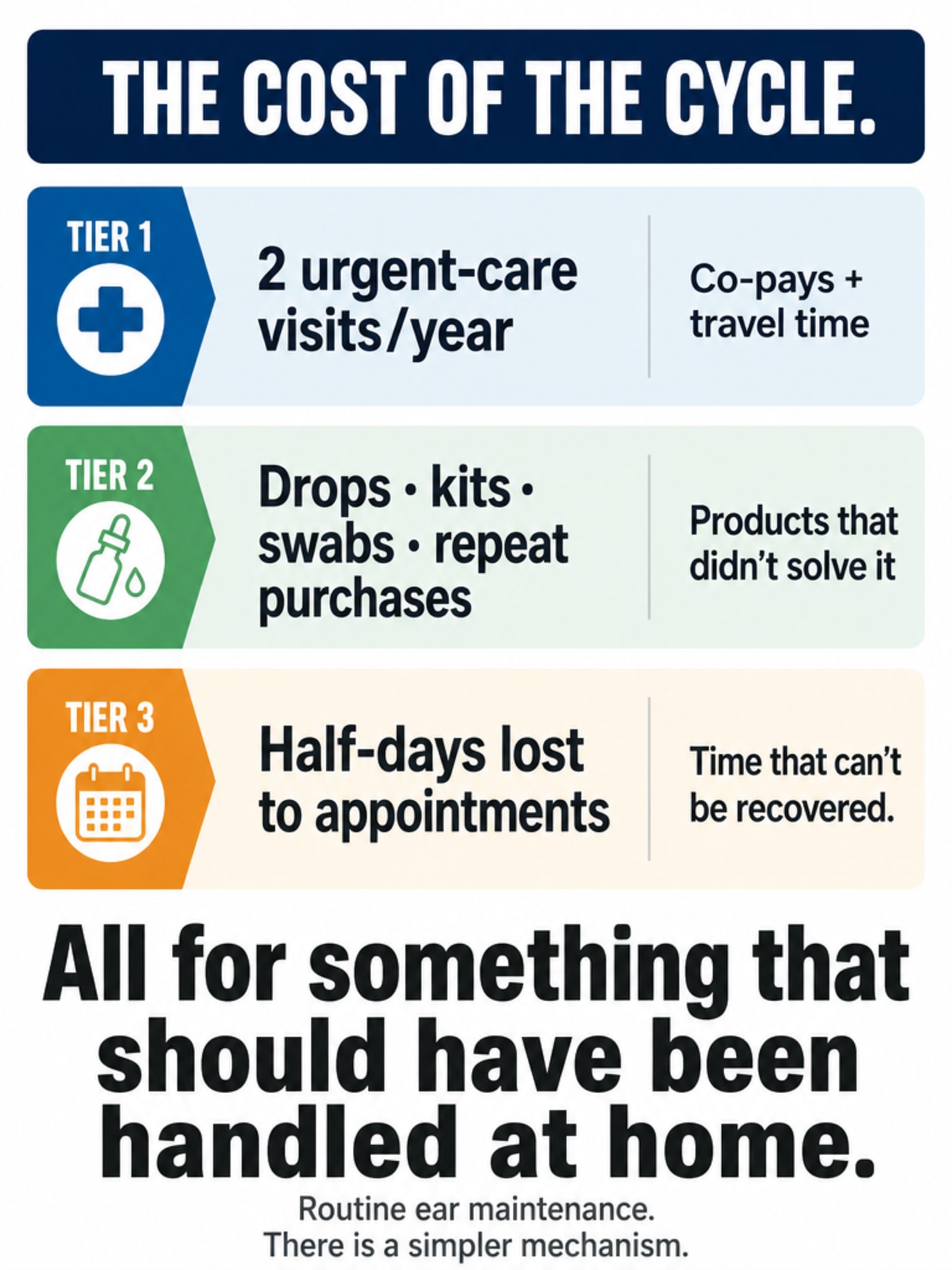
A standard urgent-care co-pay in the US runs between $30 and $75, depending on coverage. If that happens twice in a year, you're at $60 to $150 before travel and time. Add the pharmacy products: over-the-counter ear drops (typically $8–$15 each), an irrigation syringe kit ($12–$25), replacement cotton swabs and specialty ear picks that accumulate in the drawer — it is not difficult to land above $60 in product spend before the year is out. Now account for time: the drive, the wait, the visit, the follow-up call, the lost work hour or rearranged afternoon. In purely practical terms, a single urgent-care visit for ear irrigation can cost the better part of a half-day.
Diane has been through this cycle. Not once — several times across roughly eighteen months. She is 58, organized, not a hypochondriac, and she still found herself in the chair at the ENT clinic twice in fourteen months for what the doctor described each time as "routine impaction." Each visit meant rescheduling something else. Each visit meant a co-pay. Each visit meant a Monday-morning debrief about why she was dealing with this again. The products she'd tried in between — the drops, the bulb syringe, the kit she ordered after reading a forum thread — didn't eliminate the visits. They added to the overall spend.
The thing about these costs is that they are individually small enough to dismiss and collectively large enough to fund a meaningfully better solution several times over. The math is not the point. The point is the pattern: a minor problem treated with inadequate tools, requiring repeated escalation, producing repeated expense.
Vacurio is cordless, uses replaceable soft silicone tips, and is built for routine at-home maintenance — the kind of regular, manageable upkeep that keeps the small problem from compounding into the expensive one. It is not a medical device. It is not a replacement for professional care when professional care is needed. It is the tool for the routine maintenance that should have been handleable at home all along.
The comparison between what the cycle has cost and what a different approach costs is not a difficult one to make.
But the cost is only half the story. The other half is what the old routine actually looks like when you put it next to something designed to work differently.
Reason 4: The Old Routine vs. a Different Mechanism — Side by Side
Comparing approaches is useful only when the comparison is honest.
The old routine — the one most adults inherited without being taught it formally — looks something like this: cotton swab for daily cleaning, ear drops when things get worse, warm water or an irrigation kit when the drops don't work, a wait-and-see period, and eventually a clinic or ENT visit when waiting doesn't help either. Each step requires supplies. Some require preparation time. The irrigation approach requires a basin, warm water at a specific temperature, and the patience to flush and drain several times. It is not complicated in theory. In practice, many people find it awkward, messy, and only intermittently effective.
The Vacurio approach is different in mechanism and different in practice. Cordless. Three suction levels. Soft silicone tip. No water preparation. No basin. No waiting for drops to work. The device is held the way you'd hold a pen; the suction does the directional work. For routine at-home maintenance involving trapped water and loose, soft surface wax, the mechanics are straightforward.
What the comparison reveals is not that the old tools are useless. It is that they were built for different tasks — or no specific task — and the routine assembled from them carries friction and cost that a purpose-built mechanism simply doesn't.
Joel, 33, keeps a work schedule that doesn't accommodate half-day appointments. His bathroom drawer has an irrigation syringe he's used three times, a half-empty bottle of drops, and two packets of cotton swabs. He has spent money across all of those. None of them has been the reliable, repeatable routine he was hoping for. A tool that does one thing consistently and doesn't require preparation is not a luxury purchase for someone in that drawer — it's a practical calculation.

Reason 5: What Routine Maintenance Actually Feels Like When the Routine Works
The difference is not dramatic. That is almost the point.
When the mechanism is right — when the tool you're using is pulling rather than pushing, when there is no basin to fill and no drops to wait on and no awkward angle over the bathroom sink — ear care takes about as long as it should. A few minutes. Done. Not a half-step in a longer, messier process. Not a precursor to checking whether the drops worked. Not a precursor to deciding whether the problem is bad enough for an appointment.
Diane no longer tracks the months between ENT visits the way she used to. The routine is not dramatic. The device lives in the bathroom cabinet, not in a cluttered drawer of failed alternatives. She uses it when it makes sense, at the suction level that feels right for the day, with a clean silicone tip. The full feeling does not build the way it used to, because the routine maintenance is actually routine now — not a cycle of attempt, partial relief, and escalation.
This is not a transformation story with a before-and-after photograph and a changed life. It is something quieter than that. It is the feeling of handling something simple simply — without the co-pay, without the Tuesday afternoon, without the receipt that sits in your hand a moment longer than it should.
The cost of the old cycle was never just money. It was the ongoing assumption that a minor, manageable problem required more than it should. Once the mechanism is right, that assumption goes away.

What Customers Are Saying
"I'd been dealing with the same blocked feeling for months, buying product after product. Vacurio is the first thing that actually made sense to me mechanically. Clear, practical, does what it says."
R.M. — Portland, OR
"I kept putting off yet another clinic appointment. Having something I can use at home on my own schedule has made this so much less of an ordeal. Well made and easier to use than I expected."
Sandra T. — Austin, TX
"My bathroom drawer used to have three different ear products in it. Now it has one. The suction levels are a nice touch — I could find what felt right without any guesswork."
D.K. — Chicago, IL
You've Already Paid for the Old Approach. More Than Once.
The first time, it felt minor. A small inconvenience, a routine errand to the pharmacy, a co-pay filed under "just one of those things." But the cycle ran. It ran again. Products accumulated. Appointments happened. Time left that didn't come back.
You now understand what the cycle has been costing — not just the headline number, but the invisible compounding of repeated products, rescheduled afternoons, and the quiet frustration of dealing with the same thing the same way and landing in the same place.
And you understand why the mechanism matters: you cannot consistently remove something by pushing something in. The direction has to change before the result can.
What changes when the routine actually works:
- No more cycling through products that don't address the mechanical mismatch
- Routine at-home maintenance that doesn't require preparation, a basin, or a multi-step process
- Three suction levels — controlled, adjustable, soft silicone tip
- The clinic visit reserved for actual clinical situations — not routine buildup
- A bathroom counter that isn't a drawer of failed attempts
The cost of staying in the old cycle is not hypothetical. It is the next co-pay. The next Tuesday afternoon. The next product that sits half-used under the sink. Everything you've read here describes what has already happened — and what happens again, on the same schedule, unless the mechanism changes.
Vacurio is cordless, built for routine at-home ear maintenance, and designed to pull — not push. The full details, how it works, and everything it includes are on the next page.