The Direction Nobody Checks: What Your Ear-Cleaning Habit Is Actually Doing — And Why Most People Have Never Thought About It
A quiet mechanical detail, hidden in plain sight on every bathroom counter, turns out to change everything about routine ear care. Wellness Edit investigates.
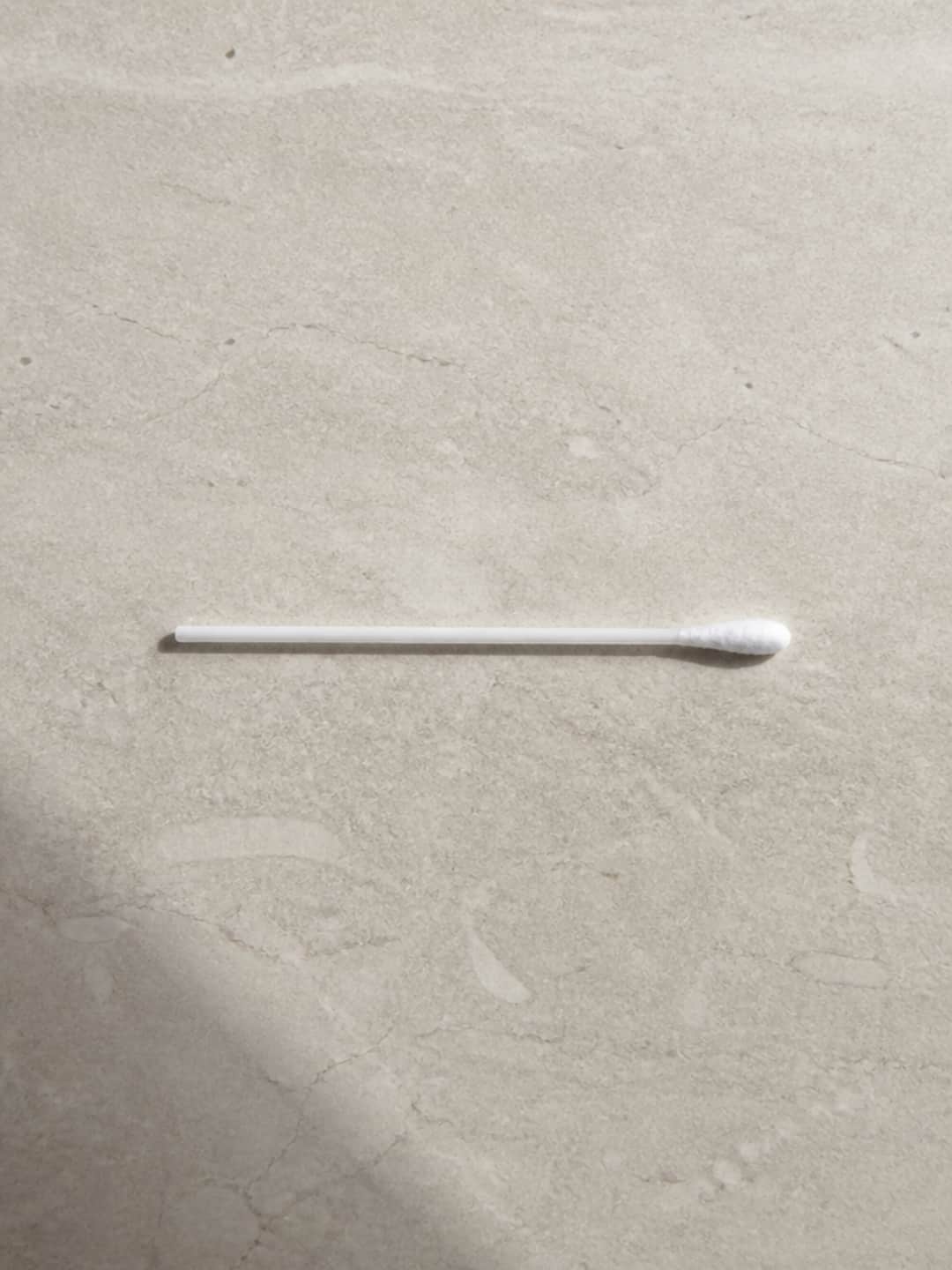
There is an object in almost every American bathroom that most people have never really looked at. Not quickly, anyway. Not the way you'd look at something you were about to use on a part of your body that connects directly to your hearing, your balance, and your sense of the world.
Pick one up. Look at the tip. Now think about the direction it moves when you use it.
Most people, when asked this question for the first time, go quiet for a second. Because it is genuinely the first time they've thought about it — which is strange, once you realize it. The tool is used in one of the most sensitive parts of the human body. The direction it moves turns out to matter quite a bit. And almost nobody checks.
The Direction of the Tool
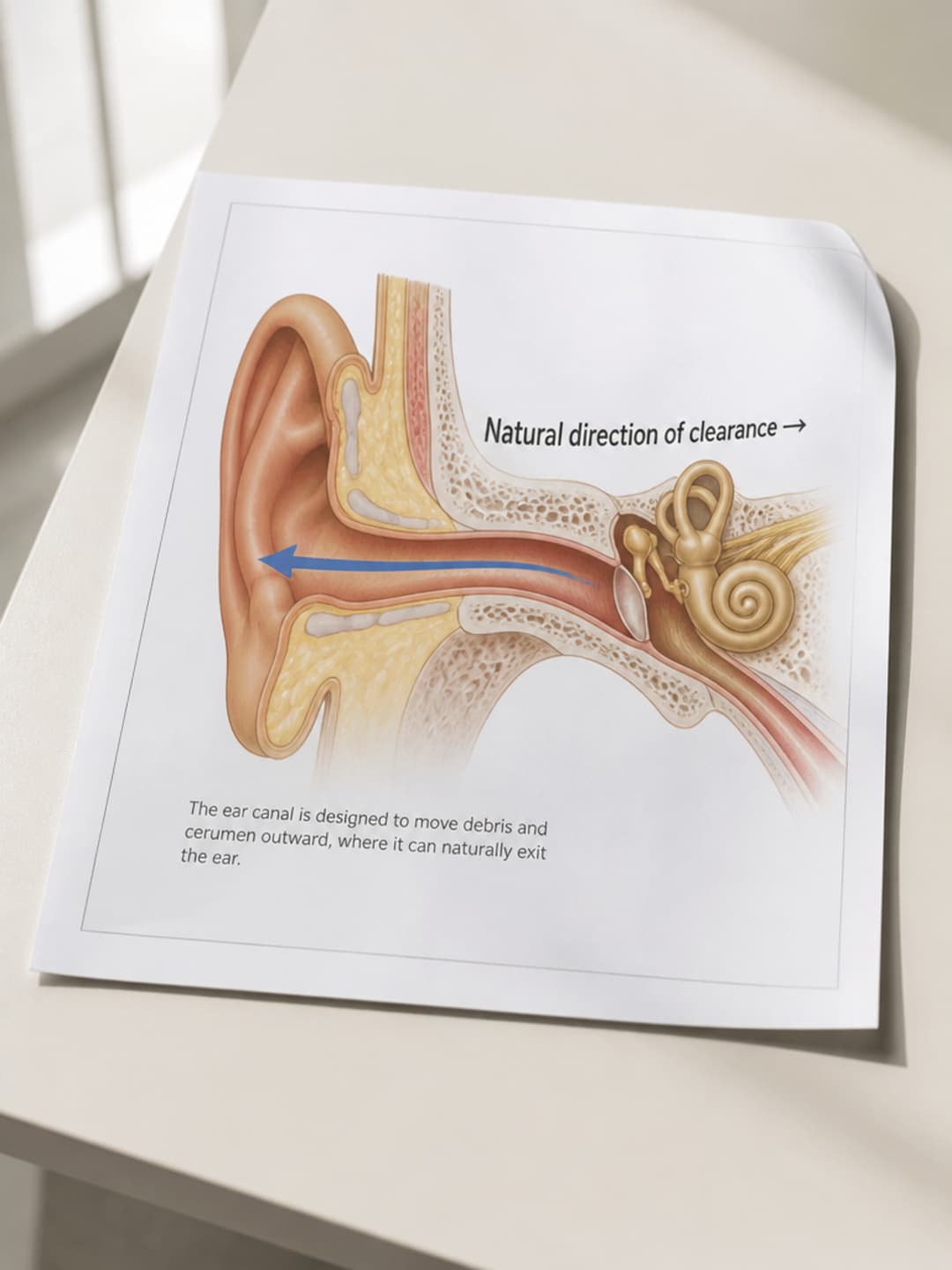
The ear canal is not a straight passage. It runs roughly inward and downward from the outer ear, and it is lined with skin that produces cerumen — what most people call earwax — as a normal, continuous part of the body's self-maintenance. That wax, along with any water that gets in during showering or swimming, sits somewhere in the canal until something moves it.
Here is the part that tends to stop people mid-thought: the body already has a mechanism for moving wax outward on its own. The skin cells lining the ear canal migrate slowly outward over time — a process called epithelial migration — carrying debris with them toward the outer ear, where it can dry and fall away. The canal is, in other words, designed to move things in a specific direction.
The question is what happens when the tool people introduce into that canal moves in the opposite direction.
The answer is not complicated. A soft mass — wax, water, loose debris — that is sitting somewhere in the canal can be displaced by something pushing inward. It doesn't have to go anywhere alarming. It simply moves away from the thing pushing it, which means it moves deeper.
No one who designed the familiar cotton-tipped swab was trying to cause a problem. The tool wasn't engineered; it became habitual. But the direction it moves when you use it — inward, because that is the only place it can go — runs exactly counter to the direction the ear is designed to clear itself.
What the Category Has Tried
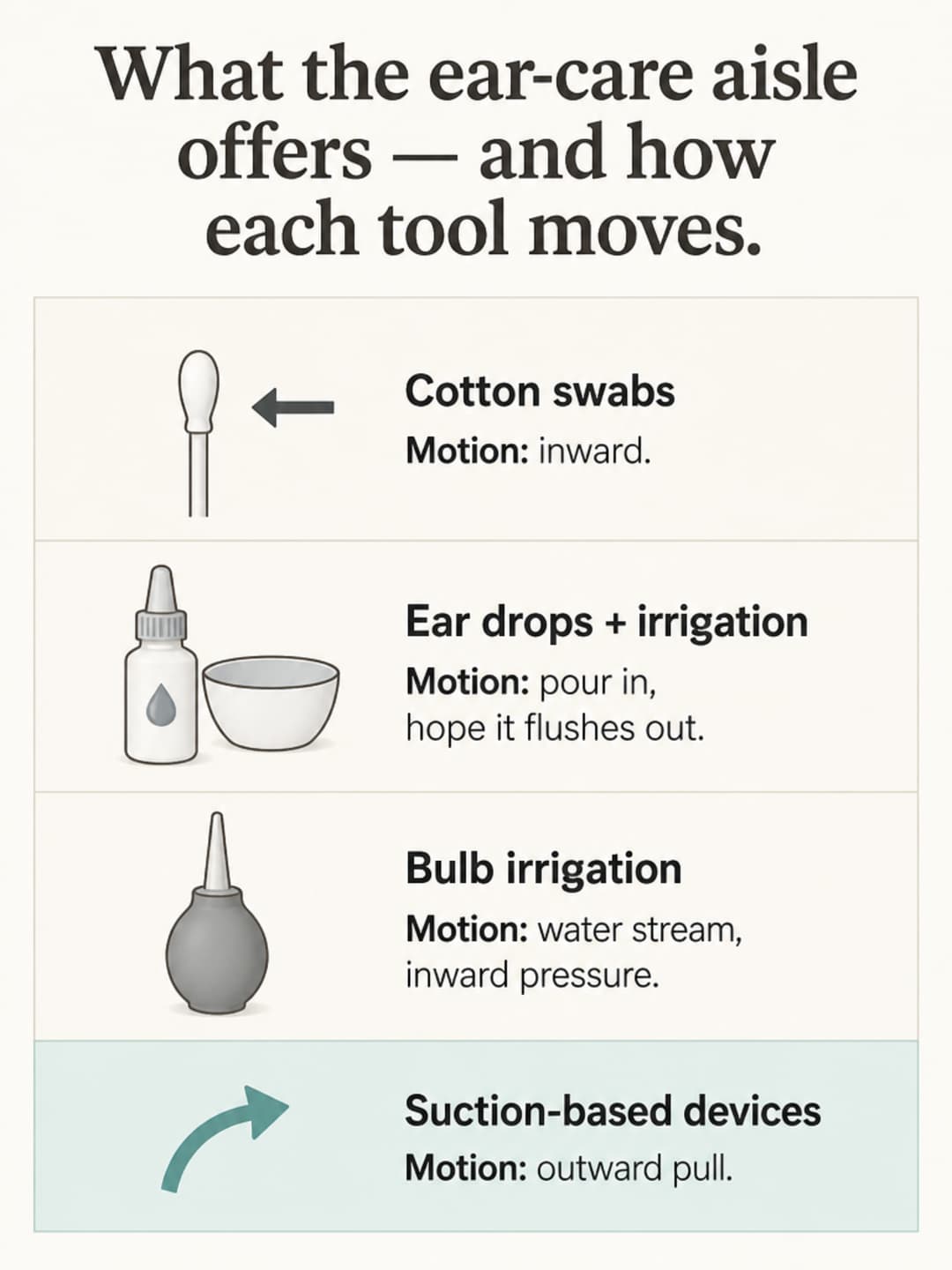
Walk the ear-care aisle of any large pharmacy and you will find a short, consistent range of options: cotton swabs in their familiar cylindrical packaging, bottled drops in several formulations, and occasionally a small rubber bulb for irrigation. The category has not changed much in decades, which is itself worth noticing.
The drops work by softening wax so it can be flushed away — a two-step process that requires waiting, often overnight, and then irrigating with warm water and a basin. The irrigation tools direct a stream of water into the canal, aiming to float material out. And the cotton swabs, which account for the overwhelming majority of ear-care purchases, do what they have always done: they move inward.
"I've honestly never thought about it. You just sort of… put it in and move it around."
What the category has not produced — until very recently — is a tool whose primary motion direction is outward. Not a tool that pushes or pours and hopes the material follows. A tool whose mechanical action begins with a pull. The investigative question is simple: if the goal of every one of these tools is to move something from inside the canal toward the outside world, why are most of them built around a motion that goes the other way?
A Different Principle
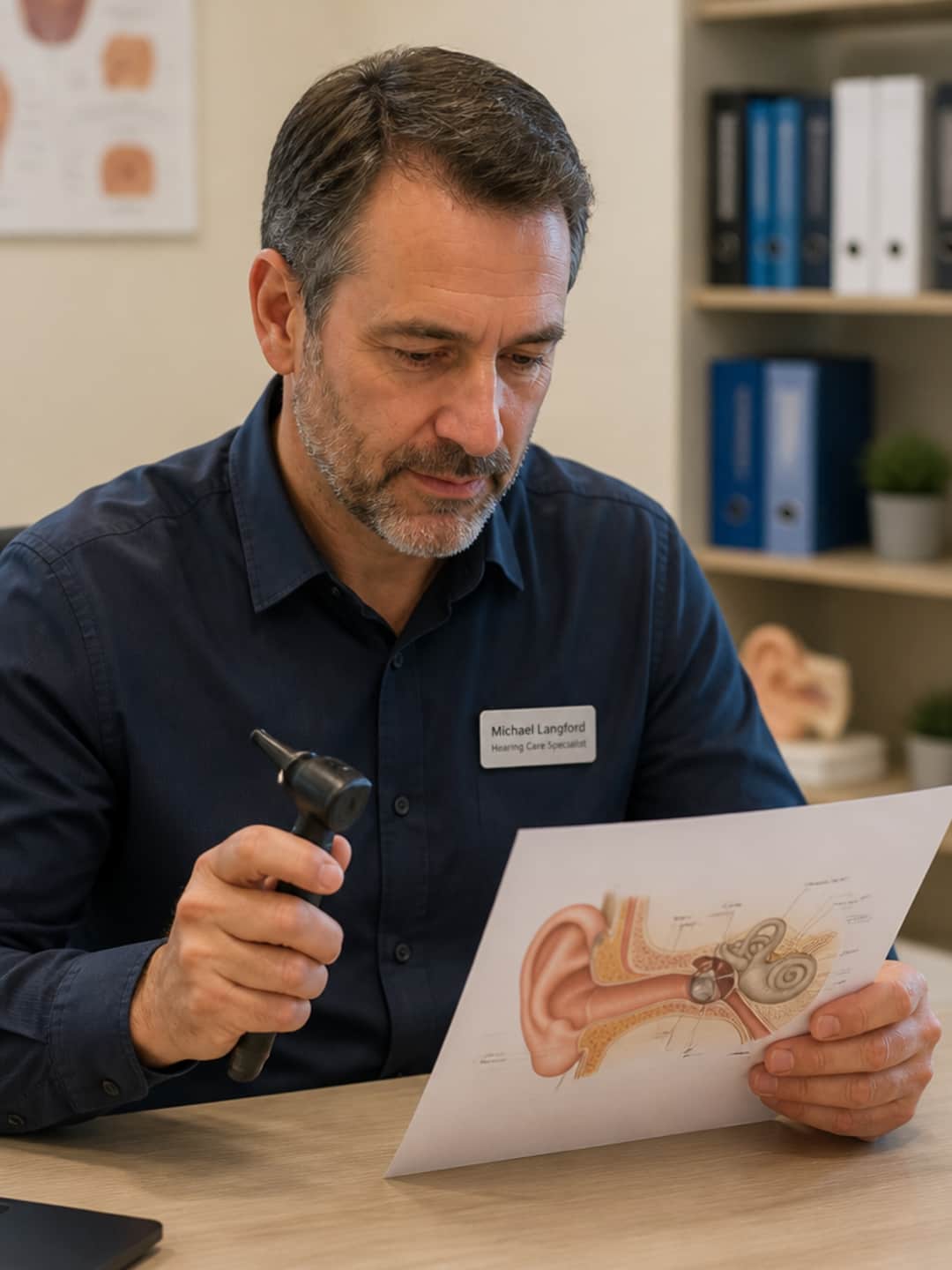
The concept of using suction rather than displacement for ear care is not new to medicine — irrigation and micro-suction have long been used in clinical settings. What is newer is the arrival of that principle in a form designed for routine at-home use.
The mechanical logic is direct. Suction, applied at the outer ear, creates a pressure differential that draws material outward — toward the source of the suction. The direction of the resulting force runs the same way the ear is already designed to clear itself: outward. Nothing needs to be pushed. The motion direction aligns with the goal for the first time.
Where the clinical versions require specialized equipment and trained practitioners, the category of consumer suction devices — still small, still developing — aims to bring the directional principle into the bathroom without the clinical setup.
The devices in this category typically use adjustable suction levels and soft, interchangeable tips sized for the outer ear canal. They are cordless. They require no water preparation, no drops, no basin. The routine is measured in seconds rather than the multi-step process required by drops-and-irrigation approaches.
What makes the emerging category worth paying attention to is not primarily the gadget — it's the direction. A motion that finally runs the same way the body already intends.
This is what specialists have been pointing toward for years when it comes to at-home ear maintenance. See what we found →
Since this article went live, our editorial inbox has filled with the same question, worded slightly differently every time: "So what does this actually look like in practice — for someone who just wants a simple at-home routine?" We kept coming back to one device in particular. It warrants its own section.
Vacurio: Built Around the Pull

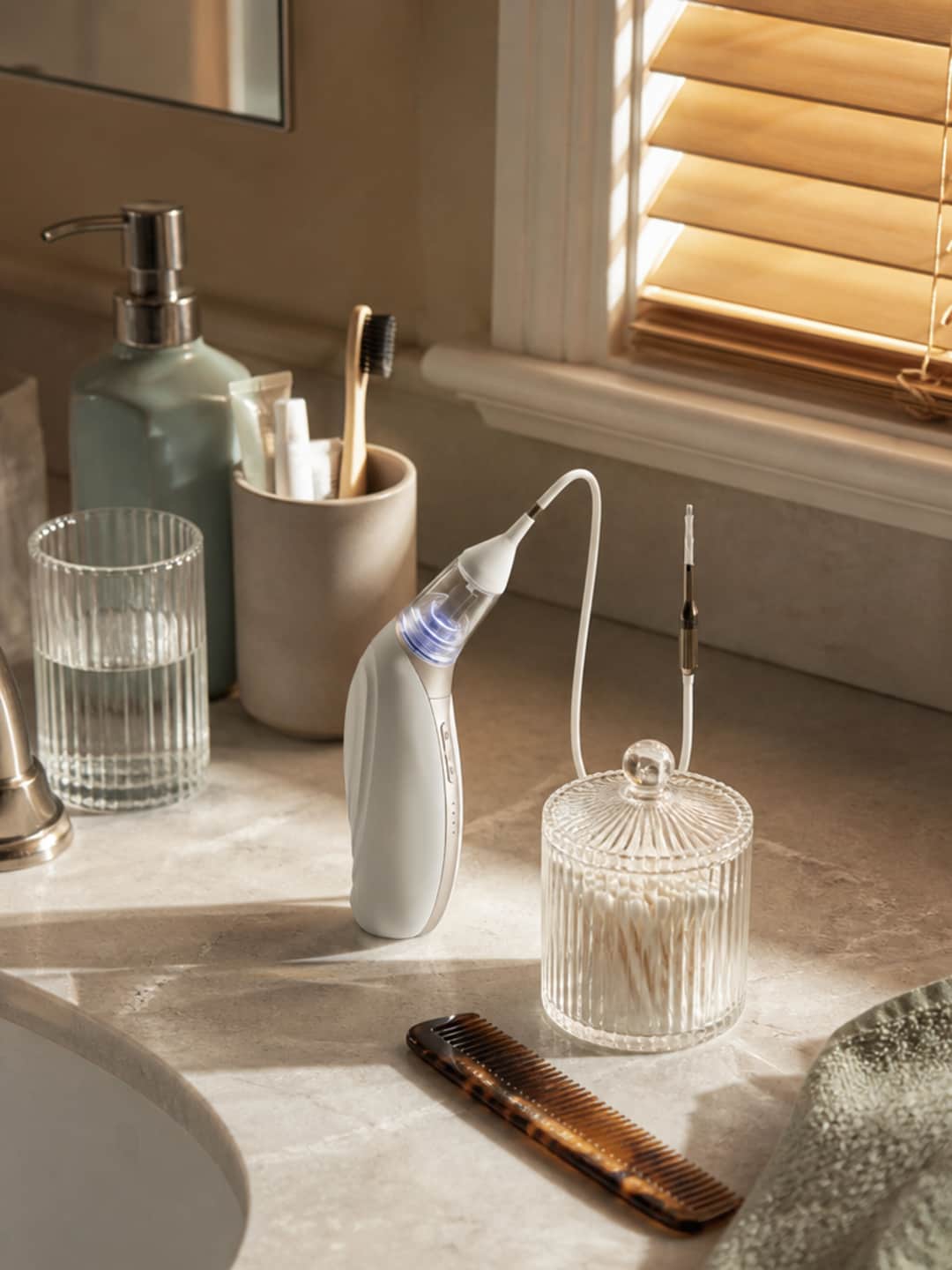
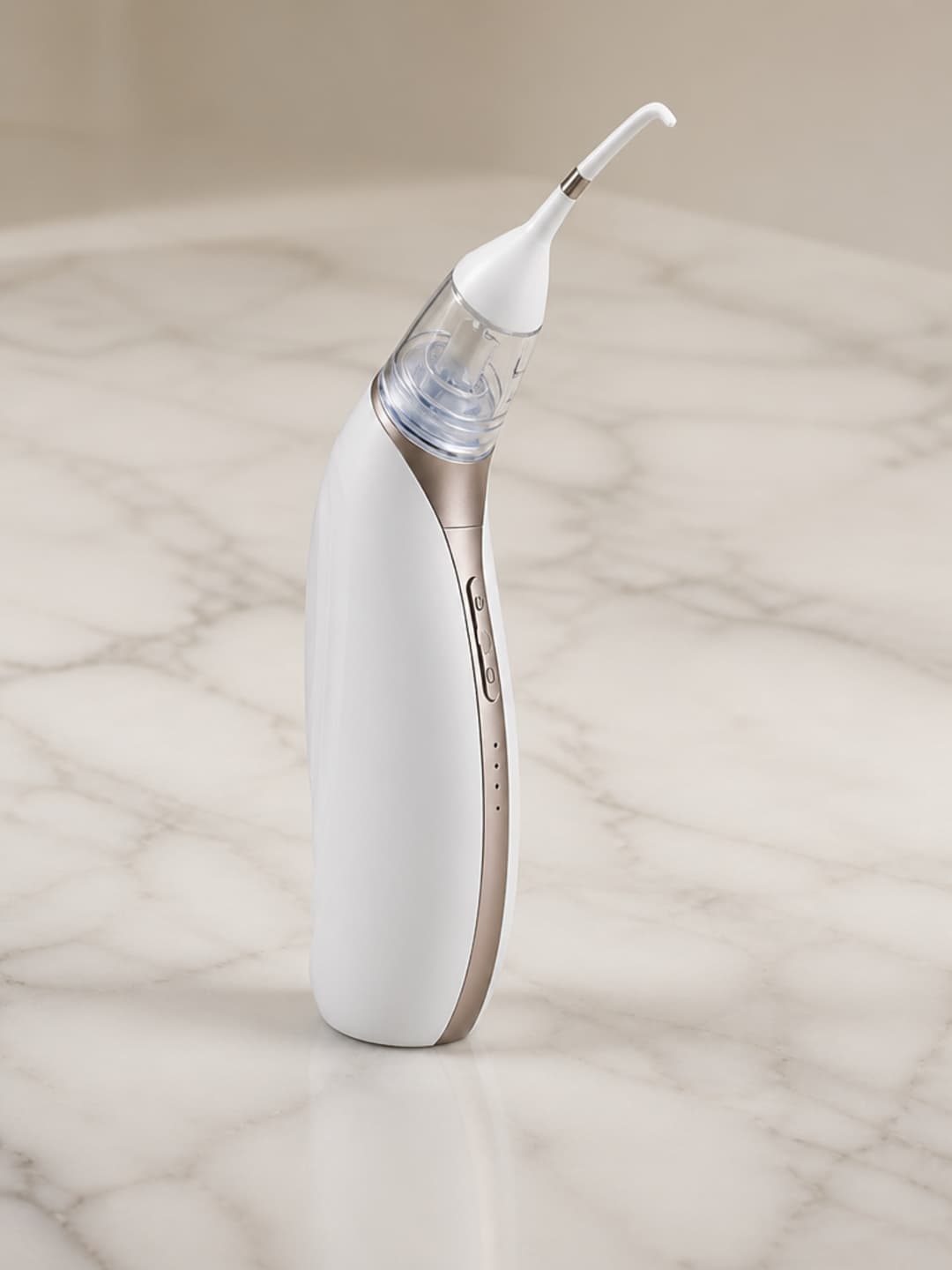
The device that kept surfacing in editorial research is called Vacurio — and it is, mechanically, a consumer implementation of exactly the principle discussed above. It uses gentle suction to draw material outward during routine at-home ear maintenance. Not drops. Not a push-in cleaning tool. Suction, directed outward.
Three adjustable suction levels let you control the intensity — the lowest level is genuinely gentle, appropriate for sensitive ears; the middle and upper levels increase draw for routine maintenance sessions where trapped water or soft, loose surface wax is the concern. The tips are soft silicone, shaped for the outer ear — not rigid, not pointed, designed to sit comfortably at the canal entrance without going deeper. They are washable and replaceable.
The design detail that keeps coming up in any close look at the device: a transparent collection chamber. You can see what the suction draws out. That is not a minor feature — it is the first time an at-home ear-care tool has made the result of the session visible. No guessing. No wondering whether anything actually happened. The chamber shows you. Cordless. No preparation. No basin. Nothing to set up and nothing to clean up beyond rinsing the tip.

- ✓Gentle suction pulls outward — designed to work the same direction the ear clears itself
- ✓Three suction levels, soft silicone tips, transparent collection chamber — visible confirmation of every session
- ✓Cordless, no drops, no water preparation — a complete at-home maintenance routine
What Happens When People Actually Switch
The people who've made the switch from the familiar push-in routine to a suction-based approach tend to describe the experience in terms of the transparent chamber more than anything else. The chamber is, it seems, the first moment it becomes real — the first moment the routine produces visible confirmation that something happened.
"The first time I used it I finally understood why what I'd been doing before wasn't working."
The other consistent observation is the time. Most people who've used both a multi-step drops-and-water routine and a suction device report that the time difference is not marginal. The drops approach is measured in overnight waiting periods and repeated sessions. The suction approach is measured in the time it takes to pick up a cordless device and spend ninety seconds. The routine simplification — fewer items, fewer steps, no water preparation, nothing to clean afterward — turns out to matter to people more than they expected it to before they tried it. See what we found →
"Is This Actually Safe for At-Home Use?"
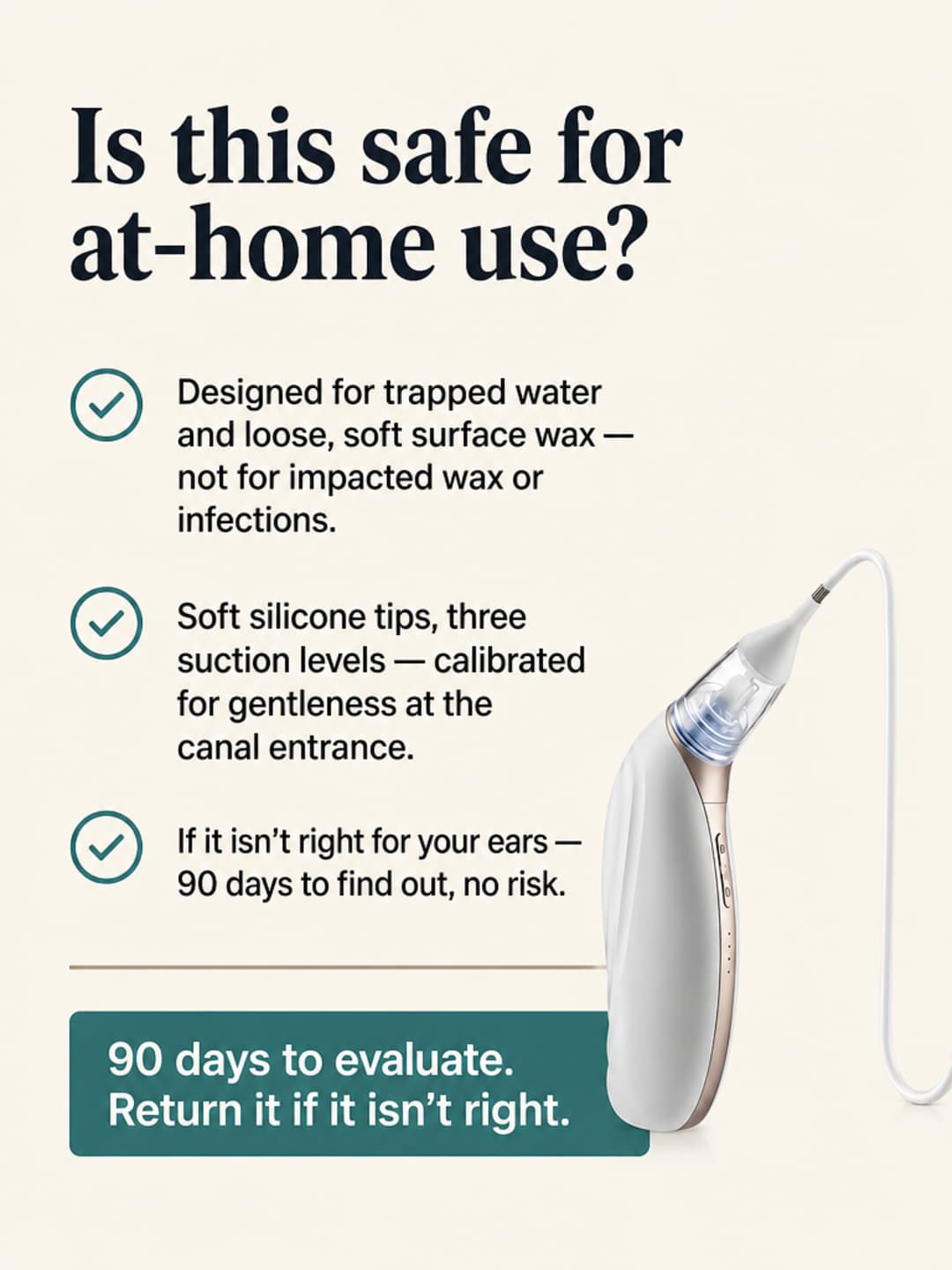
It's the reasonable question, and it deserves a direct answer.
Vacurio is designed for routine maintenance — specifically for trapped water and loose, soft surface wax at the surface of the ear canal. It is not designed for, and is not claimed to address, impacted wax, ear infections, or anything requiring a clinical evaluation. The suction levels are calibrated for gentleness: the soft silicone tips do not enter the canal, and the draw of the lowest suction level is mild by design.
The 90-day return window exists specifically for this concern. If you use it for routine maintenance and find it isn't right for your ears, you return it. The window is long enough to know. That is the honest answer to the safety question: try it with real time to evaluate, and the risk of being wrong is removed.