Before You Replace Your Ear-Cleaning Routine, Check Which Direction It Actually Moves
For anyone who has tried cotton swabs, ear drops, or a warm-water rinse — and still feels like their routine isn't really working.

Most people who use cotton swabs don't think of themselves as doing something wrong. They've been doing it since they were children. They've watched someone older do it first. They reach for the swab, they clean the ear, they move on with their day. Routine.
Except — somewhere along the way — a lot of people start noticing that the routine doesn't feel like it's doing much. There's still a sense of fullness. Still occasional muffled sound that takes a few minutes to clear after a shower. Still that vague feeling that something is sitting in there that shouldn't be. So they try a little harder. A little deeper. And the feeling comes back anyway.
Some people escalate. They try the ear-drop kits at the pharmacy. They follow the instructions: tilt the head, let the drops sit, wait five to ten minutes, rinse. The first time, it feels like it should work. The second time it feels a little less convincing. By the third, the ritual has become more of a chore than a solution — and the question begins to form: Is this actually working, or am I just doing something?
That question is worth taking seriously. Not because your ears are unusually difficult or because you're doing the routine wrong. The more useful thing to examine is what the routine is actually doing at the mechanical level — what direction everything is moving, and whether that direction makes sense for the goal.
That's what most people evaluating ear-care options have never been told to look for. And it's the thing worth checking before you replace one routine with another.

The thing most ear-care options have in common — and why it matters to a researcher
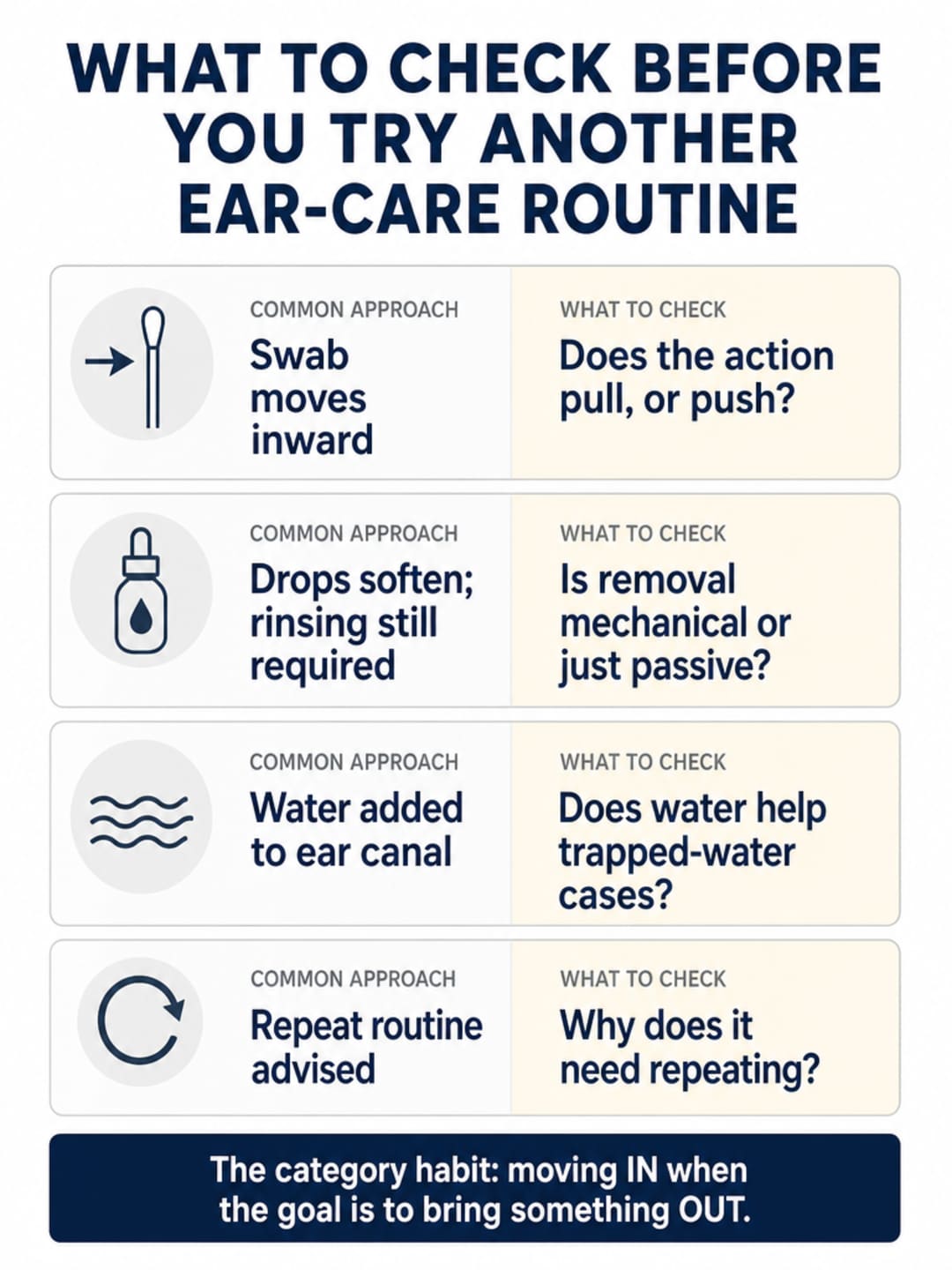
If you're evaluating what to try next, here's something worth checking before you buy anything: look at which direction the cleaning method moves.
Cotton swabs move inward. The swab tip is introduced into the ear canal and rotated or pushed. The goal is to remove something. But the mechanical action moves toward the eardrum, not away from it. Wax that is contacted by the swab tip often compresses or shifts further in rather than being lifted free.
Ear-drop solutions follow the same basic logic in a different form: introduce something (a liquid) into the canal, let it sit, attempt to flush. The flush is outward — but the drop is inward first, and the waiting period is not a cleaning action. It is a softening action. The actual removal still depends on a rinse or a wipe that may or may not work cleanly on the first attempt.
Warm-water rinses add water to a situation that often involves trapped water as part of the problem in the first place.
What all of these share: the working action is either inward, or it is passive. None of them are designed around a consistent outward mechanical pull.
This is not a criticism of any particular brand. It is a structural feature of an entire category approach. Before you invest in another product in the same category, it's worth asking whether the approach itself has that same design pattern.
You've tried the cotton swabs. You've tried the drops. You've tried the water. Why are you still dealing with this?
The reason the same methods keep producing similar results is that they are built on the same logic — add something, push something, wait for something — without changing the fundamental direction of the action. The method is the problem. Switching brands doesn't change the method.
What a researcher should look for in any alternative: does it actually move things out, mechanically, during the cleaning action itself? Not after softening. Not after waiting. During.
The direction the routine moves is the thing nobody mentioned

Here is the reframe that changes how this category looks once you see it.
The stated goal of ear-cleaning — whether you're using a cotton swab, drops, a rinse, or anything else — is to remove something from the ear canal. Excess wax. Trapped water. Debris that has accumulated on the surface.
Removal means: the thing moves outward.
But the dominant mechanical action in every mainstream ear-care method is either inward (swab tip, dropper, irrigator nozzle) or passive (softening drops, waiting). The physical motion and the stated goal point in opposite directions.
This is not a small design quirk. It is the structural reason why people who do the routine faithfully still come back a week later with the same feeling in their ears.
Once you are looking for this pattern, it becomes visible across the entire category. It also makes the evaluation question very simple: when you are assessing any ear-care tool, the one diagnostic worth running is: what does this do during the cleaning action itself, and in which direction? If the answer is "pushes," "softens," "waits" or "requires a follow-up step to actually remove anything" — you are looking at the same category logic in a different package. The only mechanism that doesn't share this pattern is one built around active outward pull during the cleaning action itself. That's the differentiator worth verifying.
If the answer is "pushes," "softens," "waits" or "requires a follow-up step to actually remove anything" — you are looking at the same category logic in a different package.
The only mechanism that doesn't share this pattern is one built around active outward pull during the cleaning action itself. See how the outward-pull mechanism works →
What a different mechanism looks like — and how to verify it
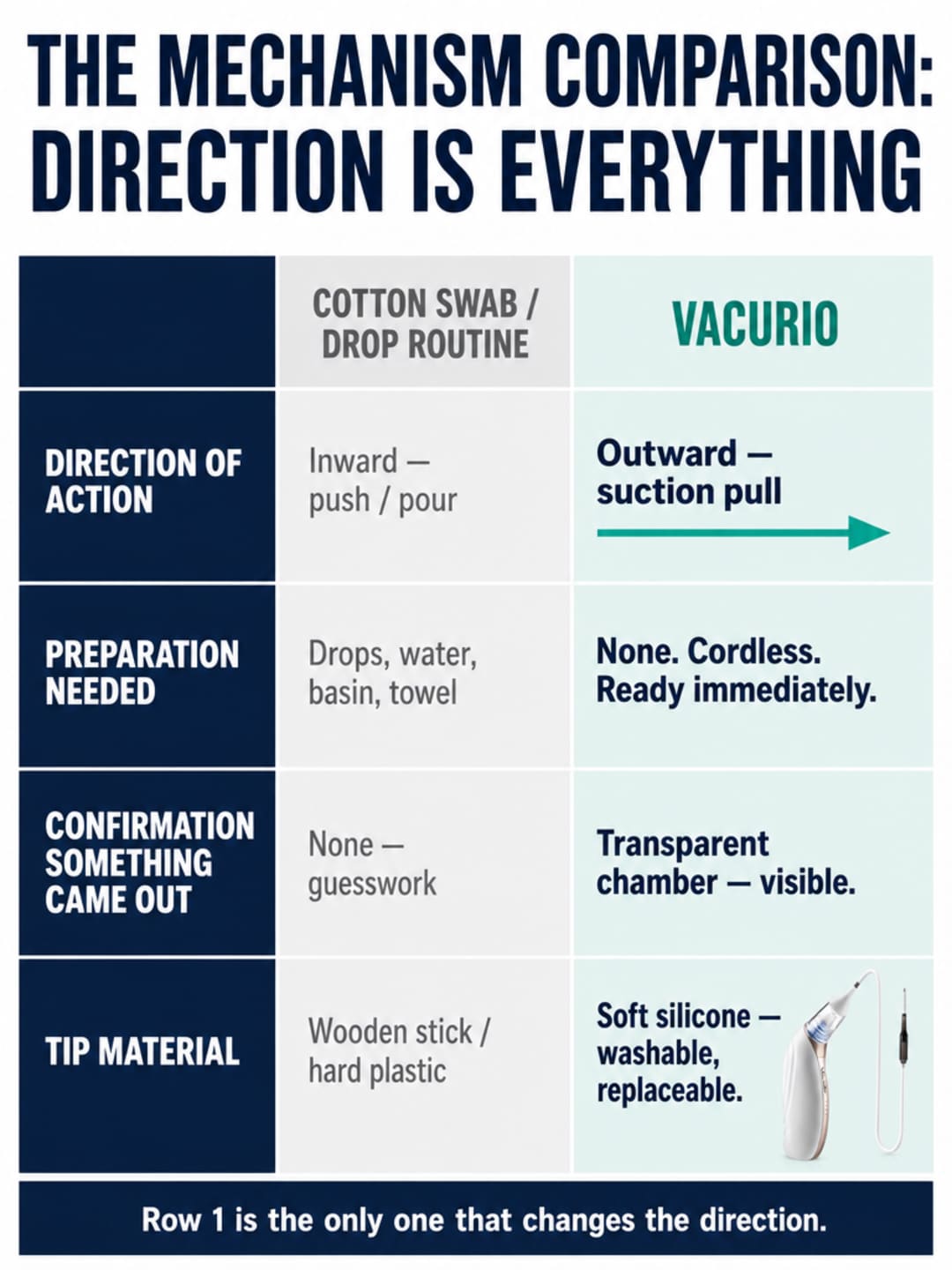
Vacurio approaches routine at-home ear maintenance through a different mechanism: gentle suction.
Rather than introducing a tool that moves inward and hoping the cleaning action follows, or adding a liquid and waiting for something to soften, the device uses a low-pressure suction draw that is outward by design. The suction head — a soft silicone tip, not a wooden stick — is placed at the entrance to the ear canal, not pushed into it. The pull is generated by the device: three adjustable suction levels, selectable by the user, cordless, requiring no water preparation and no drops.
The practical difference becomes visible through the device's transparent collection chamber. You can see what was removed. This is not incidental — it is the verification mechanism. If the routine is working, there is something in the chamber. If there isn't, the question is answerable by inspection, not guesswork.
The device is designed for routine maintenance involving trapped water and loose, soft surface wax. It does not treat impacted wax, infections, or hearing conditions. What it does do: give the outward-pull mechanism a concrete, at-home form with adjustable intensity and soft silicone tips that are washable and replaceable.
Three things to verify before you decide
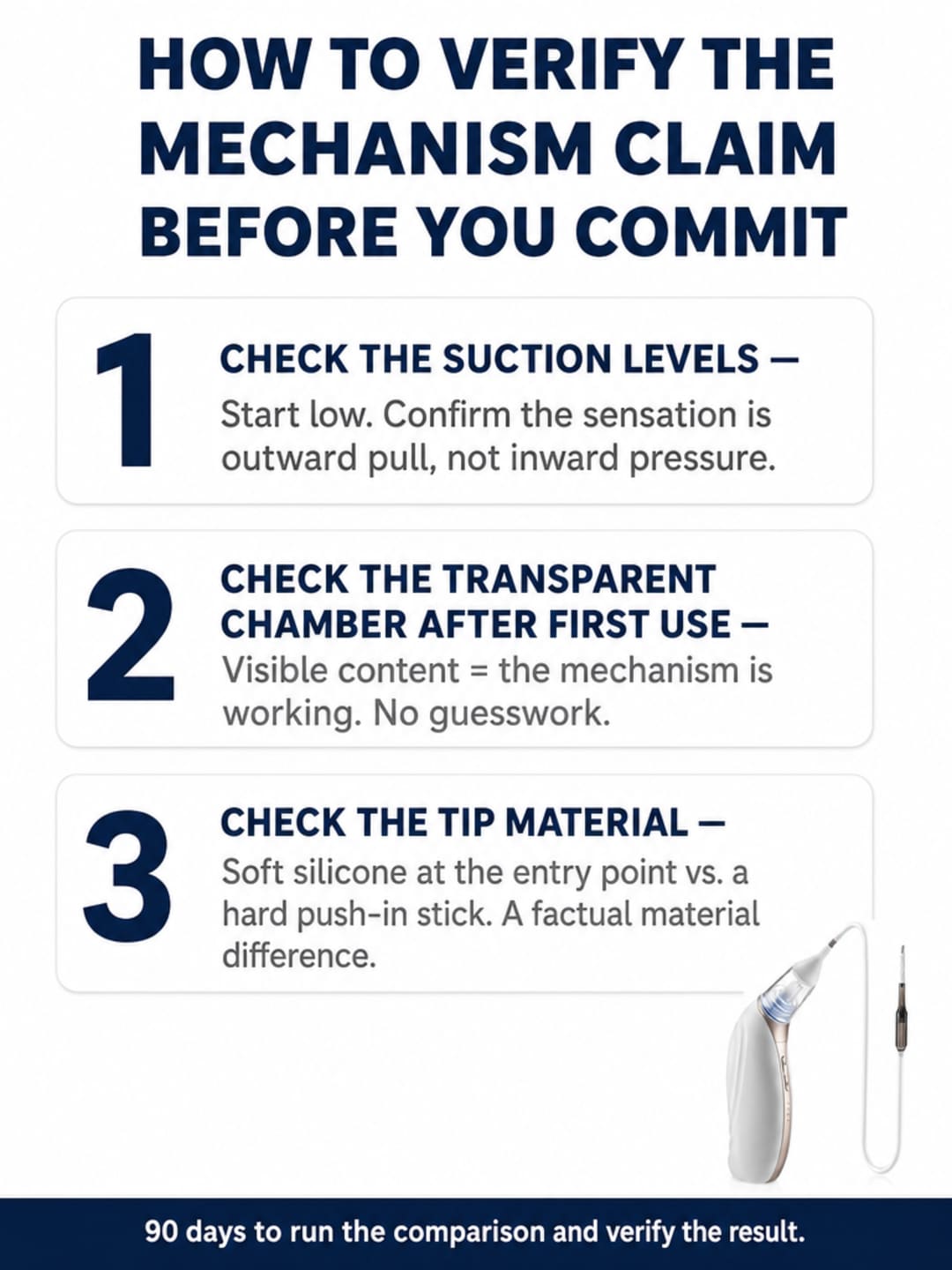
Check the suction levels
Three settings allow you to start low and increase as needed. Verify by testing the lowest setting first and confirming the sensation is suction-outward, not pressure-inward.
Check the transparent chamber
After first use, if the mechanism is working as described, there will be visible content in the chamber. This is the most direct verification available — no guesswork.
Check the tip material
Silicone versus a wooden or hard-plastic stick is a factual material difference. The feel during use is the verification.
What happens when people who've run the old routine actually try the different mechanism

The clearest signal that a mechanism change matters is when people who have been running the same routine for years — and habituated to "this is just what ear cleaning is like" — try the outward-pull approach and notice the difference the first time.
The transparent chamber is, repeatedly, the thing that lands. People who have used cotton swabs and drops for years describe seeing the collection chamber after their first use as the moment the question about their old routine got answered. Not "I feel like it worked" — but: visible confirmation. The wax and debris that the old routine was contacting but not fully removing was still there to be found.
Responses to the suction mechanism itself tend to follow the same pattern: the expectation is pressure-inward (because that's what every previous tool has done), and what the user actually experiences is a draw-outward. The adjustment takes about one use. After that, the difference in sensation compared to a cotton swab is the thing most commonly described as the reason they didn't go back.
For someone evaluating whether the mechanism claim is real before committing: the verification is available in the first use. The transparent chamber either shows something or it doesn't. That's not a marketing claim — it's a functional test the product provides out of the box.
Why are we still pushing things into our ears to get something out?
The question isn't rhetorical once you've run both methods side by side. See the full suction mechanism explained →
"How do I know this is actually different from the other ear-care gadgets I've seen?"
It's a fair question. The personal-care category is full of devices that repackage the same basic approach with a new form factor. The evaluation question is the same one this piece has been asking: what is the mechanism, and in which direction does it move during the cleaning action itself?
If the answer is suction — outward pull, adjustable, with a soft silicone tip at the entry point rather than a hard push-in nozzle — it's a different mechanism. If the answer is an irrigator (inward water pressure), a spin tip, or a push-in design, it's the same category logic. The transparent chamber provides the at-home verification. You don't have to take a claim on faith: the chamber shows what was removed.
If after a reasonable trial the result isn't visible and the routine doesn't feel different, there's 90 days to return the device. Not 30. Ninety. The point of that window is to give you enough time to actually run the comparison — not to make a rushed decision based on one or two uses and return it if it doesn't immediately transform your life. A genuine mechanism difference tends to show up in the first use. The 90 days are there to make sure you've had the time to verify that properly.